
Over the past year, the largest AI labs signed compute deals measured in gigawatts. Anthropic alone has committed to rent more than 10 gigawatts of servers from cloud providers, including a $200 billion agreement with Google, according to DatacenterDynamics.
On September 18, CNBC reported a different kind of deal. Anthropic and OpenAI are now looking for data center capacity in blocks of 20 to 30 megawatts, in the UK, the Nordics, and the United States. A block that size is roughly one-fiftieth of a gigawatt campus.
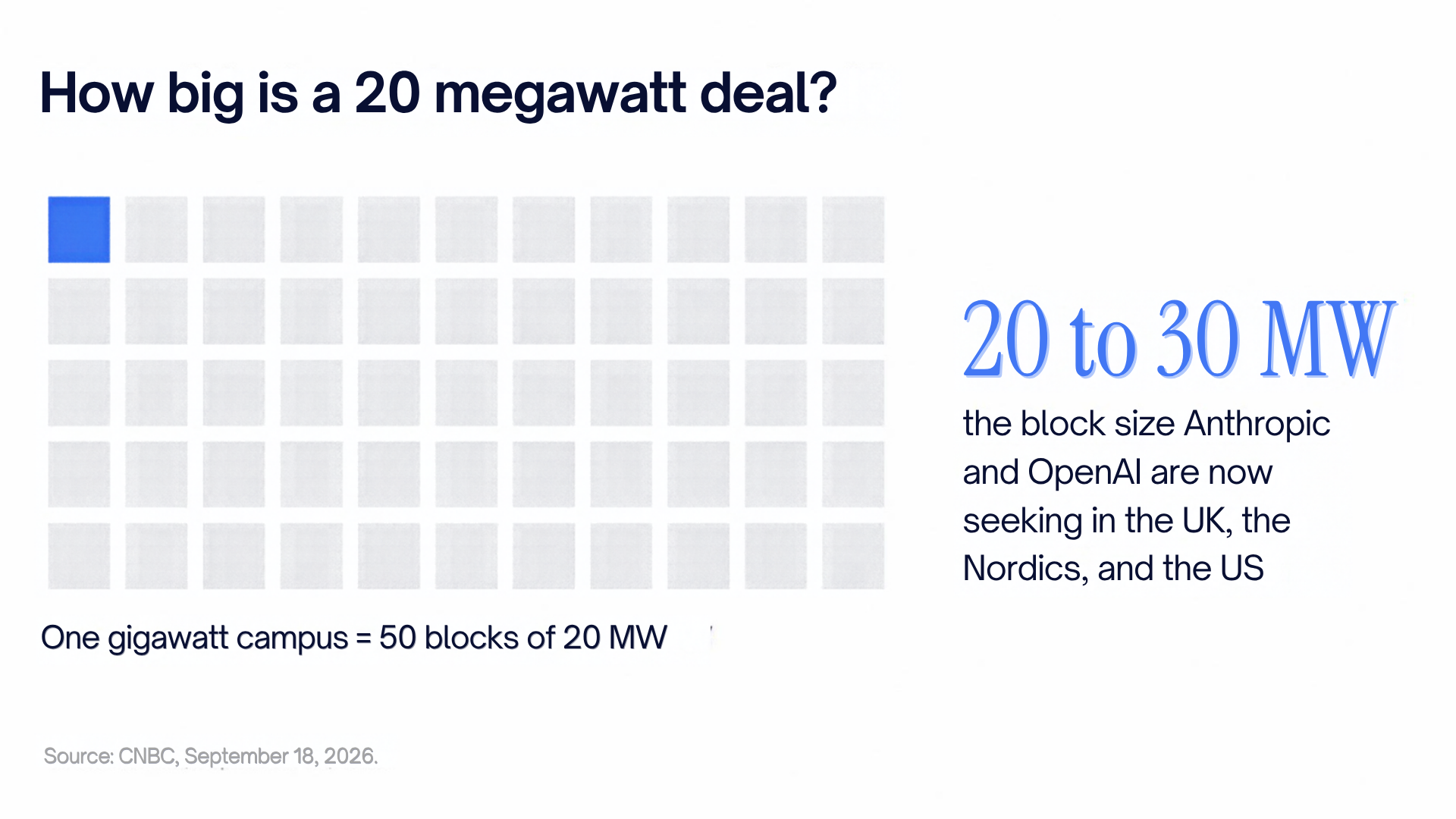
The labs have not lost interest in scale. They are reacting to a market in which large projects arrive late and small ones arrive on time. We read the shift as a signal that AI infrastructure is splitting into two markets with different buyers and different sites. The training market still needs gigawatt campuses. The inference market needs many mid-size sites near users, and its scarcest input is a building with power already connected.
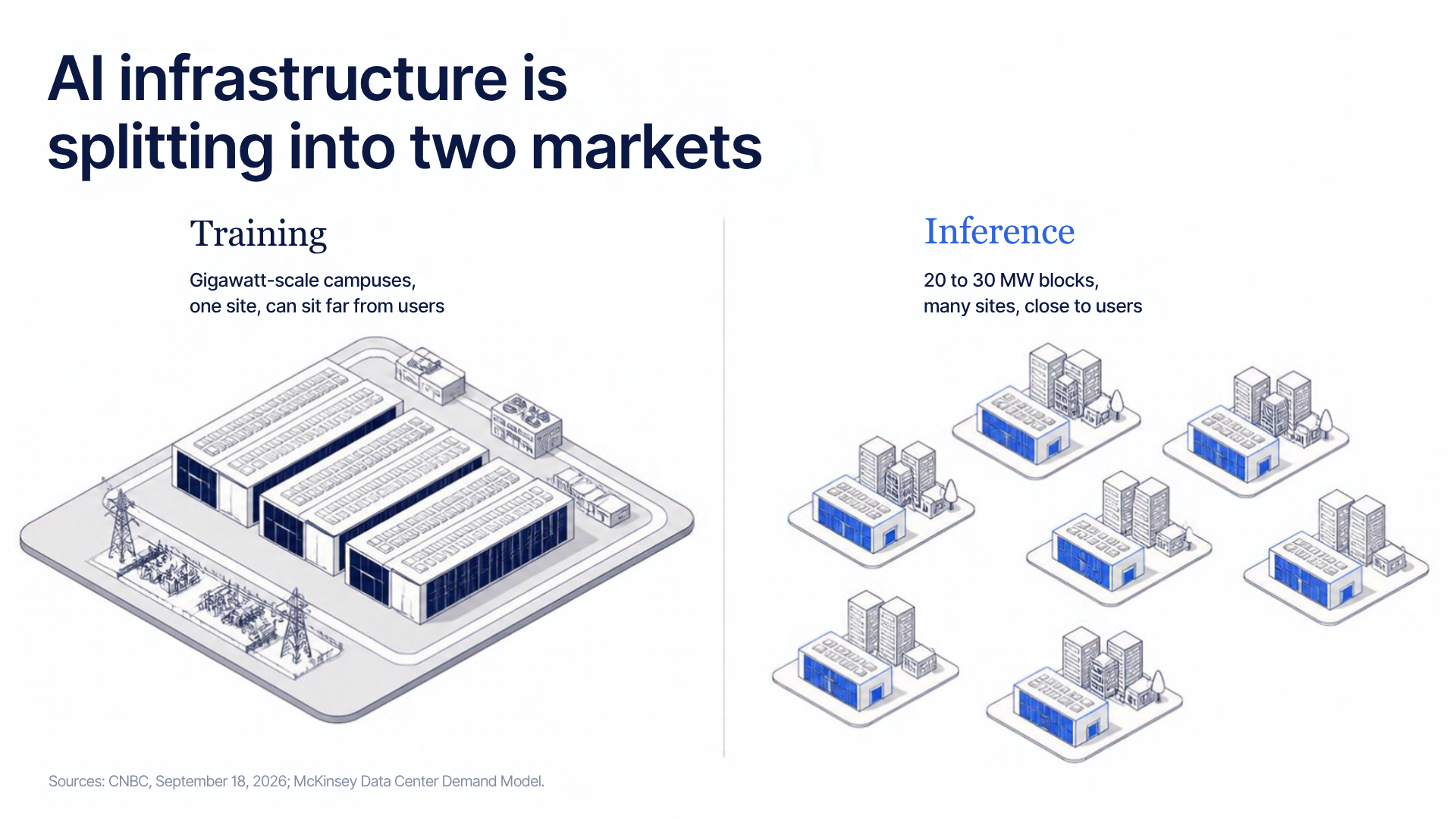
According to the reports, smaller blocks give the labs faster access to usable compute, especially for inference, which does not need one central site. A 20 megawatt hall in an existing building can go live within months. A new campus has to wait for land, permits, equipment, and a grid connection.
The labs are not alone in this. Nvidia has announced work with data center companies on smaller facilities built for distributed inference. Crusoe, which runs a large campus used by OpenAI, is now investing in smaller sites to avoid the delays of large projects.
The delays on large projects are now well documented. Sightline Climate's 2026 outlook found that about 16 gigawatts of US data center capacity was due to come online this year across roughly 140 projects. It expected 30% to 50% of that capacity to be delayed or canceled, and only about 5 gigawatts had entered construction. For 2027, about 6.3 gigawatts were under construction against 21.5 gigawatts announced.
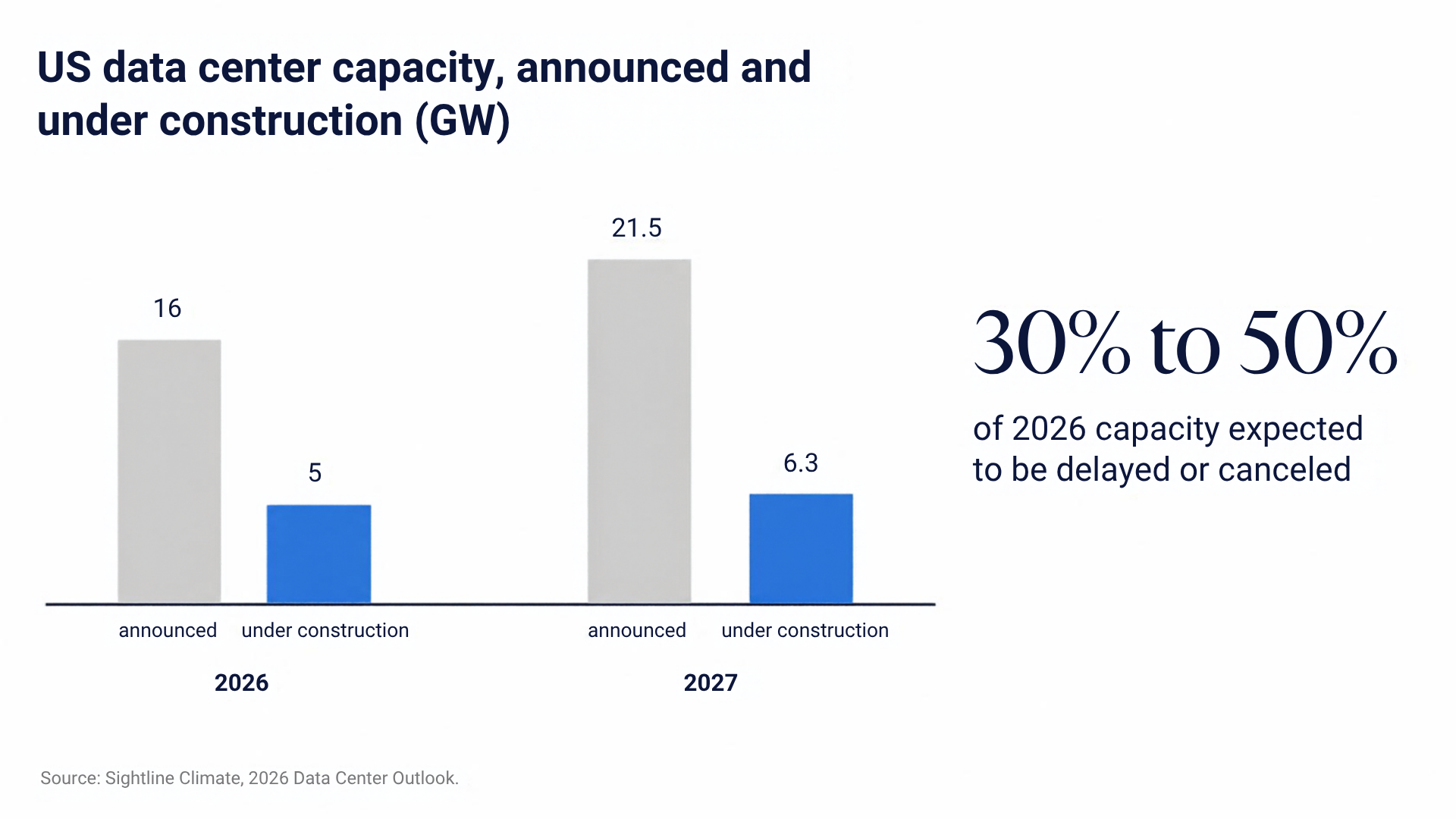
Sightline named three causes: power constraints, shortages of grid equipment, and community opposition that has become more effective. Transformers, circuit breakers, and batteries make up less than 10% of the cost of a data center, but a project cannot open without them. In August, Texas paused new data center grid connections while regulators audit the projects in its queue.
When a market has this much announced capacity and this little of it under construction, the value moves to whatever can be delivered now.
Training and inference need different buildings. Training a frontier model needs very large, dense clusters in one place, and it can run far from users. Inference is the work of answering requests from people and software in real time. McKinsey notes that inference is driving construction in metro and near-metro sites chosen for low latency, strong network links, and energy efficiency.
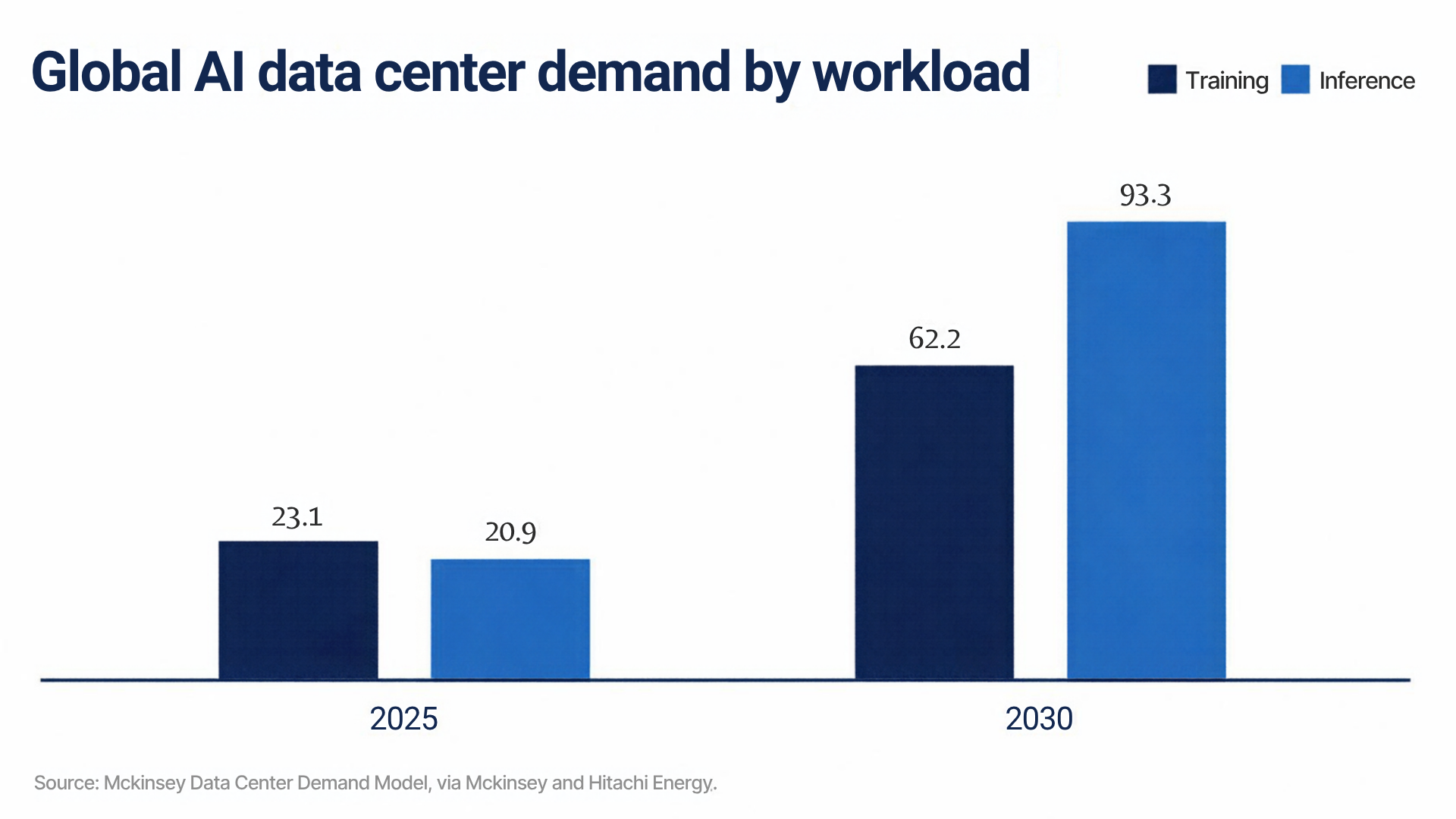
The forecasts show inference becoming the larger market. McKinsey projects that AI inference demand will grow from 20.9 gigawatts in 2025 to 93.3 gigawatts in 2030, while training grows from 23.1 to 62.2 gigawatts. JLL expects inference to overtake training as the main AI requirement as early as 2027. Every model that reaches production creates inference demand that grows with each new user.
The strongest objection is that smaller deals signal caution. In past spending cycles, buyers that moved to smaller tranches were often phasing their purchases or hedging against weaker demand, tighter financing, or uncertain power supply.
The evidence points the other way this time. The same labs are still negotiating gigawatt-scale campuses. Anthropic has also signed more than a dozen letters of intent with US data center developers, as part of an effort to control more of its own infrastructure. The small blocks sit alongside these commitments and serve a different purpose. They put models into production sooner, and they spread the labs' capacity across more sites and more countries.
There is still a real risk in the shift, and it falls on the owners of small sites. A lab that rents many 20 megawatt blocks can move its workloads more easily than a lab committed to a single campus. Tenant strength and lease terms will matter more in the inference market than they did in training.
This pattern has a precedent. In the early years of online video, content came from a few large central servers. As viewing grew, content delivery networks placed servers in many cities close to viewers, because distance and congestion degraded the service. The central servers remained, but most of the growth in capacity moved toward the edge.
AI is following a similar path. Training plays the role of the central server, and inference plays the role of the delivery network. The difference is power. A video cache needed a rack in a carrier hotel. An inference site needs tens of megawatts, and in most markets that power is now the hardest thing to find.
The market is placing a new value on sites that already have a grid connection and some spare capacity. These include older industrial buildings and parcels next to substations. Their owners hold something the largest buyers in technology now want, which is the ability to deliver compute within months.
We expect the price gap between powered and unpowered sites to widen through 2027. The gap will be largest in metro markets near users, where inference demand concentrates and new grid connections take the longest. The owners who benefit most will be those who sign leases with strong tenants and terms that hold if a lab moves its workloads.
For most of the last three years, AI infrastructure was a story about building larger. The next part of it will be about connecting faster.
When a market has this much announced capacity and this little of it under construction, the value moves to whatever can be delivered now.
Sign up for our latest insights and firm announcements.
We respect your privacy and will not share your information.