
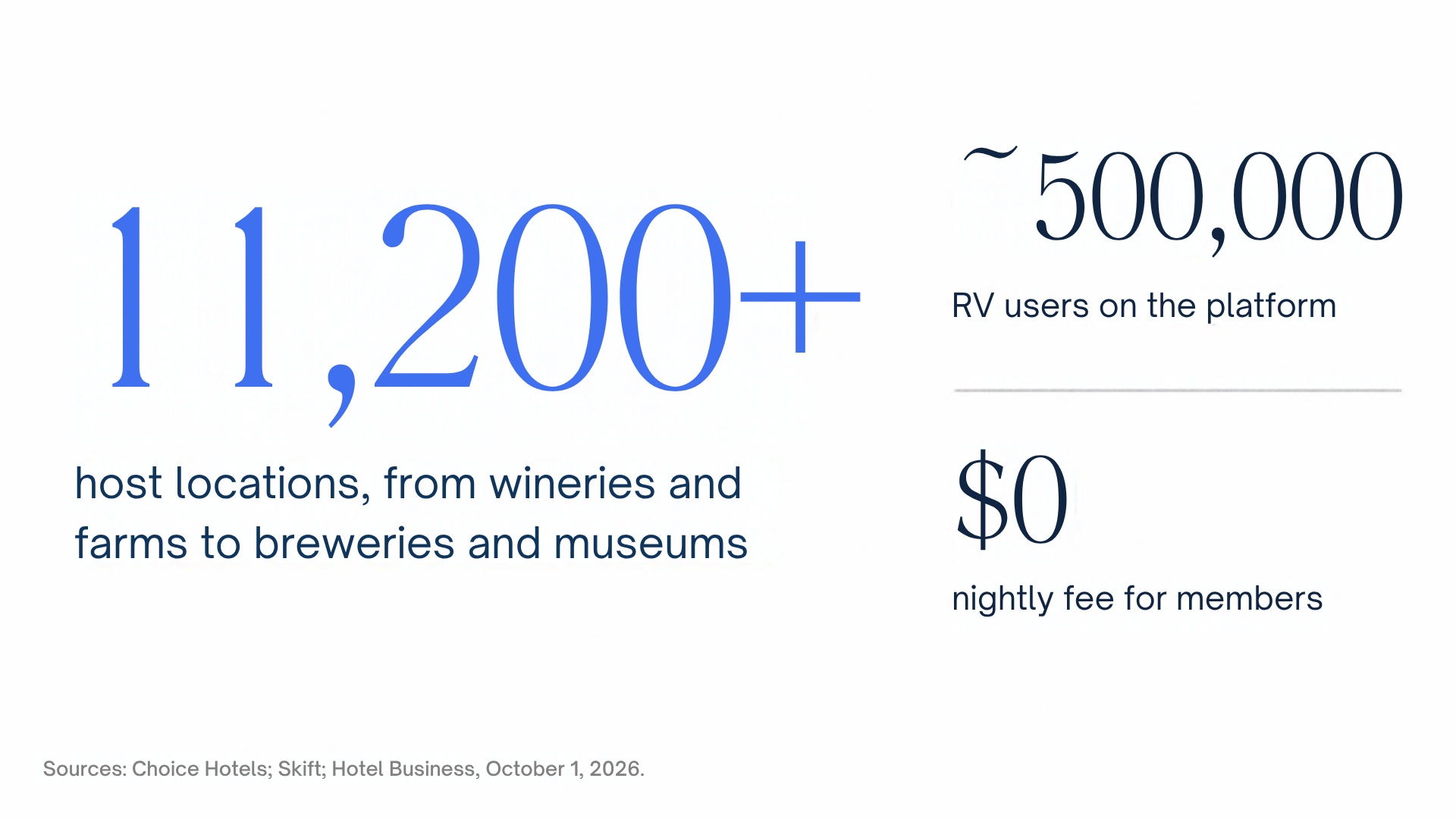
On September 30, Choice Hotels agreed to buy Harvest Hosts for about $130 million in cash. Harvest Hosts is a membership club for RV travelers. Members pay an annual fee and can park overnight at more than 11,200 wineries, farms, breweries, golf courses, and museums, with no nightly charge. The deal was expected to close on October 1.
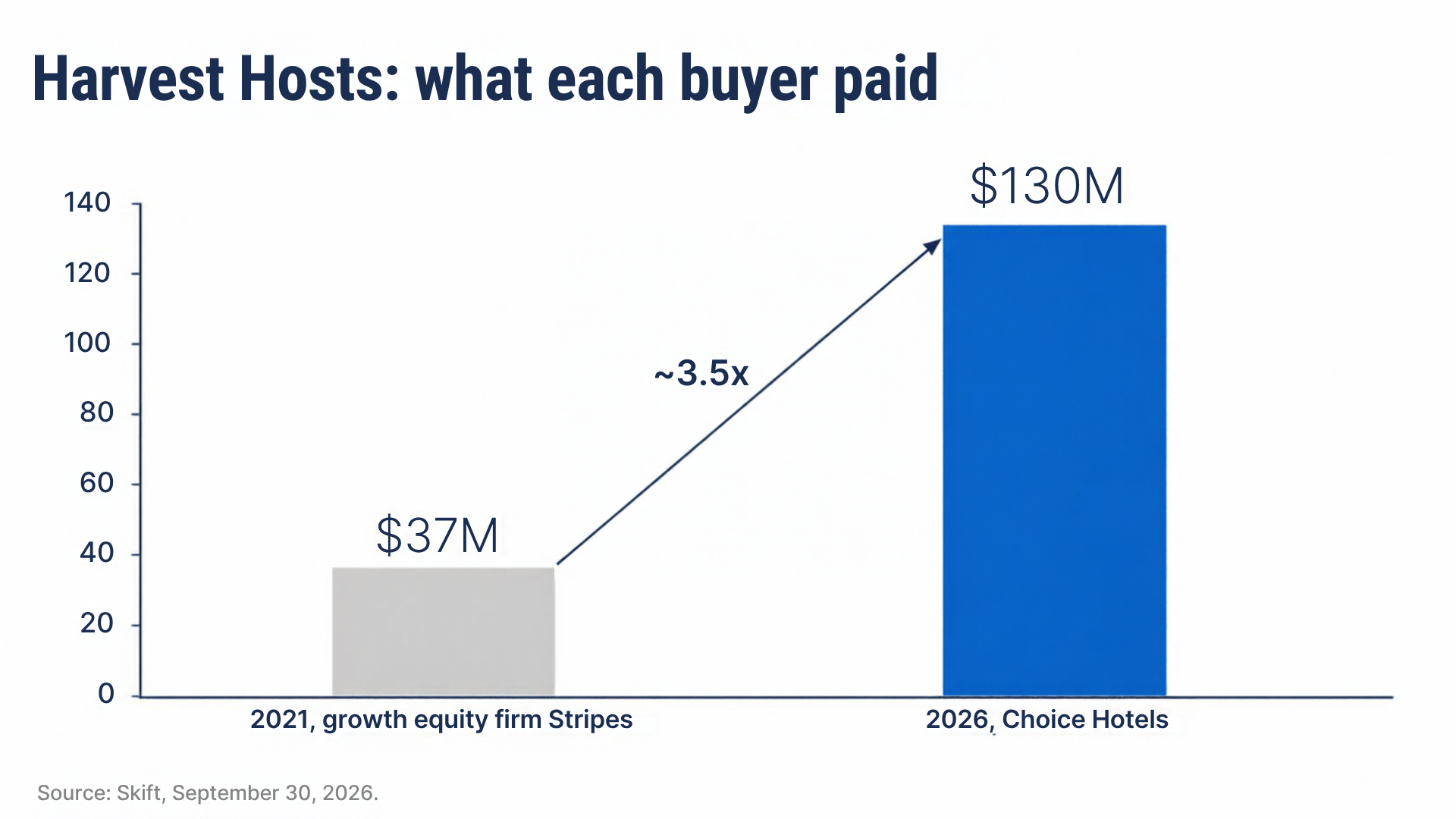
It is Choice's first acquisition outside hotels and the first under its new chief executive, Dom Dragisich, who took the role in August. Choice is paying roughly three and a half times the $37 million that the growth equity firm Stripes paid for Harvest Hosts in 2021.
The deal is small for a company of Choice's size. Its logic says a good deal about where the economics of hotel franchising are heading. A franchisor earns most of its money from fees on rooms that other people own. When the supply of new rooms slows, that model needs another source of growth. Choice's answer is to sell access to its travelers through a product that needs no rooms at all.
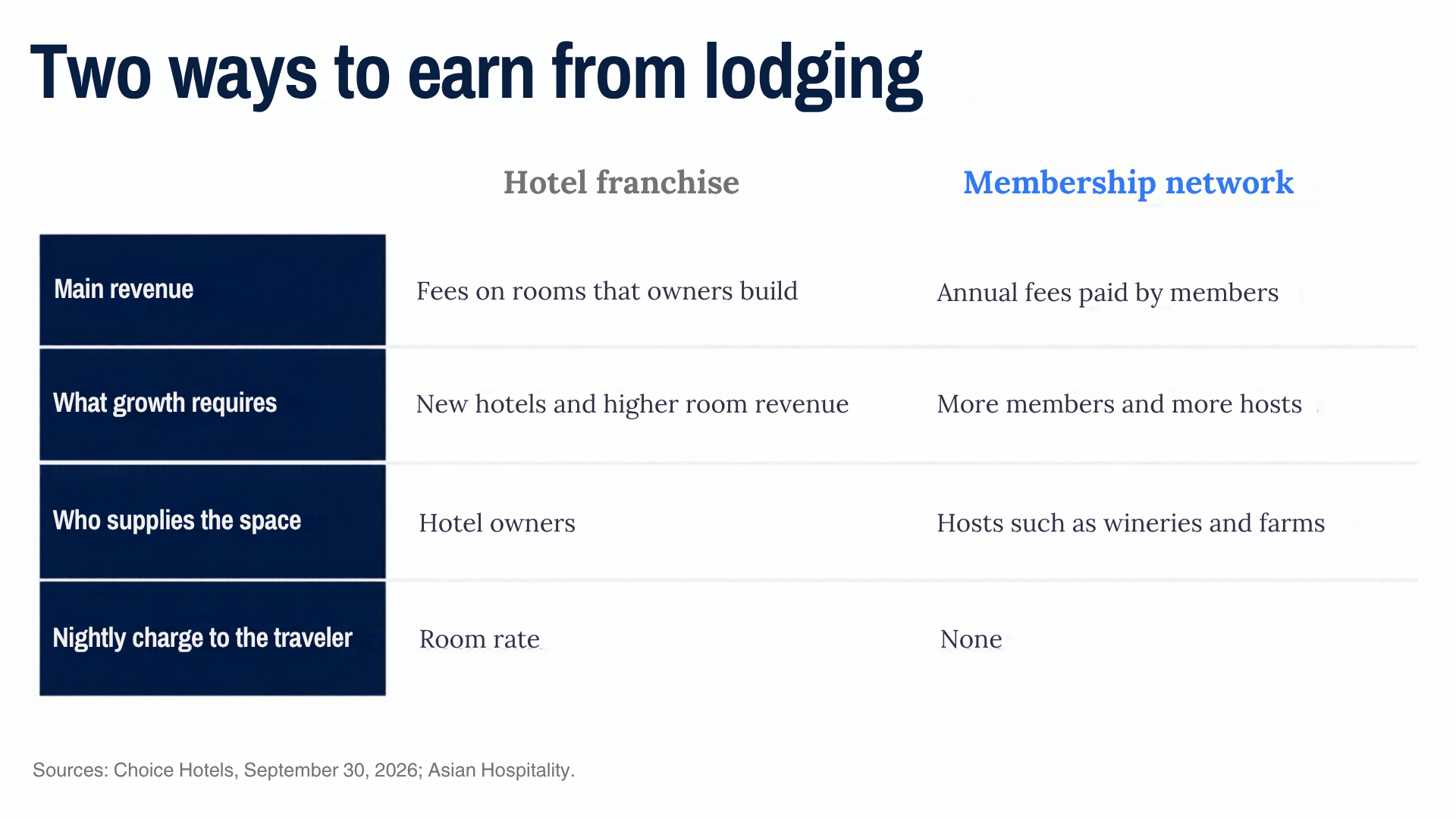
Choice, like the other large franchisors, owns few of the hotels that carry its names. Owners pay it fees to use its brands and its loyalty program. Those fees rise when owners open new hotels or when existing hotels earn more per room.
Both sources are under pressure. New hotel construction in the US is running at its lowest level in years. Asian Hospitality noted that Choice's room count has been under pressure, and it described the Harvest Hosts deal as a way to bring in revenue that does not depend on hotel room sales.
Harvest Hosts runs on a different model. Its members pay an annual fee. Its hosts, such as a winery or a farm, offer a parking space for one night, and in return they gain visitors who often buy wine or food. Harvest Hosts neither owns the land nor pays the hosts, and it earns its revenue by selling members access to the network.
That model fits Choice's strategy closely. Choice has said the purchase is consistent with its asset-light approach, which grows without owning real estate. Harvest Hosts takes that approach one step further. Choice needs a hotel owner to build a property before it can collect a franchise fee. Harvest Hosts needs only a host willing to offer space it already has.
Harvest Hosts also owns Boondockers Welcome, Escapees RV Club, CampScanner, and Brit Stops, which widens the network beyond its core brand.
Choice's stated logic rests on its loyalty program. The company says members of Choice Privileges are more likely than average to also travel by RV. If that holds, Choice can offer Harvest Hosts to millions of existing members, and Harvest Hosts can offer Choice hotels to its own members on nights when they want a bed.
This tells us what large lodging companies now treat as their main asset. It is the group of travelers they know and can reach, along with the data on what those travelers want. Rooms are one product that this group buys. An overnight space at a winery is another. Each product the franchisor adds gives its members another reason to stay in the program, and each one adds revenue without new construction.
Choice is following a path its rivals have already taken. In 2024, Hilton partnered with AutoCamp and Hyatt partnered with Under Canvas. In 2025, Marriott launched an Outdoor Collection anchored by its Postcard Cabins and Trailborn brands, with points that members can earn and redeem.
The approaches differ. Hilton and Hyatt chose partnerships with operators of upscale outdoor stays. Marriott built a collection of brands. Choice bought a membership network aimed at value-minded travelers, which matches its core customer. All four companies are moving toward the same idea: the loyalty program can sell lodging that the company does not build.
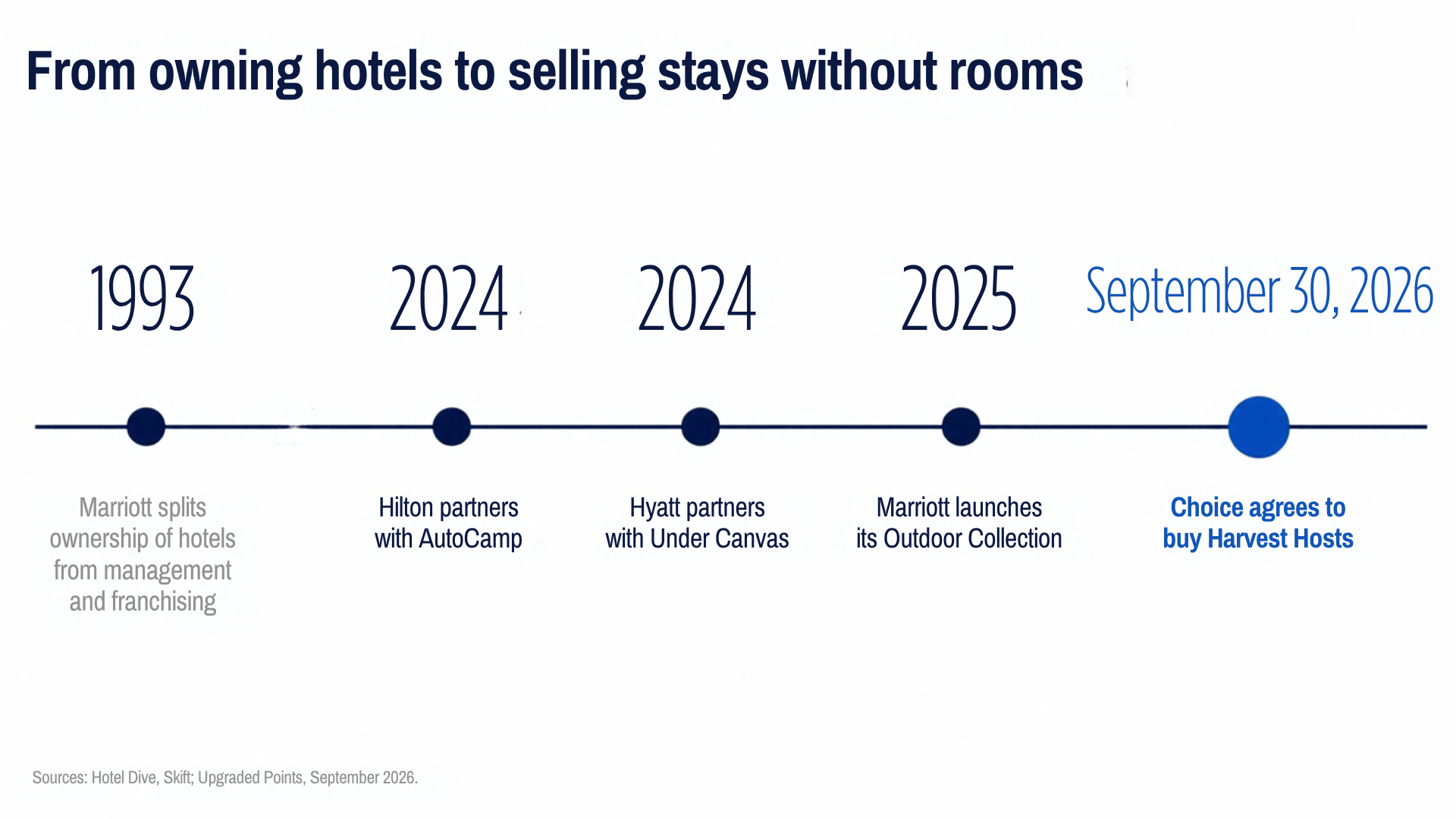
The history of the industry suggests this step is a natural one. In 1993, Marriott split into two companies, one that owned hotels and one that managed and franchised them. That separation made the asset-light franchisor possible. The outdoor deals separate the next layer, which is the room itself.
The strongest objection is that the link between hotel guests and RV travelers is unproven. Choice cited its own research without naming it. Skift noted that the new chief executive will need to show that Harvest Hosts' roughly half-million RV users turn into hotel stays. At $130 million, the deal is also too small to change Choice's results soon.
Those points are fair, and they set the right test. Two early signs will show whether the model works. The first is whether Choice offers Harvest Hosts memberships to its loyalty members. The second is whether Harvest Hosts members begin booking Choice hotels. Even if neither happens quickly, the deal gives Choice a revenue stream that grows without new hotels, at a price that carries little risk for a company of its size.
The economics of lodging are spreading beyond the hotel building. For franchisors, growth no longer depends only on persuading owners to build. It can come from adding products that their members will buy.
For hotel owners, the shift has two sides. A larger and more engaged loyalty program can send more guests to their hotels. A franchisor with other sources of growth also has more choices about where it directs its attention and its marketing. Owners should watch how brands treat their hotels alongside the new products when they renew their franchise agreements.
For operators of outdoor stays, the large franchisors have become active buyers and partners. Networks that already hold a loyal base of travelers, as Harvest Hosts did, have shown that they can sell to a strategic buyer at a strong multiple of what a growth investor paid five years earlier.
The most valuable thing a hotel company owns has become its relationship with the traveler. Choice has just shown that the relationship can earn money on nights when the traveler sleeps in an RV.
The most valuable thing a hotel company owns has become its relationship with the traveler.
Sign up for our latest insights and firm announcements.
We respect your privacy and will not share your information.