
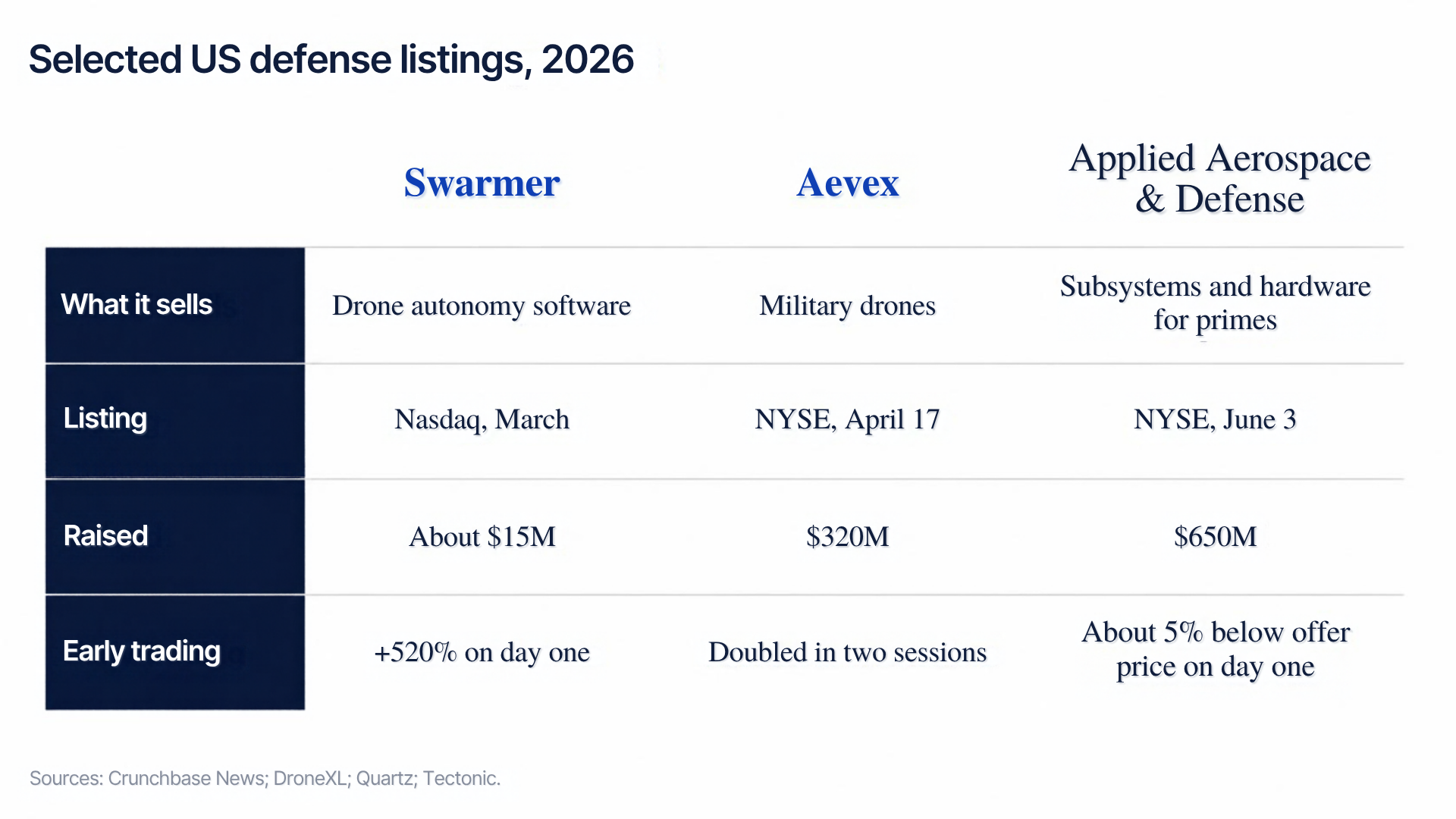
The defense industry's class of 2026 has had a strong year in the public markets. Swarmer, a drone autonomy software company, rose 520% on its first day of trading on Nasdaq in March. Aevex, a military drone maker, raised $320 million in its April listing on the New York Stock Exchange, priced at the top of its range, and its shares doubled within two trading sessions. Applied Aerospace & Defense, a supplier of subsystems and hardware, raised $650 million in June at a valuation of about $3.25 billion.
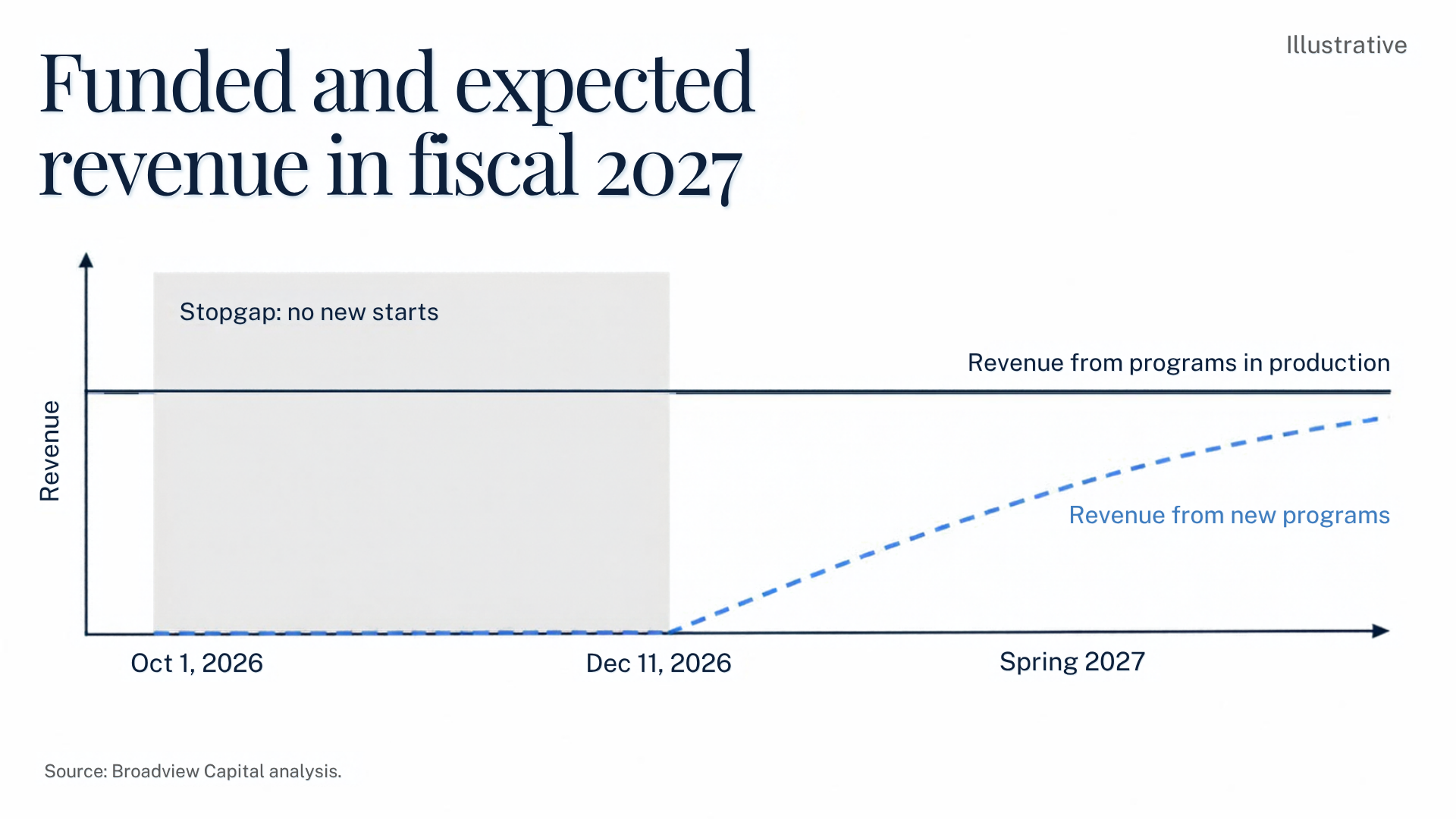
On October 1, those companies met the defense budget calendar. The government began fiscal 2027 under a stopgap that holds defense spending at fiscal 2026 levels through December 11 and bars new programs. More than 150 new starts in the Pentagon's budget documents now face delay, many of them in drones and autonomy.
For investors, this is a useful moment to separate two kinds of value in defense. One is the value of a business that already earns revenue from funded programs. The other is the value of a business whose growth depends on programs that have not yet started. Public markets have paid generously for both this year. The stopgap will show which one holds up.
The year's defense listings fall into two groups.
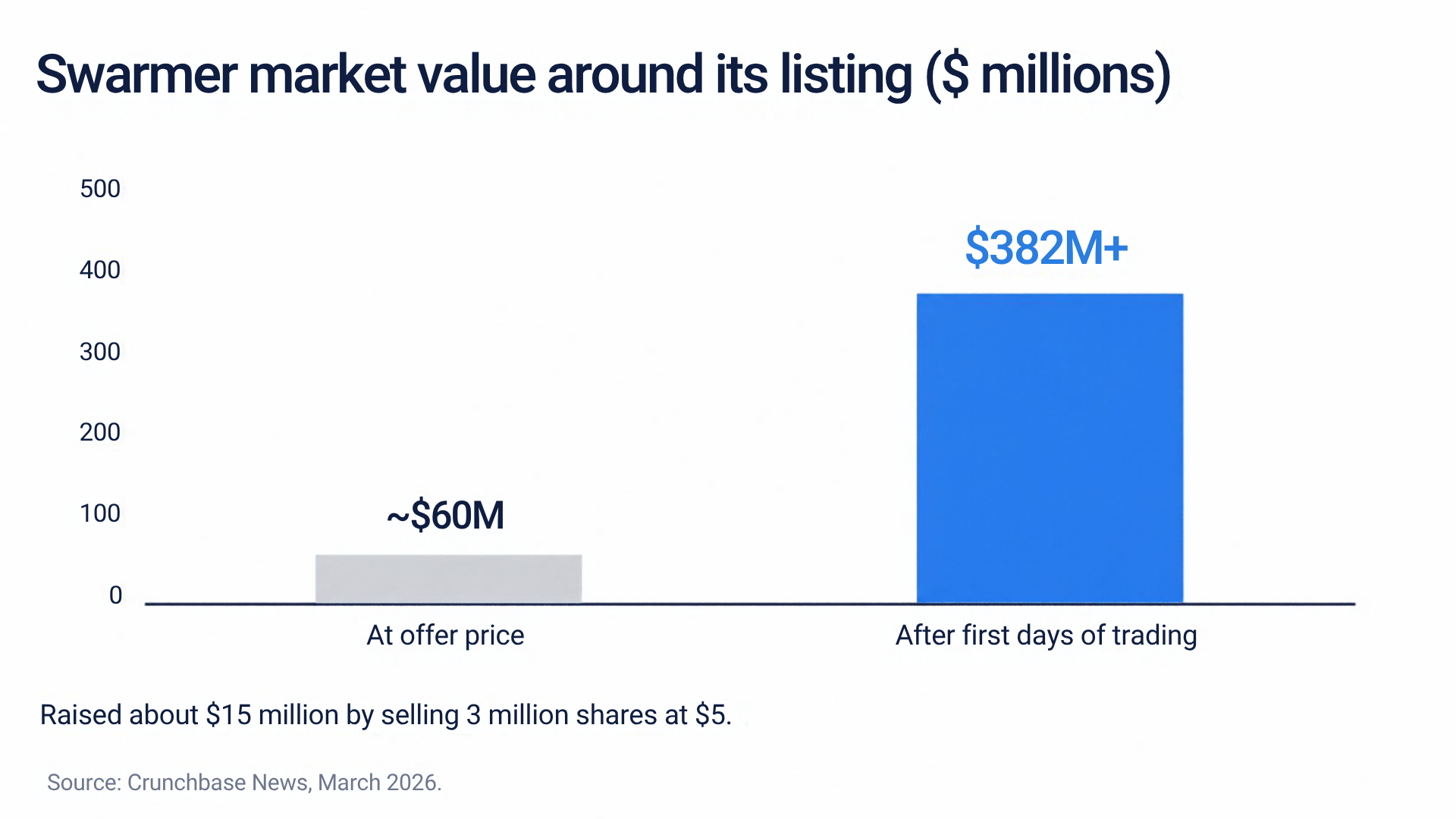
The first group sells new technology, often drones or autonomy software, with growth plans tied to new government demand. Swarmer, founded in 2023, raised about $15 million in its offering. Its first-day rise took its market value from about $60 million to more than $382 million. Aevex's listing was oversubscribed several times over.
The second group sells parts and subsystems to companies that build the end products. Applied Aerospace & Defense makes fuselages, flight control surfaces, solid rocket motor cases, and engine shafts. It reported $498.8 million in revenue for 2025, up 24.8%, and a backlog of $1.06 billion. Its shares did not jump. They closed their first day about 5% below the offering price.
Applied Aerospace & Defense is also a case study in how private capital has approached the defense supply chain. Greenbriar Equity Group, a middle-market buyout firm, acquired Applied Aerospace in 2022. In 2025, it merged that business with PCX Aerosystems, another of its portfolio companies, which traces its history to 1900. The combined company then bought Vestigo Aerospace and other businesses to expand its capacity.
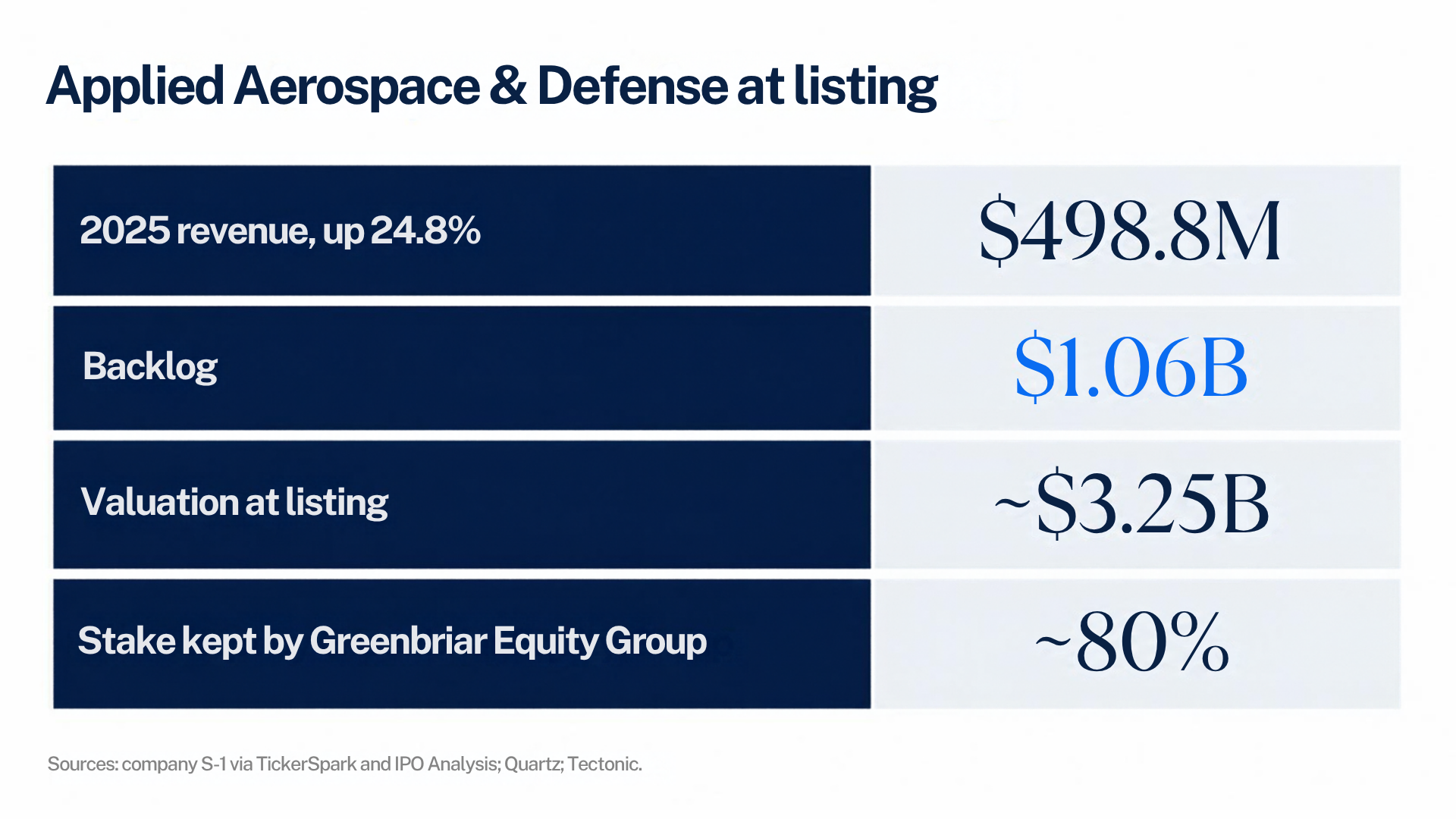
The pattern is a familiar private equity approach applied to a sector in high demand. The firm bought established suppliers and combined them into a larger platform. It then took the platform to the public market while investor interest was strong. Greenbriar was set to keep roughly 80% of the company after the listing. The company said it would use most of the proceeds to repay debt.
The defense technology rally has a recent precedent. In 2021, a wave of space companies went public, many through mergers with special purpose acquisition companies. Investors paid high prices for future launch and satellite businesses. When those businesses grew more slowly than planned, many of the companies lost most of their market value within two years.
The current cycle differs in one important way. Defense budgets and munitions demand are real and rising, and many of the 2026 listings already have government customers. The warning is about timing. When valuations assume that new programs will start on schedule, a delay in Washington can hit share prices long before it hits the long-run demand.
The strongest objection is that this cycle rests on real spending. The S&P Aerospace & Defense Select Industry Index rose 44% in 2025. The administration has requested $1.5 trillion for defense in fiscal 2027. Drones and autonomy are among the department's stated priorities.
That is all true, and it supports the sector as a whole. It does not settle the price of any single company. The requested budget is not yet law, and the stopgap holds spending at the prior year's level. A company valued on new drone programs may wait until spring 2027 for those programs to begin. Its costs continue in the meantime, and its share price must absorb the wait.
The 2026 listings suggest several practical rules for investors.
First, value funded revenue separately from expected revenue. Revenue from programs in production at steady rates is the most protected under a stopgap. Revenue that depends on new starts should carry a discount for timing, especially in the first months of a fiscal year.
Second, look closely at the supply chain. Suppliers like Applied Aerospace & Defense sell to many programs and many primes. Their growth follows the overall rise in production, and they are less exposed to any single program's start date. The ones that sit at narrow points in the supply chain, such as rocket motor components, also gain pricing power as production rises.
Read the balance sheet as well. Leverage magnifies timing risk. A supplier that uses its listing mainly to repay debt has a stronger base afterward, but investors should check how much debt remains and how its interest costs compare with its cash flow.
First-day gains say more about the mood of the market than about the business. The defense companies that hold their value through 2027 will be the ones whose revenue does not depend on Congress acting on time.
First-day gains say more about the mood of the market than about the business.
Sign up for our latest insights and firm announcements.
We respect your privacy and will not share your information.