
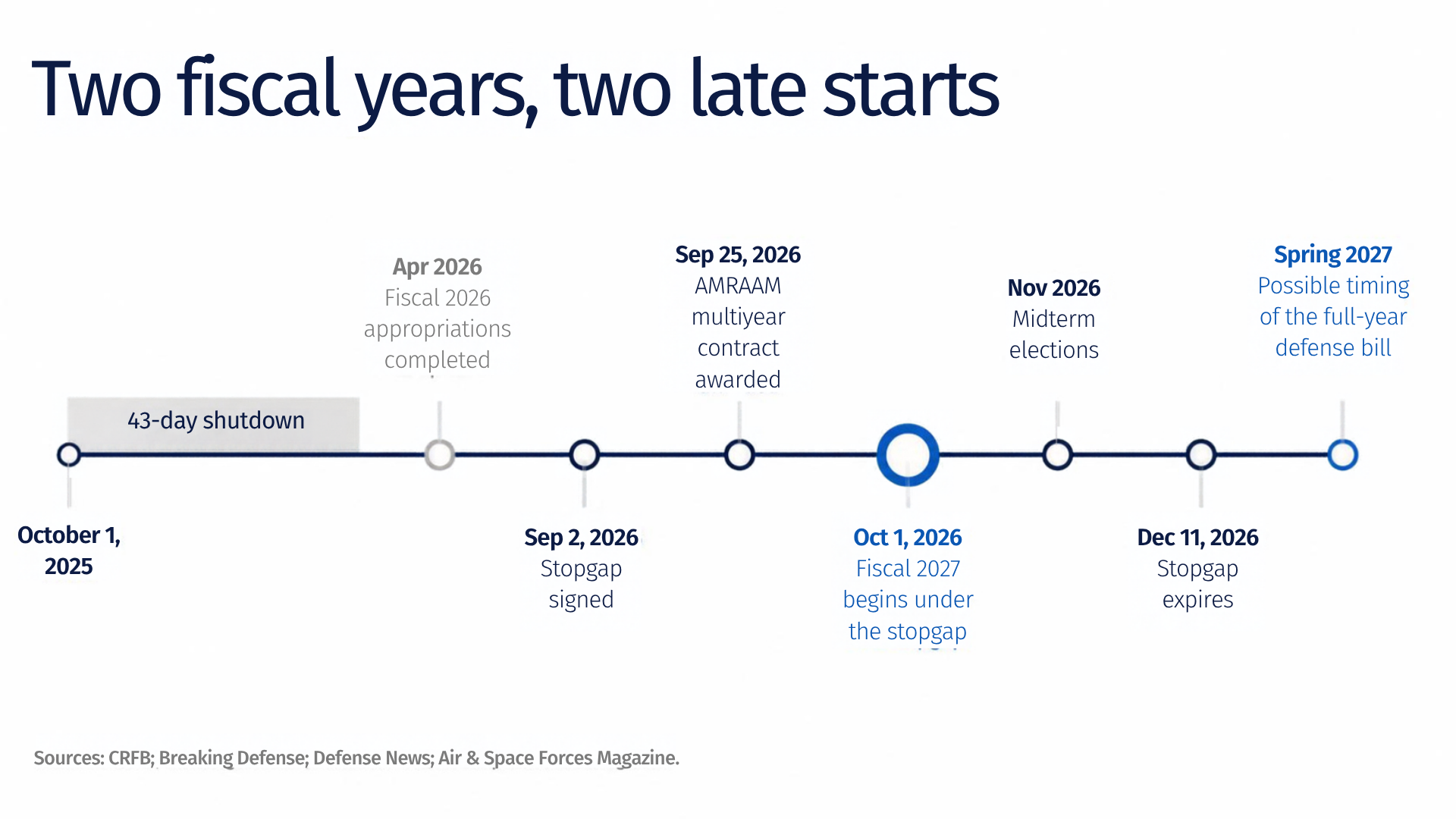
The federal government began fiscal 2027 on October 1 under a continuing resolution. The stopgap law, signed on September 2, funds the government through December 11 at fiscal 2026 levels. It passed the House 370 to 48 and the Senate 90 to 6, and it avoided a repeat of last year's 43-day shutdown.
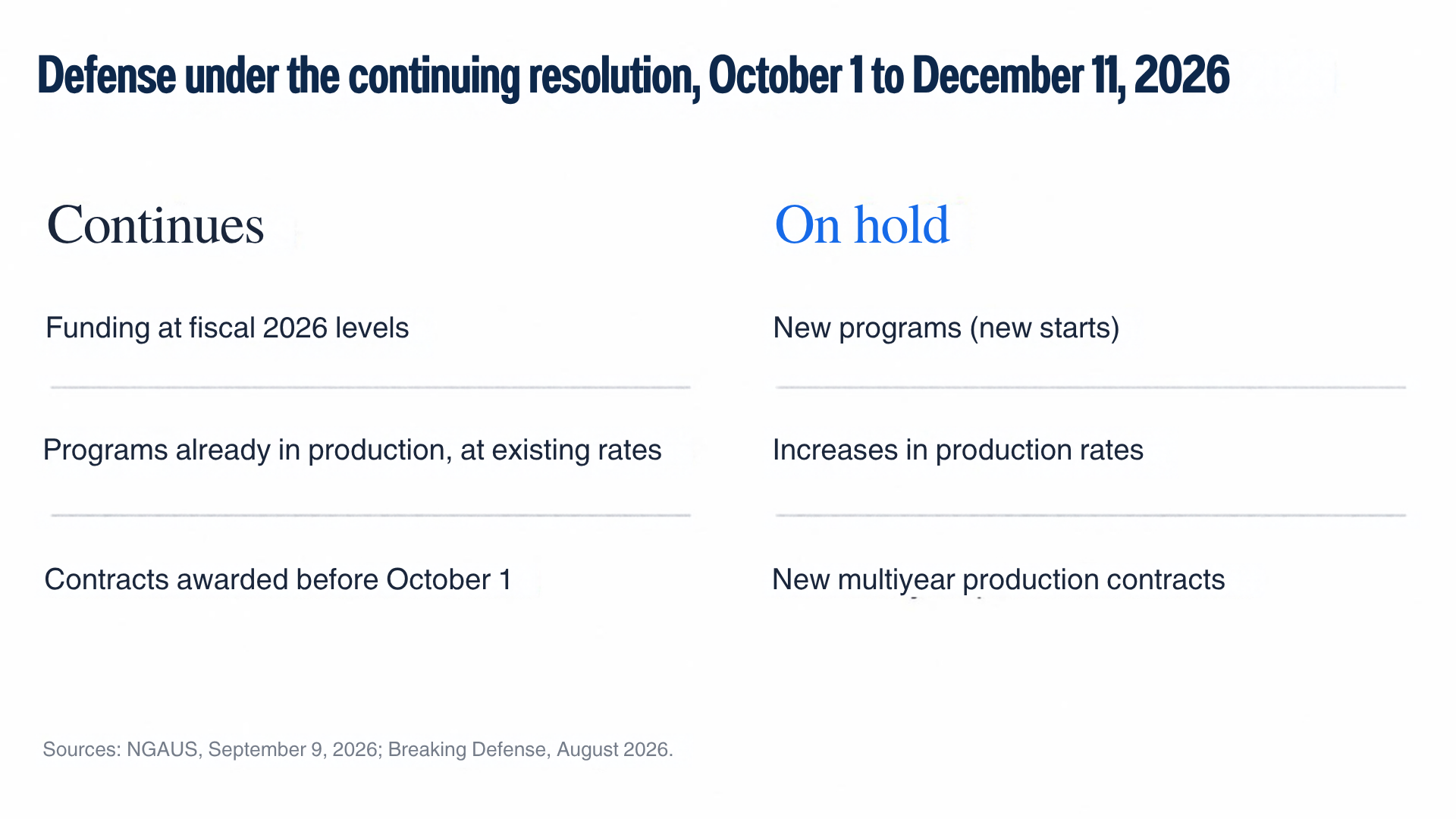
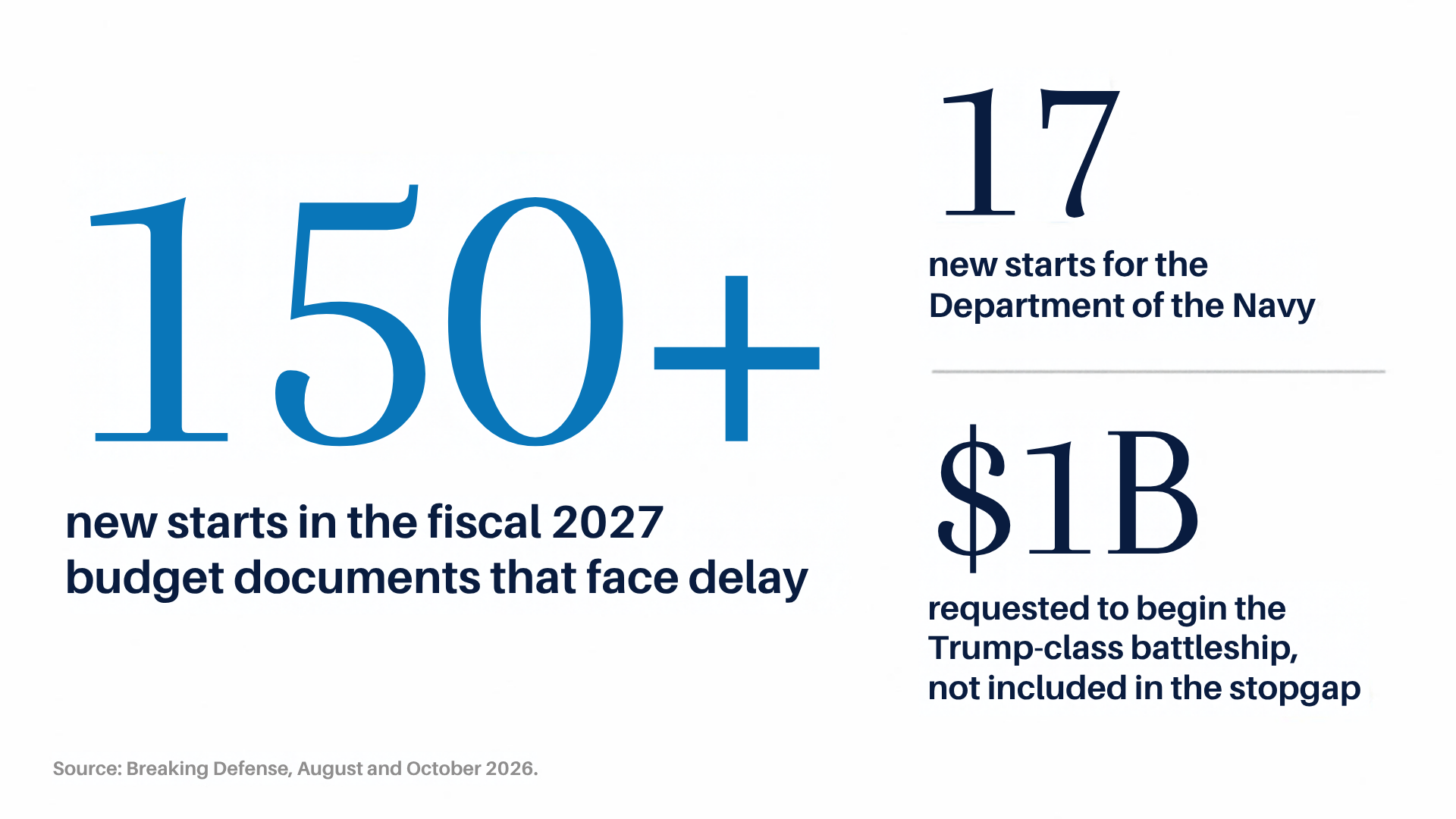
For the Pentagon, the stopgap freezes more than spending. It bars "new starts," meaning programs that did not receive funding the year before. It bans increases in production rates for existing weapons, and it bars the start of new multiyear production contracts. A search of the fiscal 2027 budget documents by Breaking Defense found more than 150 new starts that now face delay.
The headline number in defense this year has been the administration's $1.5 trillion request. The number that governs the market today is the $838.7 billion that Congress enacted for fiscal 2026. The gap between them, and the time it takes Congress to close it, will decide which parts of the defense industry grow in 2027 and which wait.
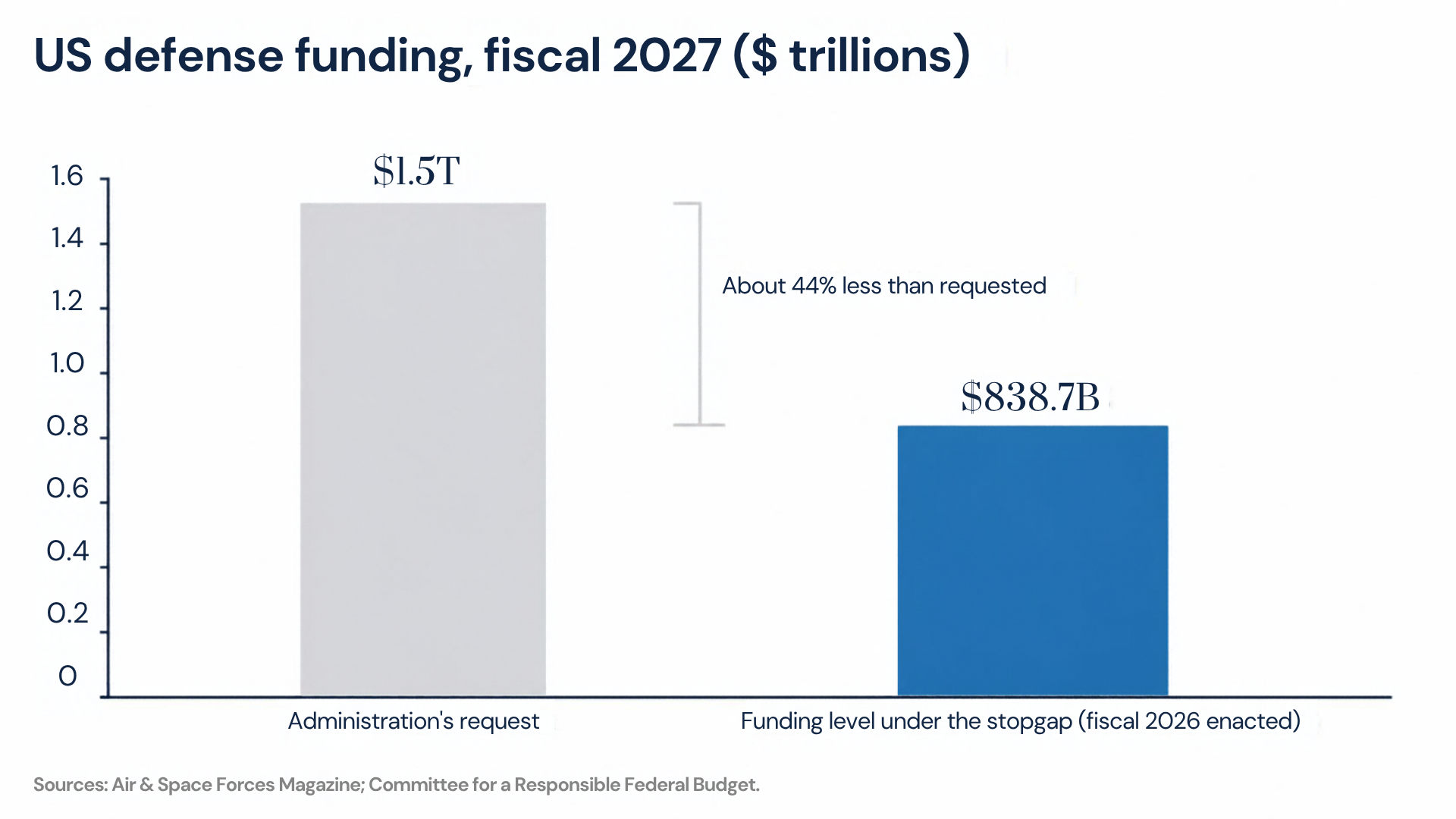
The size of the gap is unusual. Under the stopgap, the Pentagon is working with roughly 44% less than it requested, according to Air & Space Forces Magazine. Most continuing resolutions hold a department near the level it expected. This one holds it far below.
Congress also declined most of the Pentagon's special requests. Senate appropriators rejected a request for $1 billion to begin the Trump-class battleship program. They also left out language the Pentagon had sought to protect funds from last year's reconciliation bill from automatic cuts.
The stopgap runs to December 11. Byron Callan of Capital Alpha Partners has suggested that the base defense budget for 2027 may not clear Congress until spring 2027, six or more months late. The midterm elections in November add to the uncertainty about how quickly a final bill can pass.
The rules of a continuing resolution do not affect every program the same way. Programs already in production at their existing rates continue. Programs that the Pentagon planned to start or expand this year do not.
That puts the newest priorities at the back of the line. Breaking Defense counted 17 new starts for the Department of the Navy alone. The Pentagon's planned Defense Autonomous Warfare Group, a drone initiative, could also be sidelined. Many of the programs that the department has described as urgent, in autonomy and drones, are exactly the kind that a stopgap holds back.
The timing of one recent award shows how the calendar works. On September 25, five days before the fiscal year ended, the Pentagon awarded Raytheon a multiyear AMRAAM missile contract worth up to $20.7 billion. Under the stopgap, a new multiyear contract of that kind could not have been started after October 1.
The delay is not new. The federal government starts most fiscal years under a continuing resolution. Fiscal 2026 opened with a 43-day shutdown, from October 1 to November 12, 2025, and its appropriations process was not completed until April 2026, more than six months into the year.
The defense industry has adapted to this pattern by planning around it. Contractors expect few new awards in the first months of a fiscal year, and they expect a rush of awards once a full-year bill passes. The industry's capacity to absorb those swings depends on the size of each company and the share of its revenue that comes from new programs.
The strongest objection is that this is the normal rhythm of defense budgets. The Pentagon has operated under stopgaps for most of the last 20 years, and contractors have still grown. When the full-year bill passes, the money flows.
That is true for the industry as a whole. It is less true for the newest parts of it. A large prime contractor with dozens of programs in production can wait several months for new awards. A younger defense technology company whose growth depends on one new program cannot easily wait six. If its program is a new start, it may have no government revenue from that program until spring or later, while it still carries the cost of its staff and facilities.
The effect also compounds. A program that starts six months late may not reach production in the year planned, which pushes back the orders that its suppliers had expected.
The stopgap sends a clear message about how defense demand will arrive in fiscal 2027.
Companies supplying programs already in production at steady rates are the most protected. Their revenue continues at fiscal 2026 levels while Congress negotiates.
Companies built around new programs face the most timing risk. That group includes many of the venture-backed firms in autonomy and drones, whose growth plans assumed new starts in 2027.
The award calendar will likely bunch up. When Congress passes a full-year bill, whether in December or in the spring, the Pentagon will try to start many programs at once. That will favor contractors with the capacity and cash to respond quickly.
The $1.5 trillion request tells the market where the administration wants defense spending to go. The continuing resolution tells it when the money will actually come. For most of the industry this year, the second message matters more.
The $1.5 trillion request tells the market where the administration wants defense spending to go. The continuing resolution tells it when the money will actually come.
Sign up for our latest insights and firm announcements.
We respect your privacy and will not share your information.