
In September, two reports showed how far GLP-1 drugs have moved into food deal-making. Mergermarket reported that sale documents for food companies now often include a slide dedicated to the drugs, and that buyers are modeling volume trends for each category rather than relying on headline growth. Bakery & Snacks reported that a company's exposure to GLP-1 drugs has become a standard part of how buyers set a price.
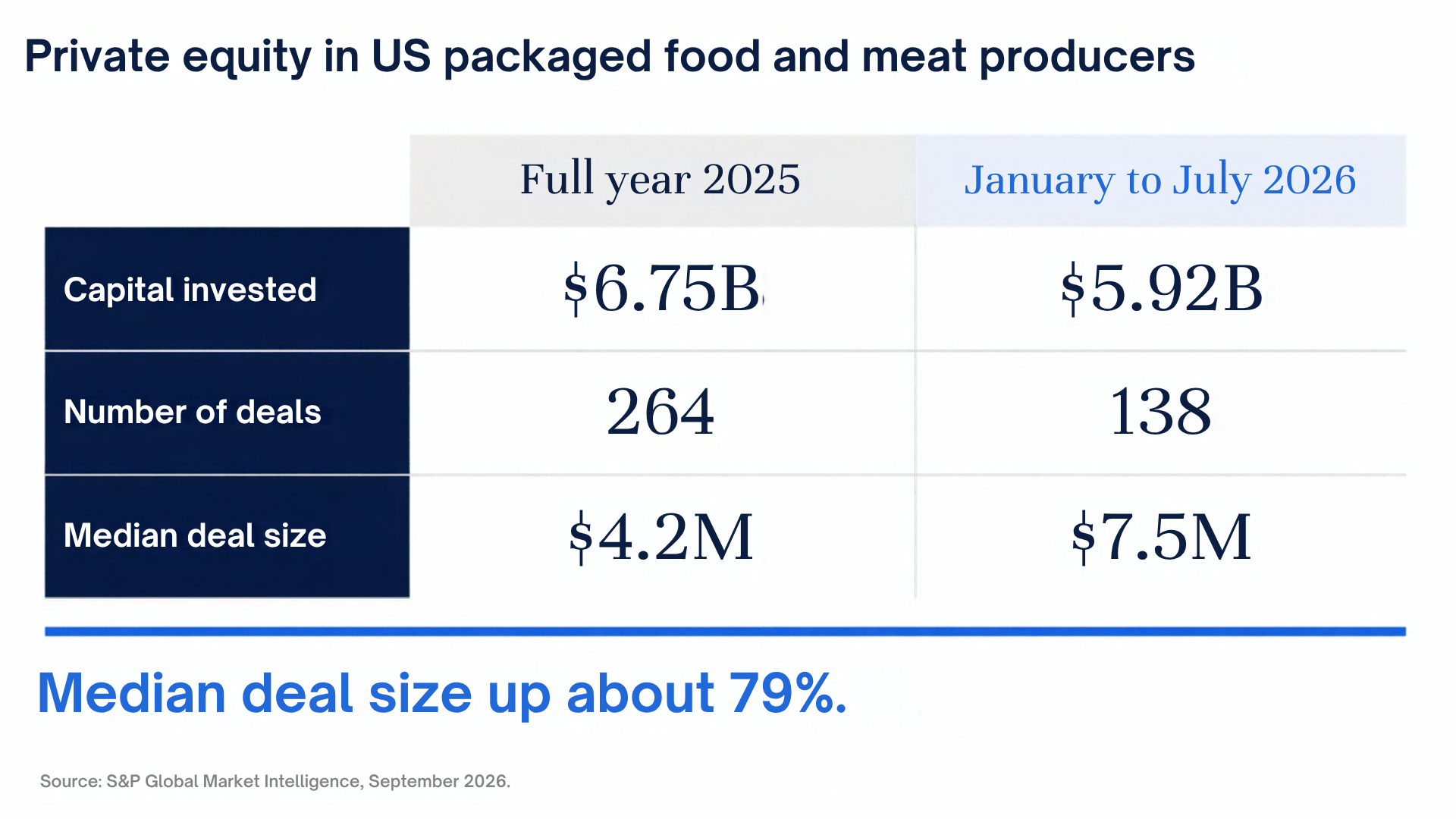
The money is still flowing. Private equity firms put $5.92 billion into packaged food and meat producers in the first seven months of 2026, according to S&P Global Market Intelligence, on course to pass the $6.75 billion invested in all of 2025. They did it in fewer, larger deals. The number of deals fell to 138, against 264 for all of last year, while the median deal size rose about 79%, from $4.2 million to $7.5 million.
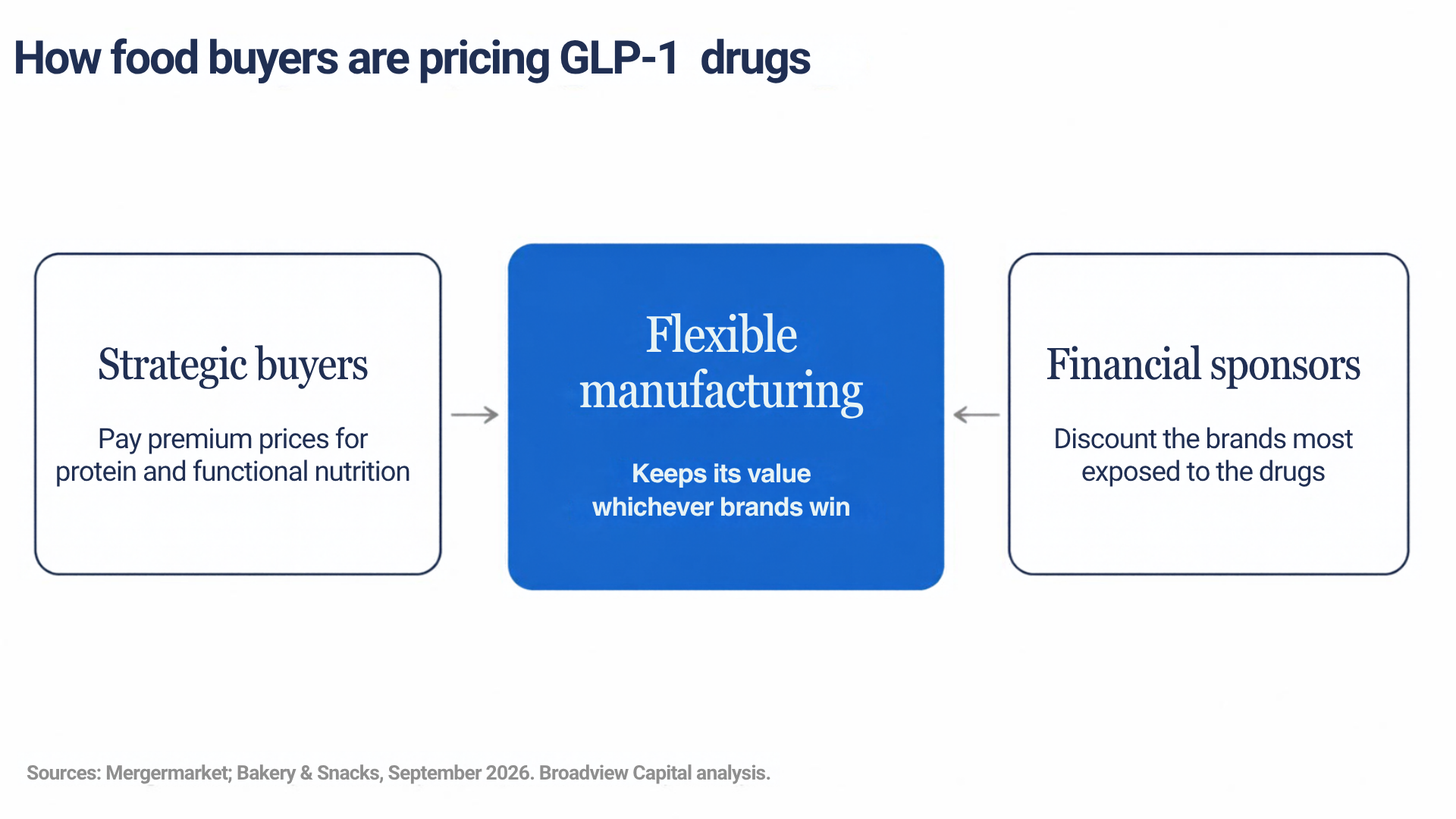
Buyers have split into two camps. Strategic acquirers are paying high prices for protein and functional nutrition. Financial sponsors are bidding down businesses most exposed to the drugs. Both camps are betting on the same thing, which is that today's winners and losers among food brands will stay that way. We think the more reliable value sits in a different place: the manufacturing that lets a business change its products as demand moves.
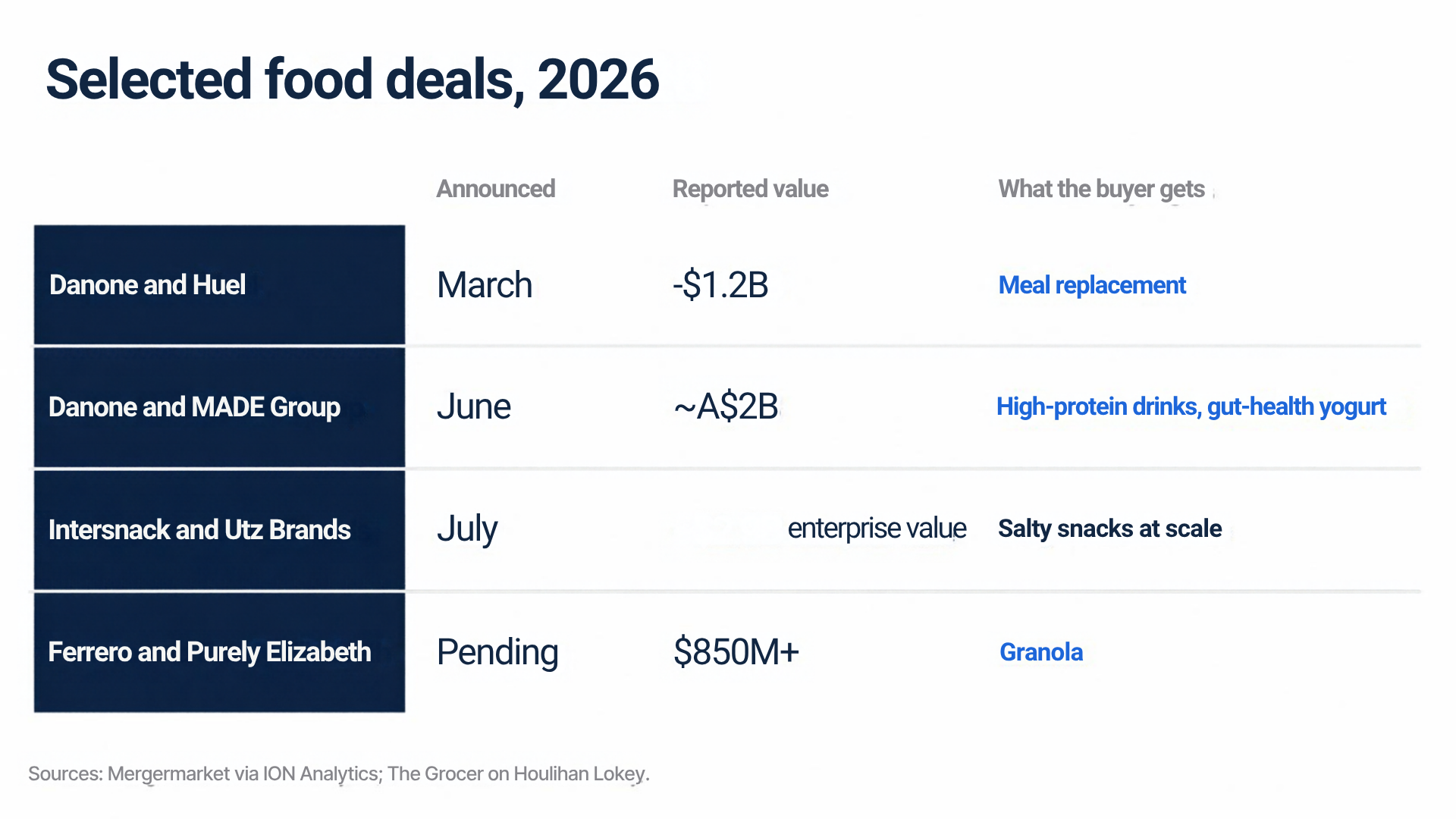
The largest food companies have moved quickly. Danone agreed in March to buy the meal-replacement brand Huel, reported at roughly $1.2 billion, and the deal has since cleared the UK competition regulator. In June, it agreed to buy MADE Group, a maker of high-protein drinks and gut-health yogurts, from TPG Capital, reported at about A$2 billion. Ferrero has a pending deal worth more than $850 million for the granola maker Purely Elizabeth.
Snacking deals have rebounded on the same theme. Houlihan Lokey counted 65 snacking deals in the first half of 2026, with about $5.9 billion in disclosed value, a return to the levels of earlier years. Advisers describe buyers building portfolios of "justified indulgence" and nutrient-dense products.
Private equity has taken a more cautious view. Mergermarket reports that buyers now value the food brands most exposed to obesity drugs well below functional nutrition peers, and that the gap has widened as lenders and acquirers moved from noting the risk to modeling it. The trend is changing prices without stopping deals.
One large deal runs against the consensus. In July, Intersnack agreed to take Utz Brands private at an enterprise value of about $2.9 billion, with the founding family keeping half the company. Utz sells salty snacks, one of the categories most affected by the drugs. The buyer is betting on scale and distribution, and on a brand that people still choose to buy.
The food industry has learned this lesson before. In February 2019, Kraft Heinz wrote down the value of its Kraft and Oscar Mayer brands by $15.4 billion. The company had built itself through large acquisitions priced on the strength of established brands. As shoppers moved toward fresher and healthier foods, those brands lost value faster than the buyer had assumed.
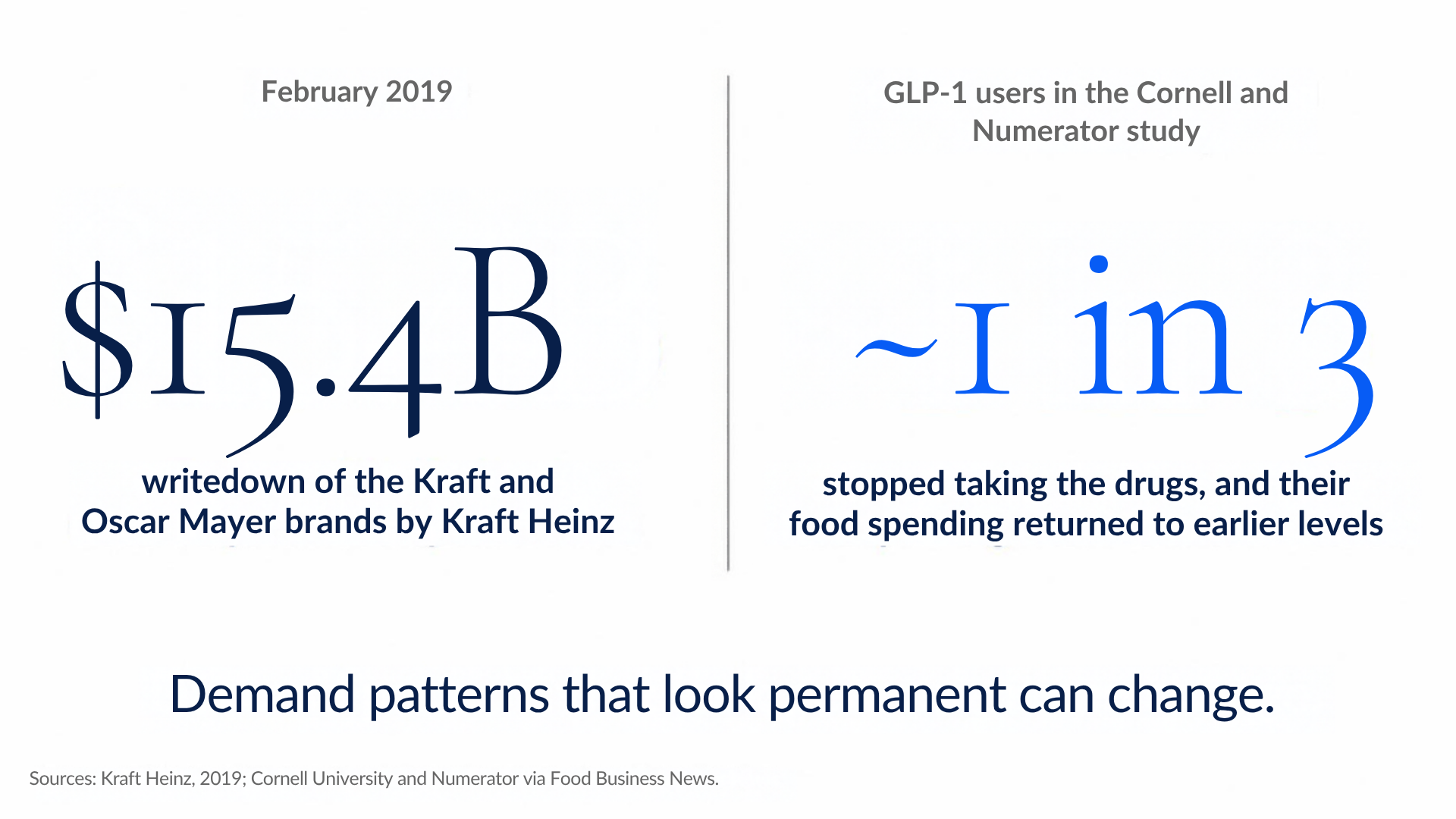
The lesson applies in both directions today. A buyer who pays a full price for an indulgent brand assumes its volumes will hold. A buyer who pays a premium for a protein brand at the height of its popularity assumes its growth will last. About one-third of GLP-1 users in the Cornell and Numerator study stopped taking the drugs within the study period, and their spending returned to normal. Demand patterns that look permanent in 2026 may prove less stable.
The strongest objection is that the direction is clear. Protein and functional nutrition are growing, and indulgent categories are under pressure. Strategic buyers are rational to pay for growth, and sponsors are rational to discount decline.
The direction is clear, and the size and duration are not. S&P Global projects that GLP-1 drugs could reduce industry revenue by more than $30 billion by 2030. That is a large number, and it is spread across many categories and many years. A premium price for a brand assumes the buyer can predict which brands will keep their share through that change. The history of food brands suggests that is hard to do.
The current market suggests a few practical rules for investors in food.
First, underwrite the category, then the brand. Model what volume in a product's category is likely to do as GLP-1 adoption rises, and set the price on that curve. As one adviser told Bakery & Snacks, what destroys value is a volume decline that the seller cannot explain.
Second, pay for manufacturing flexibility. A plant that can change recipes and pack formats without a long retooling keeps its value whatever happens to demand. Advisers have said that manufacturing able to support reformulation and smaller portions could command a stronger acquisition premium. Contract manufacturers and packaging operations that can run many formats economically gain from the same shift.
Structure the price to match the uncertainty. When a seller and a buyer disagree about how long a trend will last, part of the price can depend on future volume. That lets the buyer pay for growth only if it arrives.
GLP-1 drugs have made food deals harder to price, and the market has responded by sorting brands into winners and losers. The investors best placed for the next several years will spend less time picking those brands and more time owning the capacity to make whatever the next winners turn out to be.
What destroys value is a volume decline that the seller cannot explain.
Sign up for our latest insights and firm announcements.
We respect your privacy and will not share your information.