
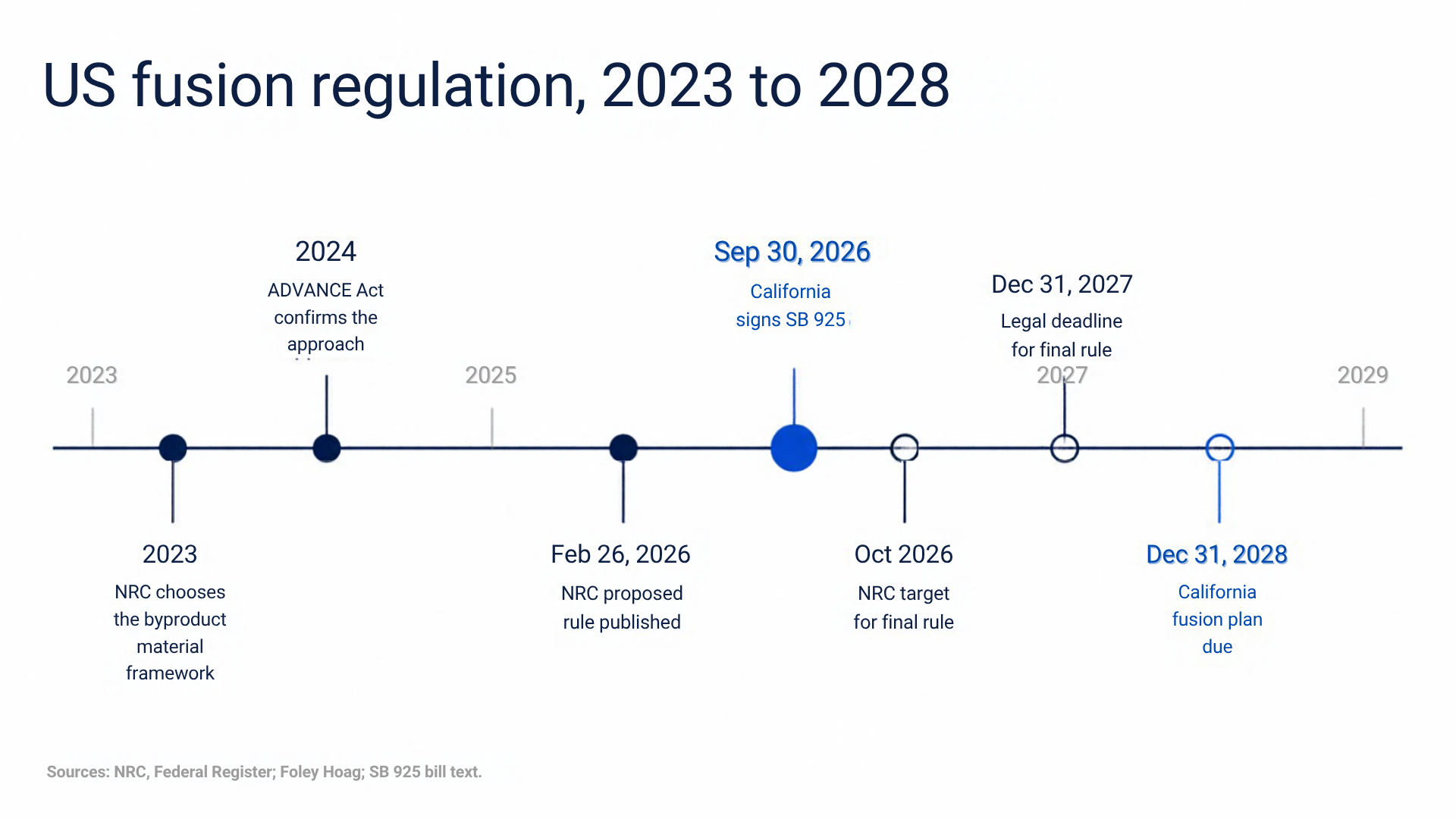
On September 30, Governor Newsom signed SB 925, a bill by Senator Jerry McNerney that directs the California Energy Commission to prepare a strategic plan for fusion energy. Among other tasks, the commission must develop a regulatory framework for fusion and a roadmap for licensing and permitting new fusion research facilities and power plants. The bill passed the state Senate 37 to 0, and it was sponsored by General Atomics, a San Diego company that has worked on fusion since the 1950s.
The bill funds no plant and approves no project. It matters because of how fusion is now regulated in the United States. The federal government has chosen a light framework for fusion, and that choice places much of the day-to-day licensing with the states. The rules each state writes will shape how long a fusion project takes and where the first plants are built.
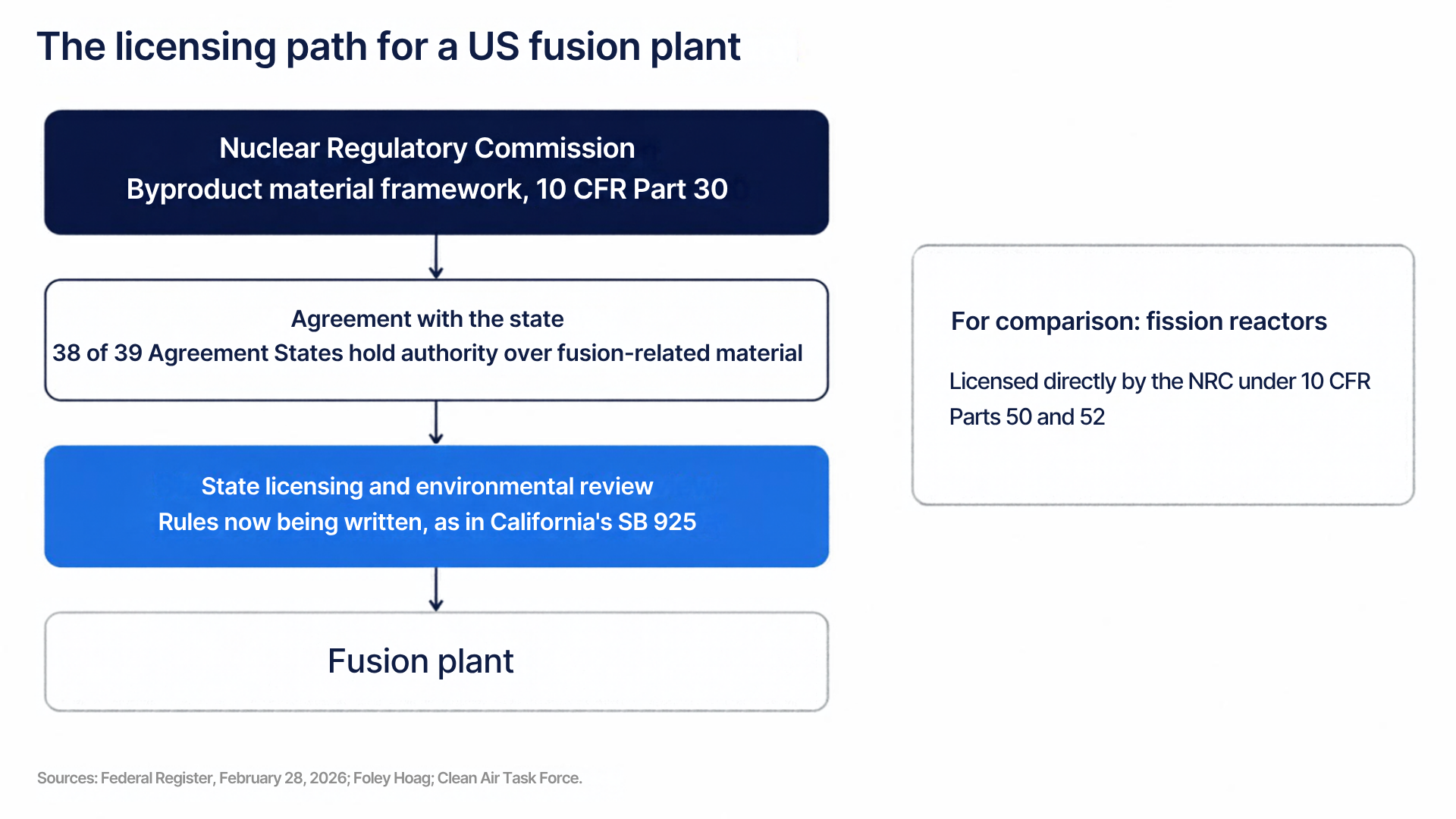
In 2023, the Nuclear Regulatory Commission decided to regulate fusion machines under its byproduct material framework, known as 10 CFR Part 30. That framework covers radioactive materials used outside nuclear power plants, such as in hospitals and particle accelerators. It is a different and far less demanding system than the one used for fission reactors, under Parts 50 and 52. Congress confirmed the approach in the ADVANCE Act of 2024.
The reasoning rests on physics. Fusion uses no uranium or plutonium, so it cannot sustain the chain reaction that defines a fission reactor, and it produces no fission products. Its main radioactive materials, such as tritium, already fall under the byproduct framework.

The NRC published its proposed rule for fusion machines in the Federal Register on February 26, 2026. Its regulatory agenda targets a final rule in October 2026, well ahead of the December 31, 2027 deadline set by law.
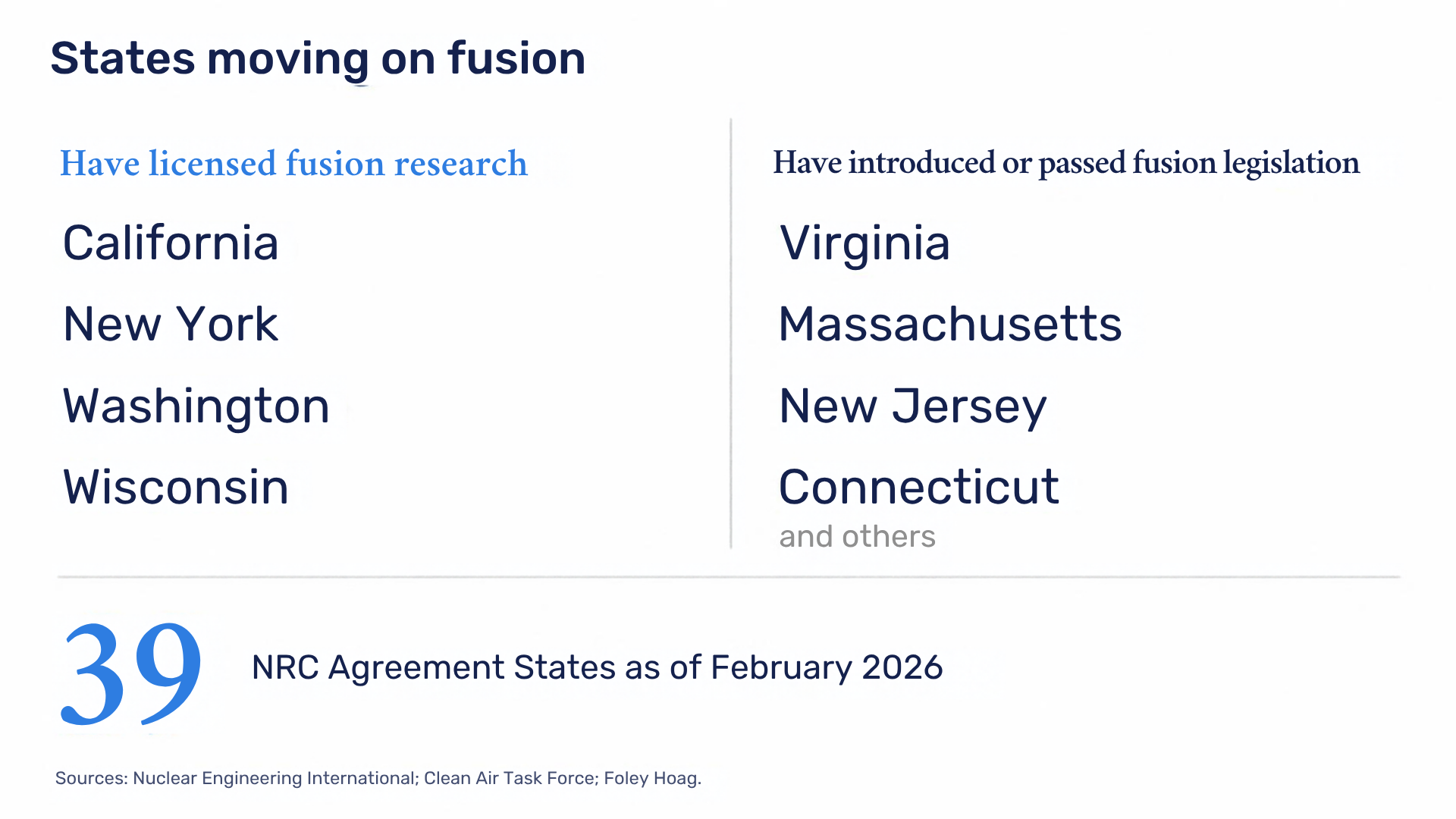
The byproduct framework has a feature that matters for investors. Under the Atomic Energy Act, the NRC can hand authority over these materials to states that sign agreements with it. As of February 2026, 39 states were Agreement States, and 38 of them had authority over the category of material that fusion machines produce. In those states, a fusion developer will apply to the state, not to the NRC.
California, New York, Washington, and Wisconsin have already licensed fusion research and development activities. Virginia, Massachusetts, New Jersey, Connecticut, and others have introduced or passed fusion legislation. Each state now decides how quickly it can review an application and what environmental review it requires.
SB 925 is California's attempt to answer those questions before the first commercial plant applies. The Clean Air Task Force, which supported the bill, described its permitting roadmap as aligned with the NRC's framework once that rule is final.
The economic effect runs through financing. A first-of-a-kind energy plant carries several risks at once, and the time it takes to win approval is one of them. Lenders and equity investors price each risk. Permitting risk is often the hardest to price, because it depends on rules that may not exist yet and on reviewers who have never seen the technology.
The fission industry shows what that costs. NuScale's small modular reactor design spent years in the NRC's design certification process before approval in 2023, at a reported cost of hundreds of millions of dollars. That burden fell on a company before it sold a single reactor.
The byproduct framework removes most of that federal burden for fusion. It leaves the state layer, and that layer is where the remaining uncertainty now sits. A state with a clear licensing path and staff who understand the technology lets a developer plan its schedule with some confidence. That confidence shows up in a lower risk premium on the project's capital, which matters more than most other inputs for a plant that will cost billions of dollars to build.
The strongest objection is timing. SB 925 asks for a plan, and the bill text sets the deadline as December 31, 2028. No commercial fusion plant is ready to apply for a permit today. A legislative analysis of the bill even noted that a strategic plan for fusion may be premature.
That is fair for 2026, and it misses how developers choose sites. A fusion company planning its first power plant must pick a location years before it files an application, because land and grid connections take years to secure. A state that can show a clear path by 2028 will be on the shortlist when those choices are made. A state that has not started will not.
The economics of fusion are moving toward a state-by-state contest, and the shift sorts the sector in several ways.
States with clear frameworks gain. They will attract the first plants, and the jobs and tax base that come with them. The first plants also set the standard that later projects follow.
Developers that choose those states early gain a lower cost of capital and a more predictable timeline. Developers that wait for every state to act will compete for the best sites with less time to secure them.
The suppliers and advisers that know the state processes gain as well. Environmental consultants and radiation safety specialists with fusion experience will be in demand wherever the first applications land.
For most of its history, fusion was a question of physics. As the first commercial machines approach, the next question is where they can be permitted, and states have begun to answer it.
Permitting risk is often the hardest to price, because it depends on rules that may not exist yet.
Sign up for our latest insights and firm announcements.
We respect your privacy and will not share your information.