
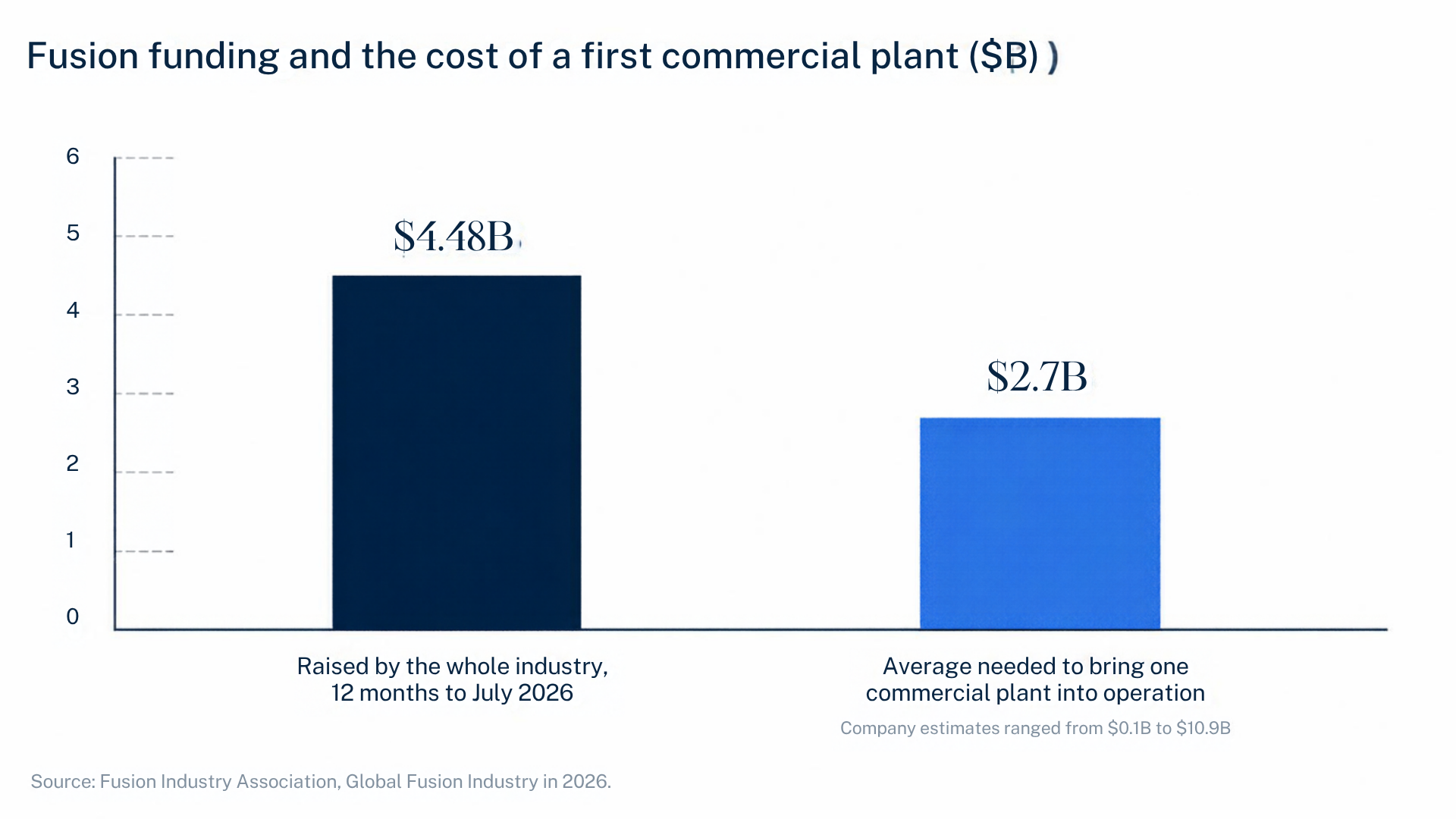
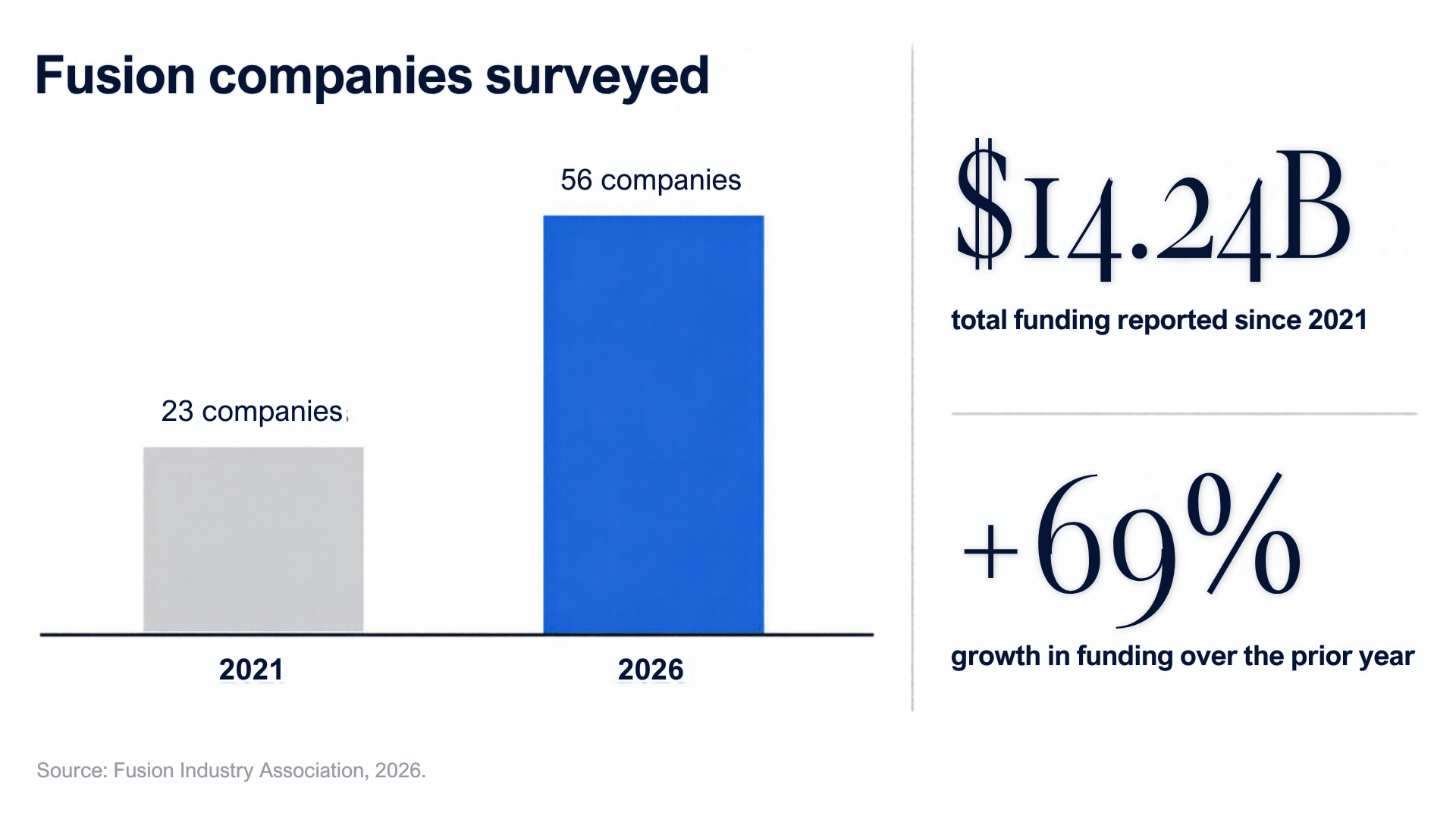
The fusion industry raised a record $4.48 billion in the 12 months to July 2026, according to the Fusion Industry Association's annual report. That is 69% more than the year before. Total funding since the association began its survey in 2021 now stands at $14.24 billion, across 56 companies that employ more than 16,000 people.
In the last week of September, a bipartisan group in the House proposed $10 billion in public funding for fusion. The Fusion Industry Association had called for a one-time injection of public capital of that size into programs with private companies, and both the association and Commonwealth Fusion Systems endorsed the bill. In the same week, nT-Tao and Orion announced plans for 20 megawatt fusion plants aimed at data centers.
The new capital and the new buyers point the same way, and the main risk in fusion still sits in the same place: whether a given machine works and can be built at a cost the market will pay. For investors, the question is how to hold exposure to fusion without staking everything on one design. The answer, in our view, lies in the parts that every design needs.
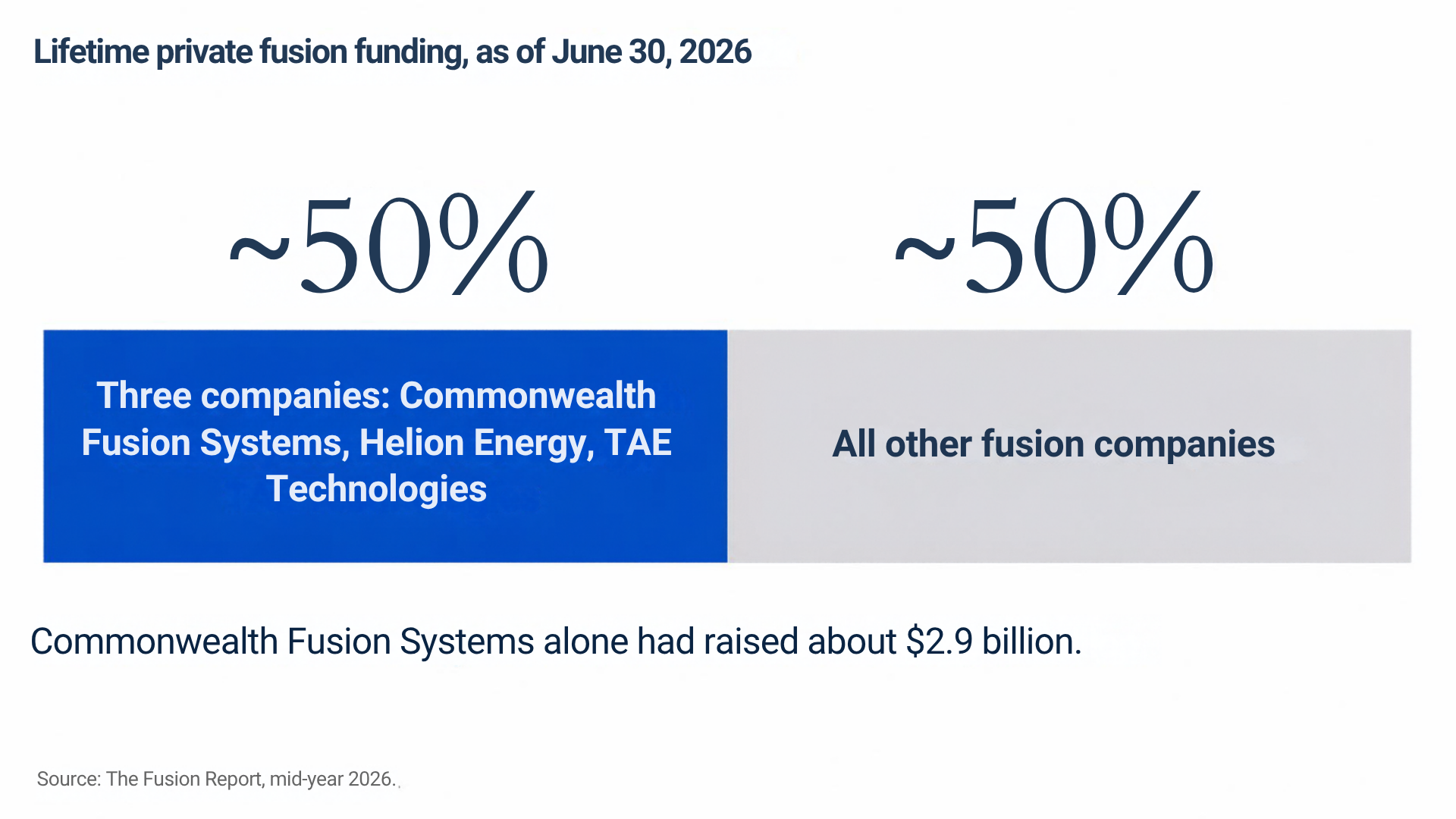
Fusion funding is heavily concentrated. As of June 30, 2026, according to The Fusion Report, Commonwealth Fusion Systems, Helion Energy, and TAE Technologies together held roughly half of all lifetime private funding in the industry. Commonwealth Fusion Systems alone had raised about $2.9 billion, after an $863 million round in 2025. Helion raised $465 million in June 2026.
That concentration follows the leaders' progress. Commonwealth Fusion Systems is building SPARC in Massachusetts and plans a commercial plant, ARC, in Virginia, with Google committed to buy power from it. Helion has a power purchase agreement with Microsoft and says it will deliver electricity by 2028.
For an investor, each of these is a bet on one machine. If the machine works, the return can be very large. If it does not, most of the capital is lost.
The scale of the next step is the clearest reason to think carefully about where capital sits. When the association asked companies how much they would need to bring a commercial fusion plant into operation, the average answer was $2.7 billion. Responses ranged from $100 million to $10.9 billion.
Compare that with the $4.48 billion the entire industry raised in its best year. Private capital alone can fund only one or two commercial plants a year at that average. The proposed $10 billion public program would help close that gap, and it is aimed at the riskiest step, the first plant of each kind.
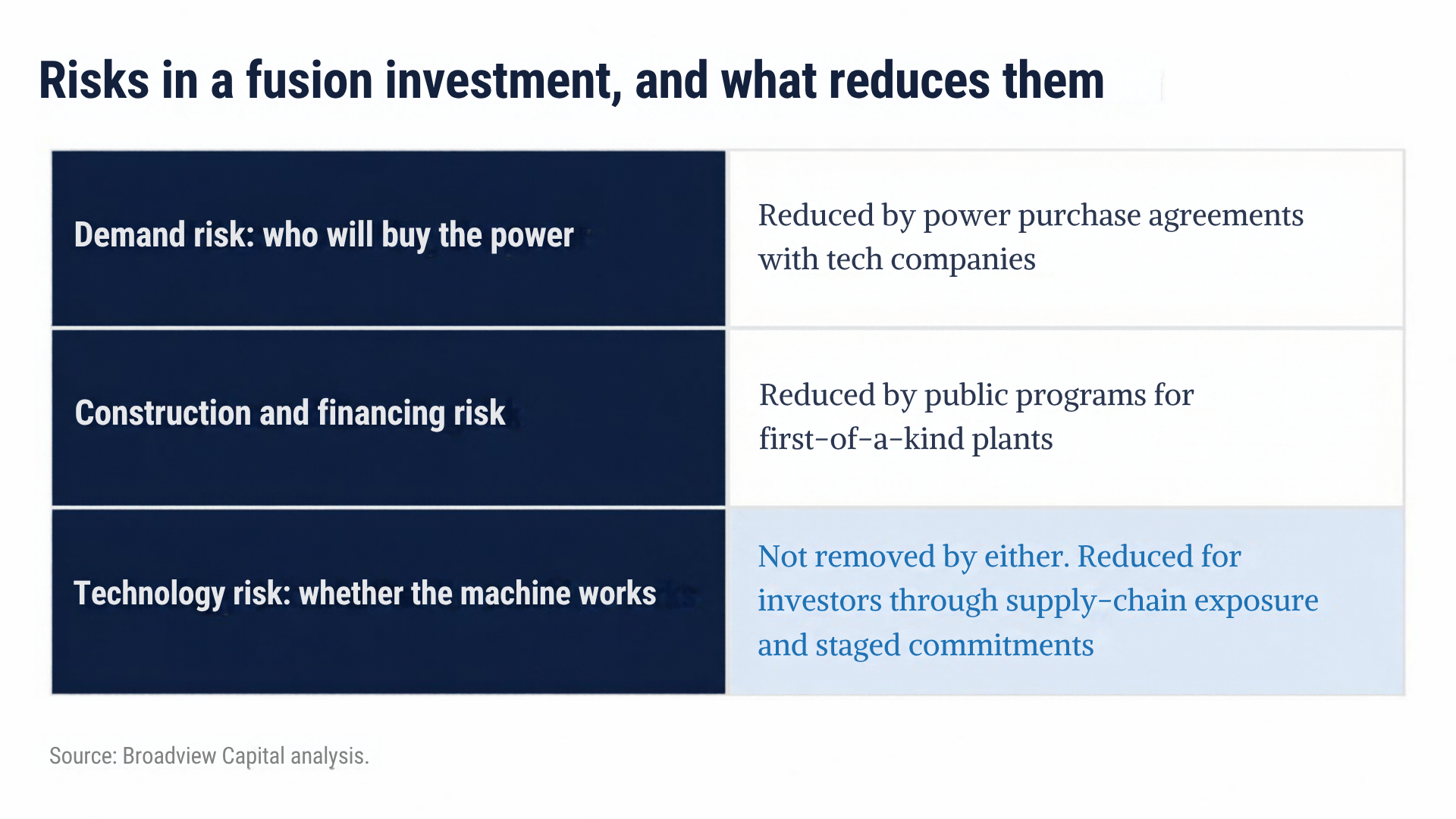
The new sources of support each address part of the risk. A public program that shares the cost of first plants lowers construction and financing risk. A power purchase agreement with Microsoft or Google lowers demand risk, because the developer knows who will buy its power.
Neither removes the main risk. A purchase agreement is valuable only if the plant produces power. A public grant covers part of the cost of building, but it does not make the physics work. An investor who reads the new buyers and the new public money as proof of success is reading more into them than they contain.
The strongest objection is that concentration is rational. The leading developers are furthest along, and they have attracted the most sophisticated buyers. Spreading capital across weaker companies would only lower returns.
That is a reasonable view of the developers, and it leaves out the rest of the industry. A fusion power plant needs high-temperature superconducting magnets, power electronics, specialized materials, vacuum systems, and equipment to handle fuel such as tritium. Proxima Fusion, which raised $518 million in July 2026, has announced plans to build a factory for superconducting tape. Suppliers like these sell to many developers at once.
The industry's own history shows why this matters. In 2021, the association surveyed 23 fusion companies. In 2026, it surveyed 56. Many different designs are now competing. A supplier of magnets or power electronics can sell to several of them, and its revenue does not depend on which design wins.
We see two practical ways to hold fusion exposure with this in mind.
The first is through the supply chain. Suppliers of components that most designs need can earn revenue during the construction of demonstration machines, years before any plant sells power. Their customers include developers and national laboratories, and they can often sell into other industries as well.
The second is through staged commitments to developers. Capital tied to clear technical milestones limits the loss if a machine fails, and it lets an investor add to a position once a design has proven itself.
Offtake agreements deserve the same care. A developer with a signed buyer is more valuable than one without, but the terms matter. Investors should read what happens to the agreement if the plant is late or produces less power than promised.
Fusion has moved from national laboratories to private companies with real budgets and real buyers. The investors best placed for the next phase will hold the parts every design needs, and they will commit to individual machines in stages as the physics proves itself.
A purchase agreement is valuable only if the plant produces power.
Sign up for our latest insights and firm announcements.
We respect your privacy and will not share your information.