
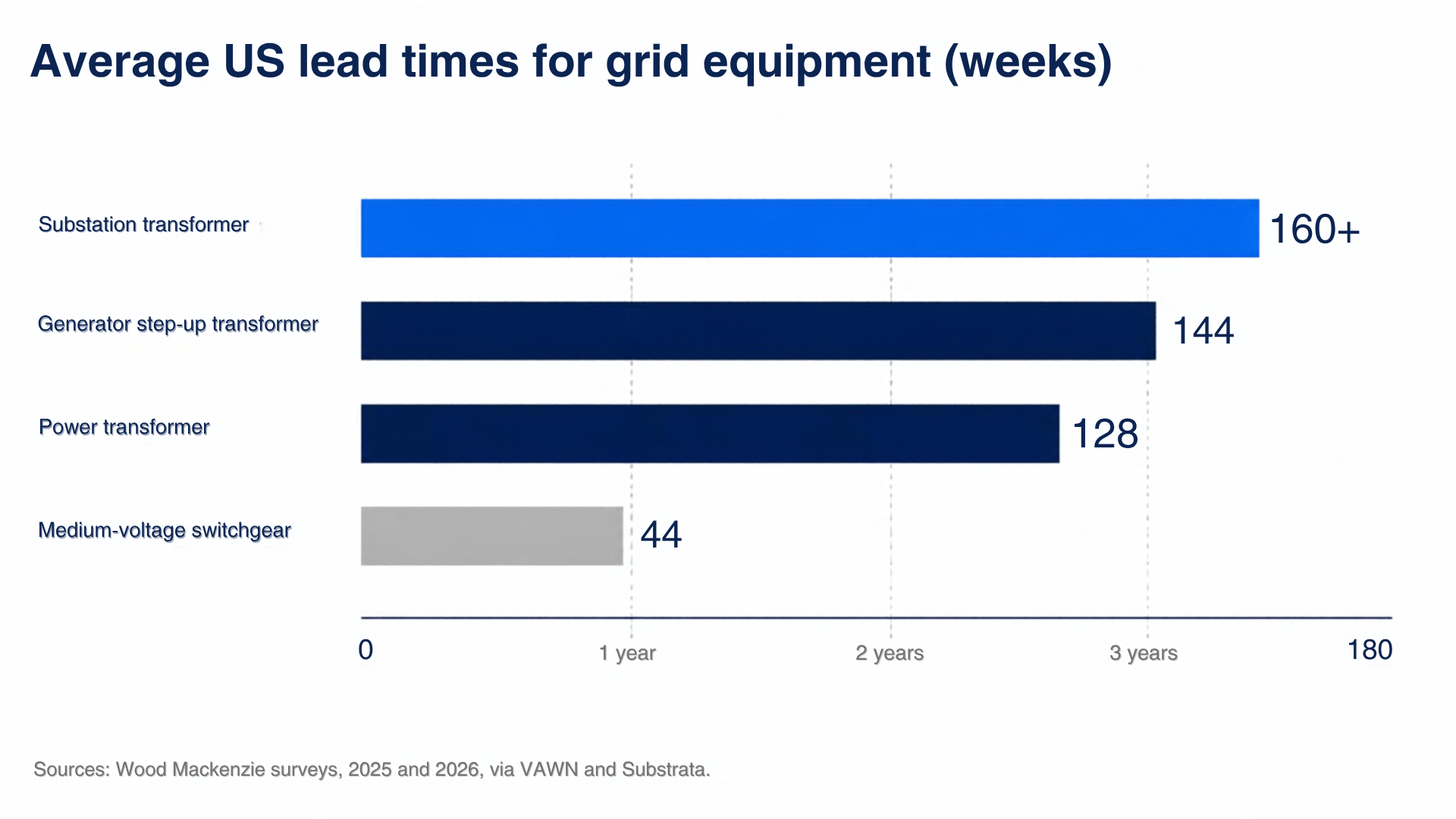
A US utility or data center developer that orders a substation transformer today should expect to wait more than three years. Wood Mackenzie's 2026 survey puts substation transformers above 160 weeks, and the largest high-voltage units can take up to four years. Generator step-up transformers, which connect power plants to the grid, average about 144 weeks. Medium-voltage switchgear averages about 44 weeks.
Manufacturers are responding with new factories. Hitachi Energy has announced more than $1 billion in US investment, including a large transformer plant in South Boston, Virginia, due in 2028. Siemens Energy has raised its commitment to a transformer factory in Charlotte, North Carolina, to $421 million. Eaton is adding a third US three-phase transformer site in South Carolina, due by 2027.
These lead times have changed how the electrical equipment business works. For most of the last decade, buyers chose suppliers on price and specification. Today they choose on delivery date, because a late transformer can hold up a project worth many times its cost. That shift moves pricing power to the manufacturers with capacity, and it creates new markets for suppliers who can deliver faster by other means.
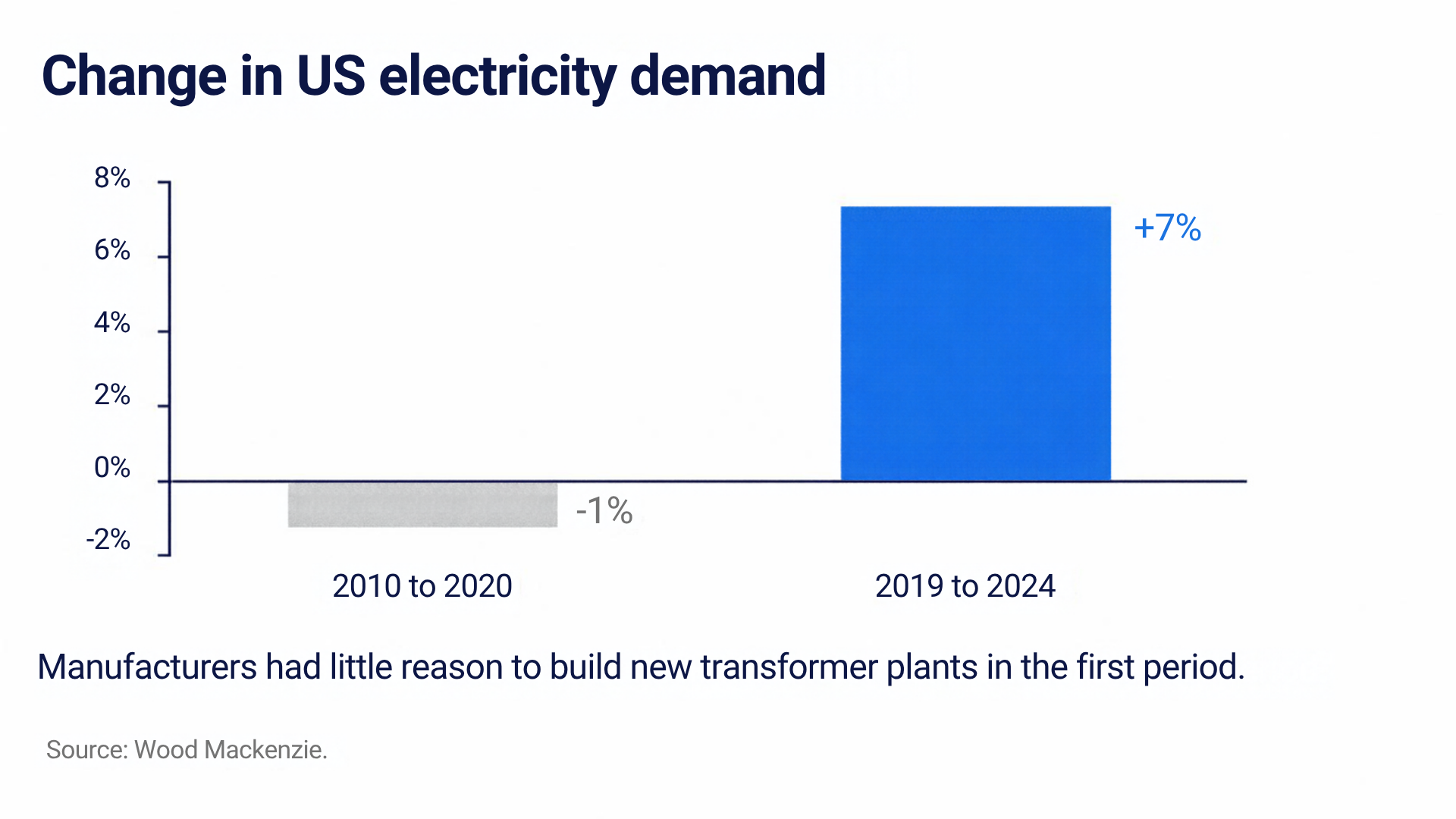
The shortage has a clear origin. US electricity demand fell about 1% between 2010 and 2020, according to Wood Mackenzie. Manufacturers had little reason to build new transformer plants when their customers were not growing. Then demand turned. It rose an estimated 7% between 2019 and 2024, driven by data centers and new factories.
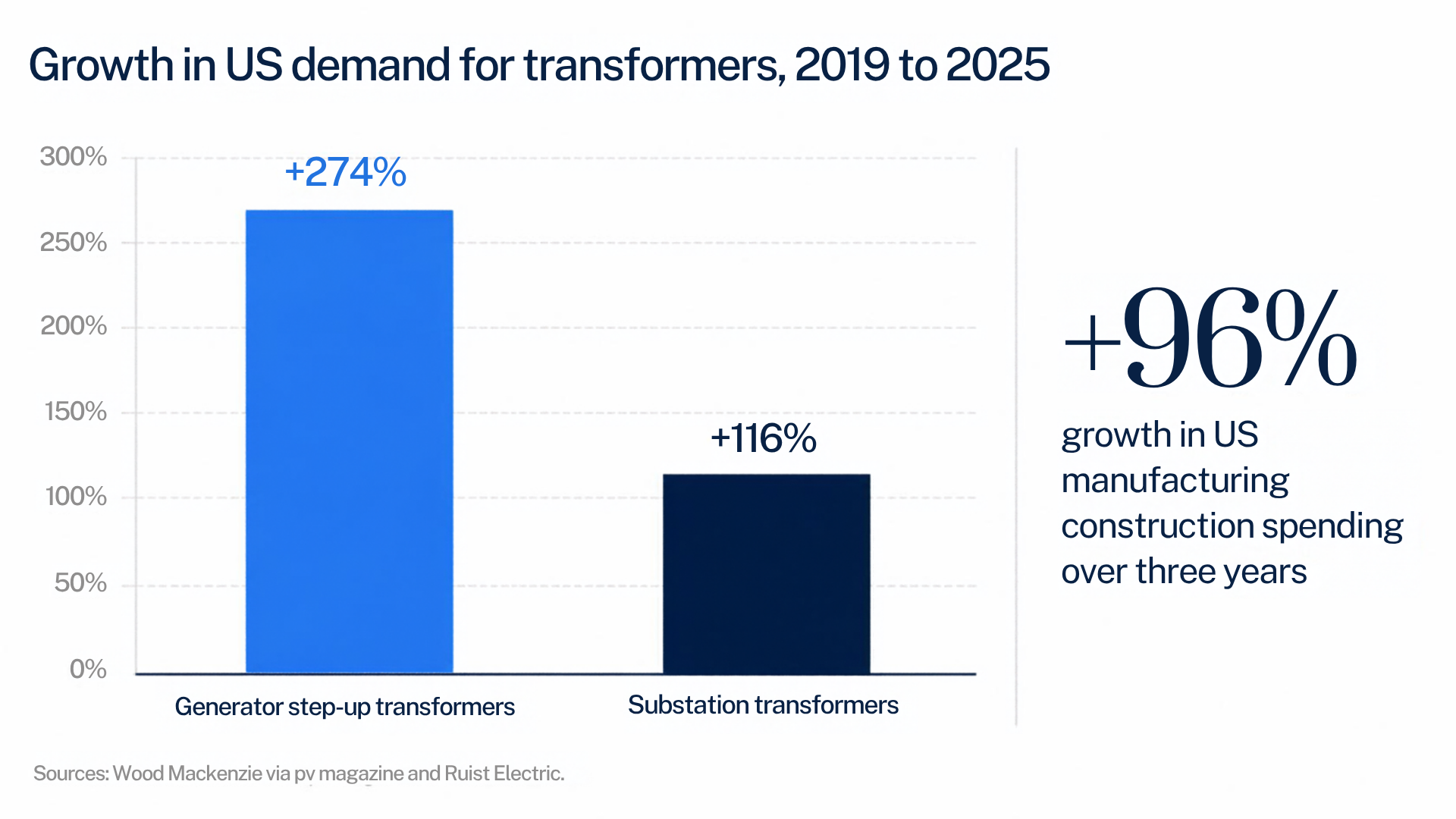
The rise in some categories has been extreme. Demand for generator step-up transformers grew 274% between 2019 and 2025, and demand for substation transformers grew 116%. Manufacturing construction spending rose 96% in three years. In 2025, Wood Mackenzie estimated that demand for step-up transformers exceeded supply by 100%.
A transformer plant takes years to build and staff, so supply could not follow quickly. Wood Mackenzie reports that labor shortages are one of the main barriers to raising output.
The economic effect is a change in what buyers value. A data center or a power plant cannot operate without its transformers and switchgear. If those arrive late, the whole project waits, and the owner loses revenue every month. For many projects, a few months of delay cost more than the equipment itself.
That makes a delivery slot more valuable than a discount. A buyer will pay a premium to a supplier that can deliver in two years rather than four. Prices have followed. Industry estimates put the price of medium-voltage switchgear about 50% above 2019 levels.
The large manufacturers have turned this into backlog. Siemens' Smart Infrastructure business reported an order backlog of €23.7 billion as of its third fiscal quarter of 2026, with orders running 1.25 times sales. A backlog that size gives a manufacturer revenue visibility for years and leaves it in a strong position in every new negotiation.
Buyers who cannot wait are finding other ways to get equipment. Some are refurbishing older transformers to keep them in service until new units arrive. Others are buying pre-engineered modular electrical systems, which some suppliers say can cut delivery to 26 to 40 weeks for certain configurations. Some are turning to smaller manufacturers or to suppliers outside the largest Western brands, accepting different specifications in exchange for earlier delivery.
Each of these is a market that barely mattered five years ago. Repair shops and second-tier manufacturers with open capacity now have customers who will pay for speed.
The shortage also changes how projects are built. Developers are ordering equipment before designs are final, and some are committing equity earlier to secure slots. Construction firms now describe electrical procurement as the main constraint on project timelines, ahead of financing and permitting.
The strongest objection is that the shortage is temporary. Nearly $2 billion has been directed toward new North American transformer production, with much of it due by 2028. Rystad Energy projects roughly 200 GVA of new transformer capacity coming online in 2026. Wood Mackenzie expects the gap between demand and supply for step-up transformers to narrow to below 10% by 2030.
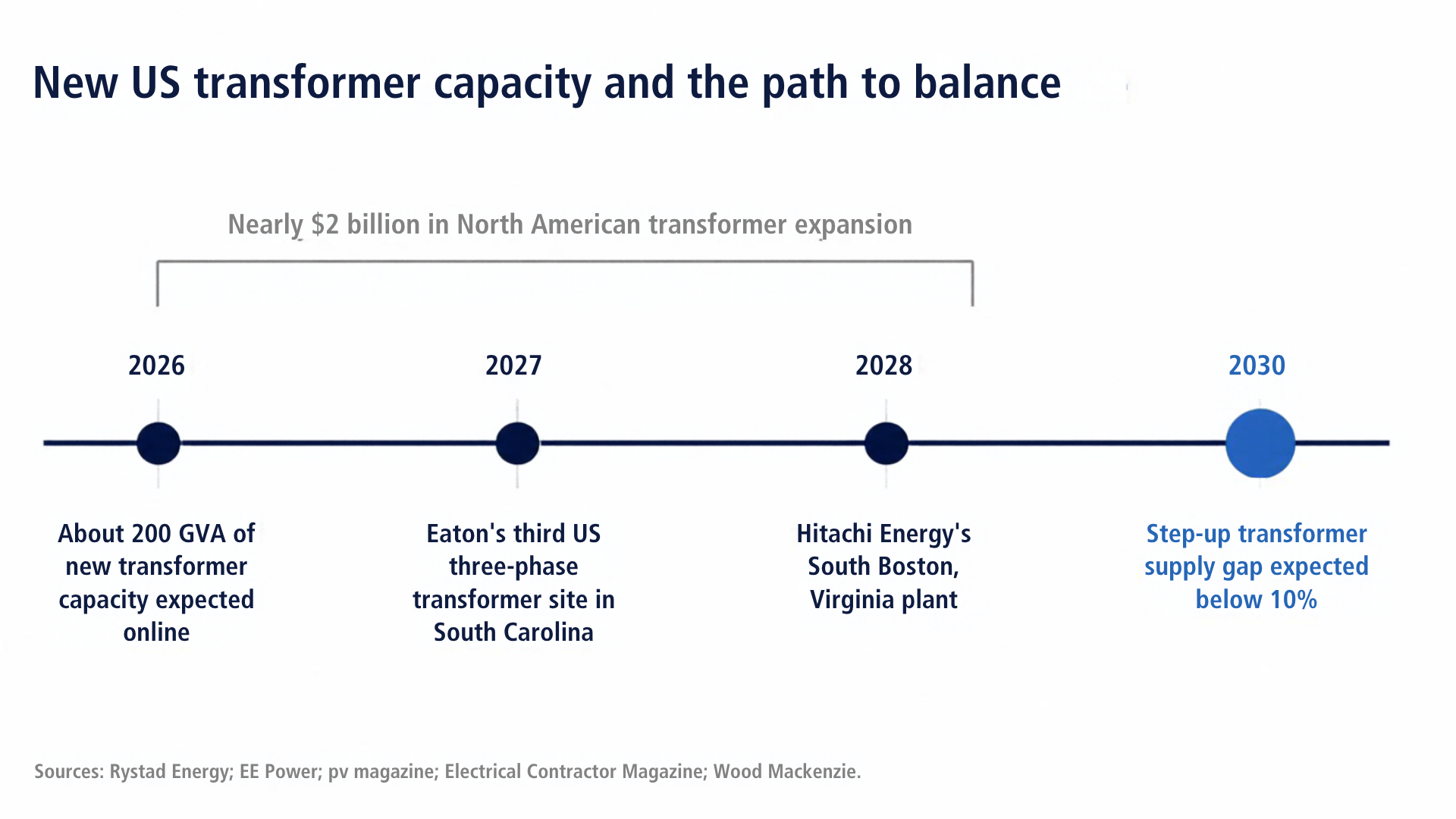
That outlook is likely correct, and it sets the timing of the opportunity. New plants sell first into existing backlogs, so the first years of new capacity will mostly shorten waiting lists. Labor remains scarce. For the next three to four years, the industry will still run short, and pricing power will stay with those who can deliver. After 2030, as supply catches up, delivery dates will matter less and price will matter more again.
The current market sorts the sector clearly.
Manufacturers with US capacity and full order books gain the most. They set prices and terms, and they can choose which customers to serve first. Their main risk is the end of the cycle, when new capacity arrives and buyers regain leverage.
Suppliers that offer speed by other routes gain as well. Modular assemblers and smaller manufacturers can win business from buyers who would never have considered them before.
Buyers without secured slots lose. Utilities and smaller data center projects compete with the largest buyers for the same capacity, and they often lose that contest. Their projects slip, and their costs rise while they wait.
For 10 years, the electrical equipment industry built for a market that was not growing. For the next several years, the companies that control delivery dates will set the terms for everyone who needs power.
For many projects, a few months of delay cost more than the equipment itself.
Sign up for our latest insights and firm announcements.
We respect your privacy and will not share your information.