
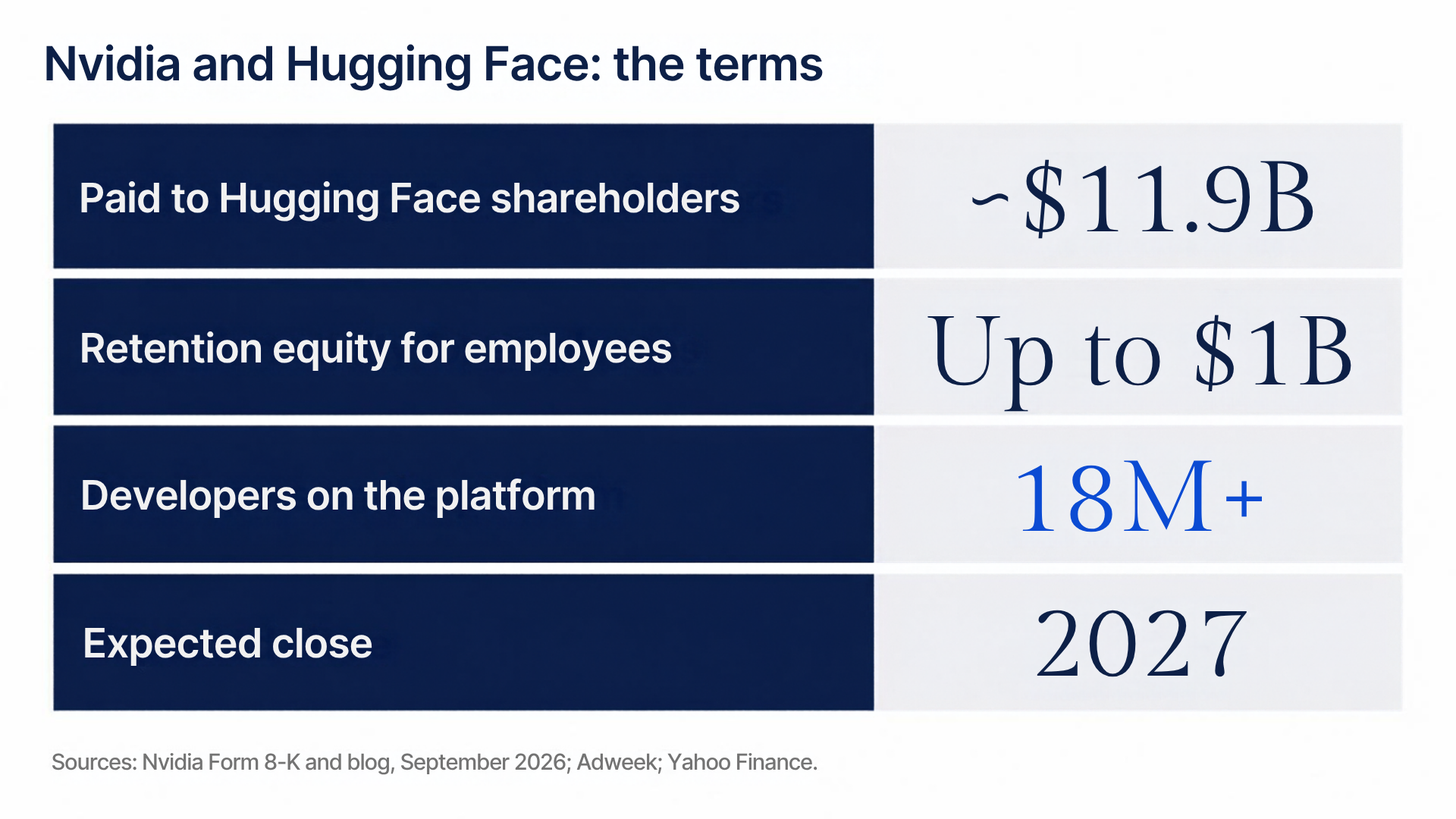
On September 3, Nvidia confirmed that it will buy Hugging Face for $12.93 billion. About $11.9 billion goes to shareholders, and up to $1 billion is set aside as retention equity for employees who join Nvidia. The deal is expected to close in 2027.
Hugging Face's annualized revenue is about $150 million, as first reported by The Information and repeated by TechCrunch. That puts the price at roughly 86 times revenue.
For most technology investors, a multiple like that would be impossible to justify. For Nvidia, it is a reasonable price for a position that no other buyer can use in the same way. The gap between those two views is the most useful lesson in the deal. A technology company's price has two layers: what the business has proven on its own, and what one particular buyer can do with it. Investors who pay for the second layer at entry are betting on a buyer who may never arrive.

Hugging Face is where much of the open-source AI world starts its work. The platform hosts about 3 million models and 1 million applications, used by more than 18 million developers. When a developer downloads an open model there, the next step is to run it, and that usually means Nvidia's chips, in the developer's own servers or in a cloud.
That makes Hugging Face valuable to Nvidia for reasons that do not appear in Hugging Face's revenue. A healthy open-source market gives customers an option outside the closed AI labs, and it keeps more of the market tied to the hardware Nvidia sells. Nvidia has said the platform will stay open, and it has committed in its filing to keep the platform consistent with its existing practices.
On its own, Hugging Face is a $150 million software business. Inside Nvidia, it is a way to influence which models get built and where they run.
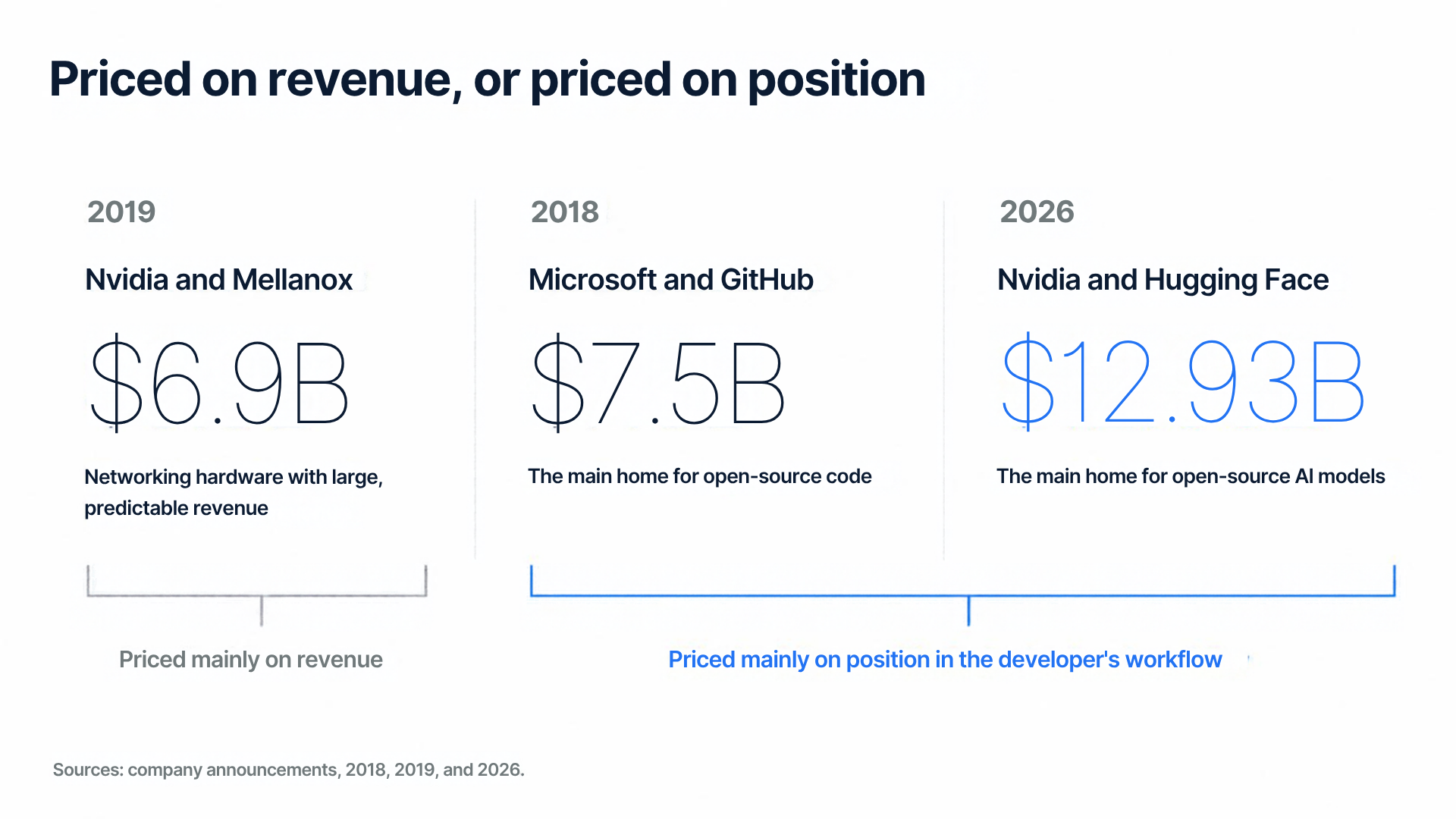
This kind of deal has a clear precedent. In 2018, Microsoft bought GitHub, the main home for open-source code, for $7.5 billion. Microsoft also promised to keep the platform open to all developers, including those who built on competing clouds. The price was far above what GitHub's revenue at the time could support on its own. Microsoft was buying a position at the start of the developer's workflow.
Nvidia's own history shows the contrast. In 2019, it agreed to buy Mellanox for about $6.9 billion. Mellanox sold networking hardware with large and predictable revenue, and the price was a modest multiple of its sales. That deal was priced mostly on the first layer. The Hugging Face deal is priced almost entirely on the second.
The first layer is standalone value. It rests on paying customers, revenue growth, margins, and retention. Hugging Face has real strength here. Reports say it doubled its paying subscribers in the first half of 2026 and was close to profitability. Any investor can underwrite this layer, because it depends on the business alone.
The second layer is strategic value. It is what a specific buyer gains by owning the asset, and it depends on that buyer's other businesses. Only a few companies can capture it, and they pay for it only when they need it and when other buyers are competing. Business Insider reported in August that Hugging Face was fielding interest from several parties. That competition helped set the final price.
The strongest objection is that this is how technology investing works. Hugging Face raised money in 2023 at a $4.5 billion valuation. Investors in that round have nearly tripled their money in three years, largely because a strategic buyer paid for something the revenue could not justify.
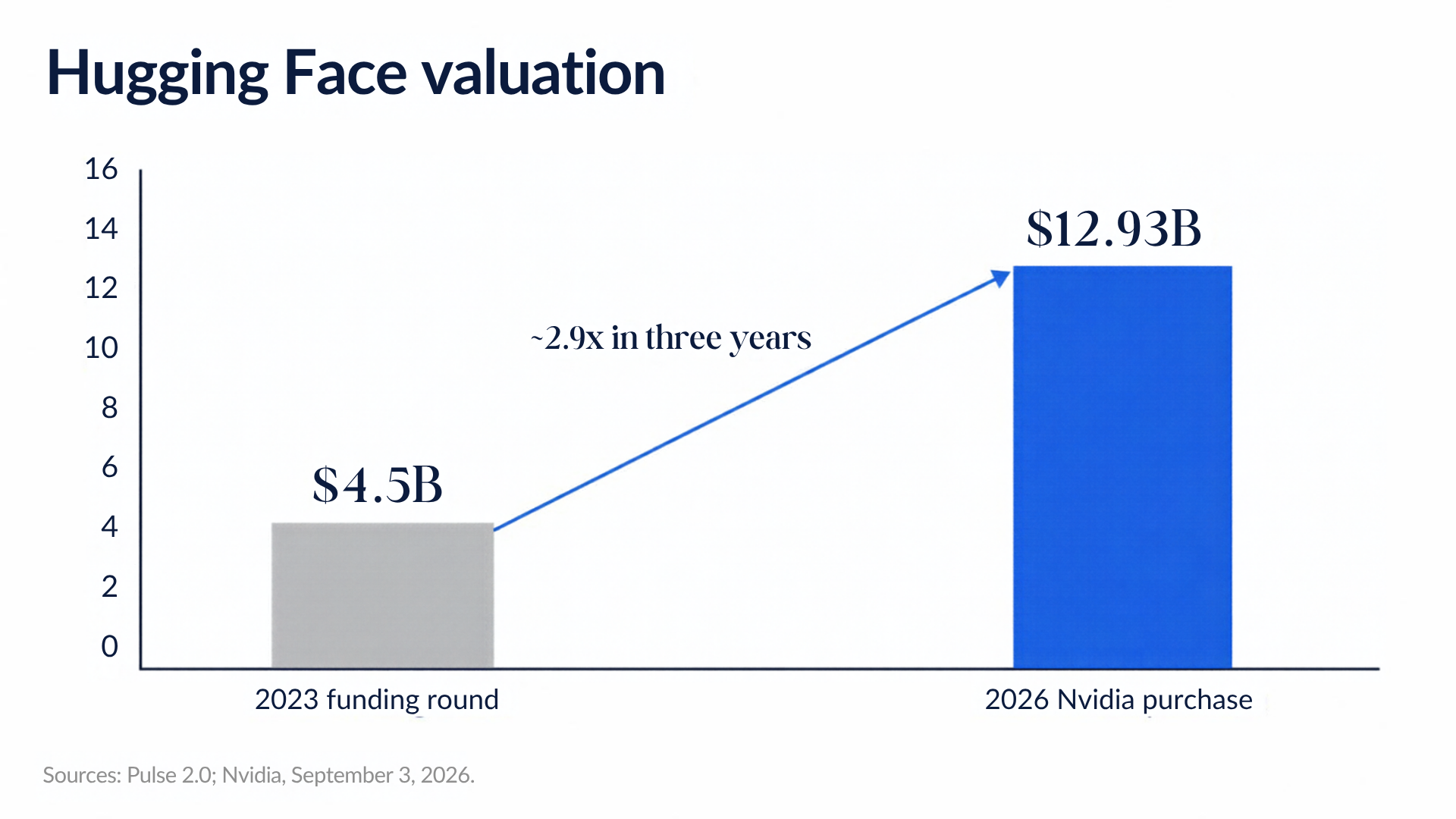
That outcome is real, and it should be read carefully. It depended on a buyer with a clear reason to own the platform, at a moment when open-source AI mattered to that buyer's core business, with other parties competing for the asset. One good outcome does not make the second layer a reliable basis for an entry price.
Even the buyer faces risks in paying for strategic value. Nvidia's filing lists several. Governments may adopt rules that restrict or disadvantage open-source models. Many of the most popular open models originated in China, which adds political exposure. The deal also needs to close, and closing is not expected until 2027.
The commitments that make the deal acceptable also limit it. A platform that must stay open and neutral cannot be steered too hard toward its owner's products, or developers will leave. The strategic value depends on that balance holding.
The deal suggests two practical rules for investors in technology companies.
First, set the entry price on standalone value. Revenue, growth, margins, and retention should support the price without help from a future buyer. Strategic value then becomes upside, and an investment that works without it is protected if no buyer appears.
Second, count the buyers. A strategic premium needs at least two companies with a real reason to own the asset. If only one company could use it, that company sets the price, and it has little reason to pay a premium.
It also helps to know which positions create strategic value. The most valuable ones sit where decisions are made, such as where developers choose a model or a framework. Assets in those positions can earn a premium even with modest revenue, but only if they stay neutral enough to keep their users.
Nvidia can afford to pay 86 times revenue because it captures the value elsewhere in its business. Most investors do not have that option, so they should pay for what the business has already proven.
Investors who pay for the second layer at entry are betting on a buyer who may never arrive.
Sign up for our latest insights and firm announcements.
We respect your privacy and will not share your information.