
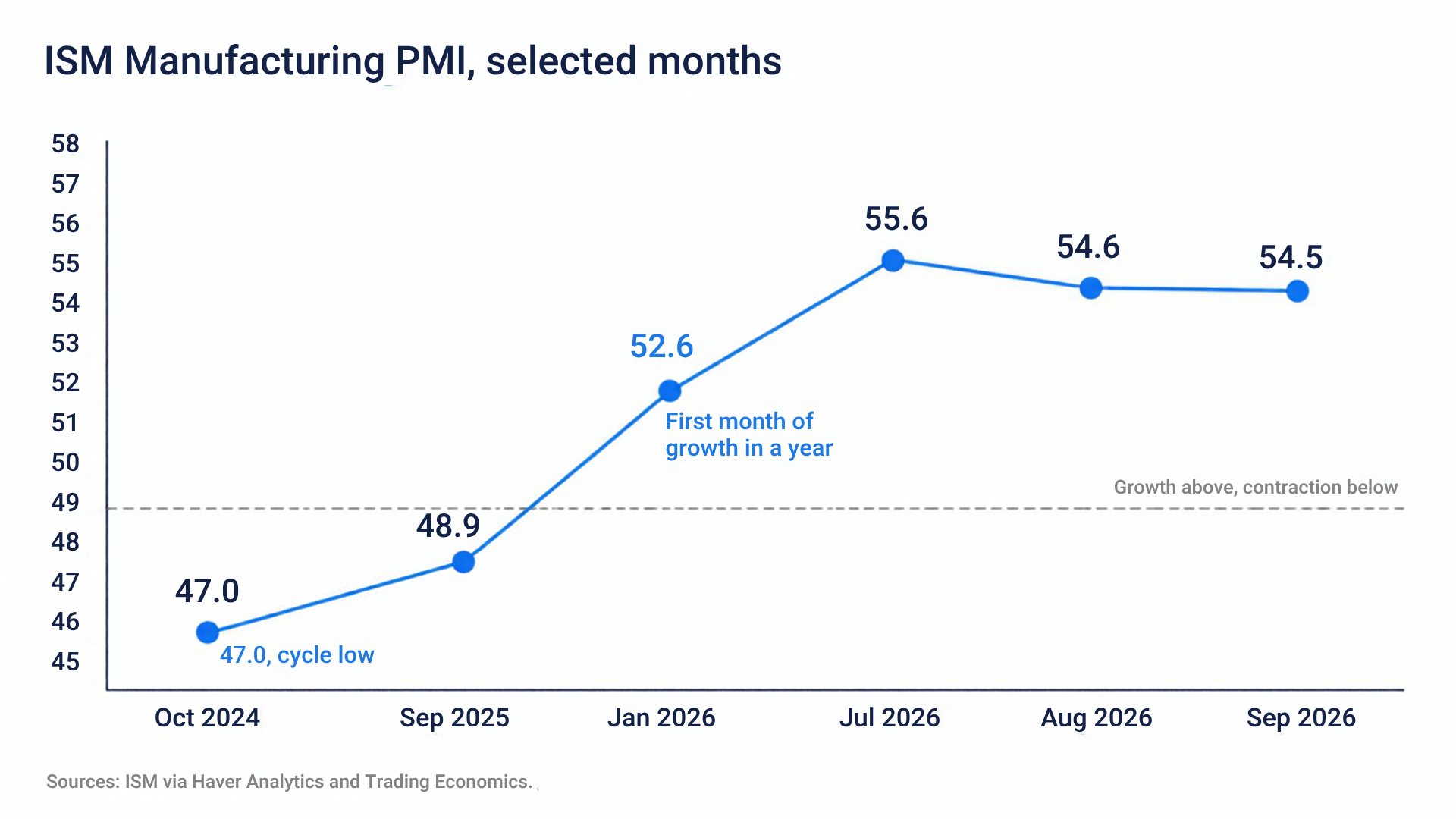
On October 1, the Institute for Supply Management reported that its US Manufacturing PMI was 54.5 in September, down slightly from 54.6 in August and below the 55.0 that analysts expected. It was the ninth month in a row above 50, the line between growth and contraction. S&P Global's final September PMI came in at 55.9, the strongest reading since May 2022.
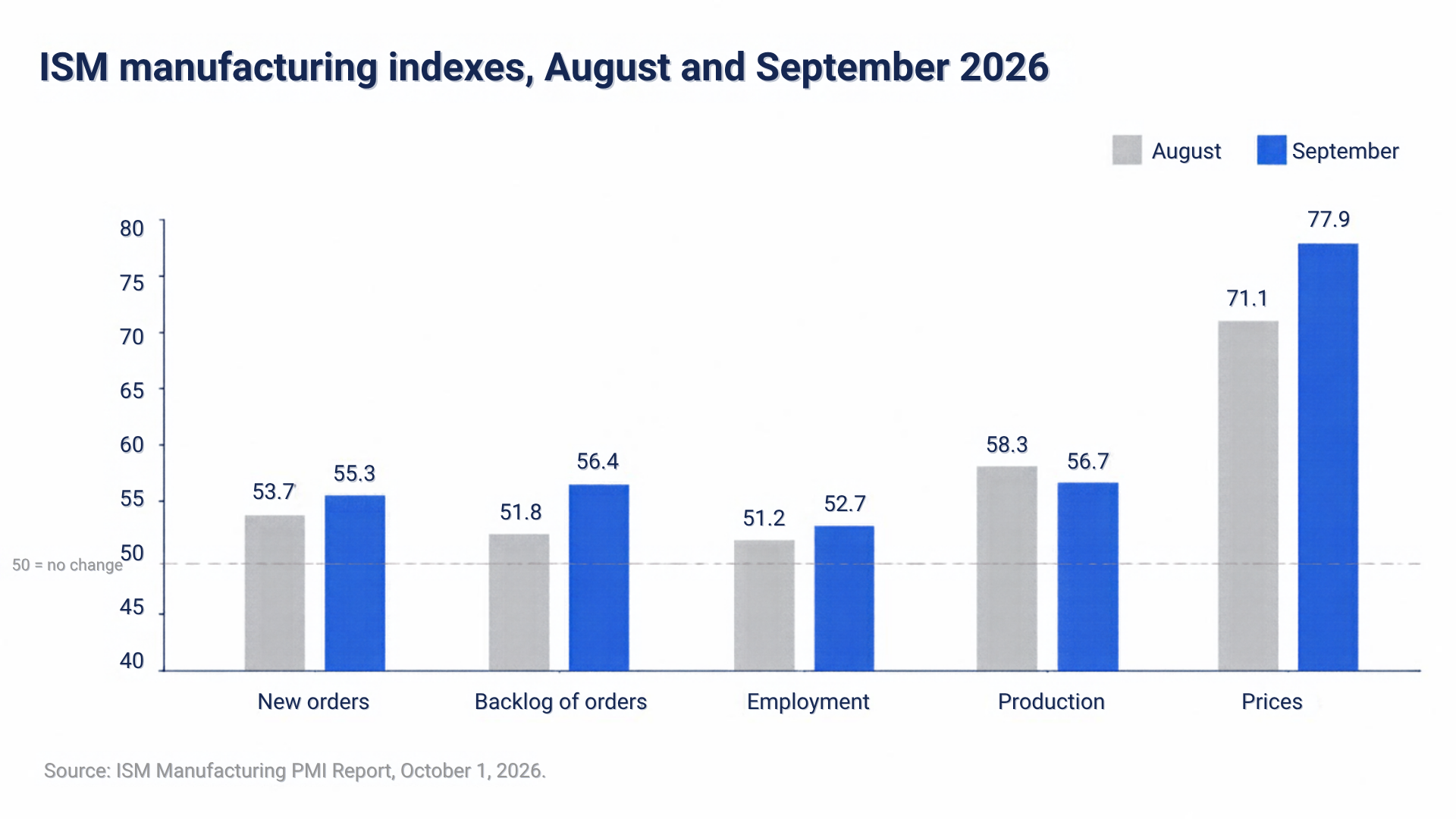
The headline barely moved, while several of the measures beneath it changed sharply. New orders and factory hiring both grew faster than in August, and the backlog of unfilled work rose. Prices rose too. The ISM Prices Index jumped 6.8 points to 77.9, its highest level since May, when the war with Iran began.
We read the report as a sign that US manufacturing demand is real and spreading, and that cost pressure is rising alongside it. The combination favors manufacturers that can pass costs on to customers. It also sets up a harder test for margins and interest rates in 2027.
The strongest signals in the report sit below the headline. The New Orders Index rose to 55.3 from 53.7, the ninth month of growth after four months of contraction. The Backlog of Orders Index rose 4.6 points to 56.4, which means factories are taking in work faster than they can finish it. Twelve of 18 manufacturing industries reported growth.
Hiring has turned. The Employment Index rose to 52.7 from 51.2, its third straight month of growth after 33 months of contraction. Manufacturers do not add staff until they believe demand will last, so this is one of the more reliable signals in the report.
The recovery looks larger when set against the recent past. A year ago, in September 2025, the ISM PMI stood at 48.9, in contraction. Its low point in this cycle was 47.0 in October 2024. January 2026 brought the first month of growth in a year.
The cost side has moved faster than demand. In September, 58.6% of purchasing managers reported higher prices, up from 46.2% in August, and only 2.8% reported lower prices. The Prices Index has now shown rising prices for 24 months in a row.
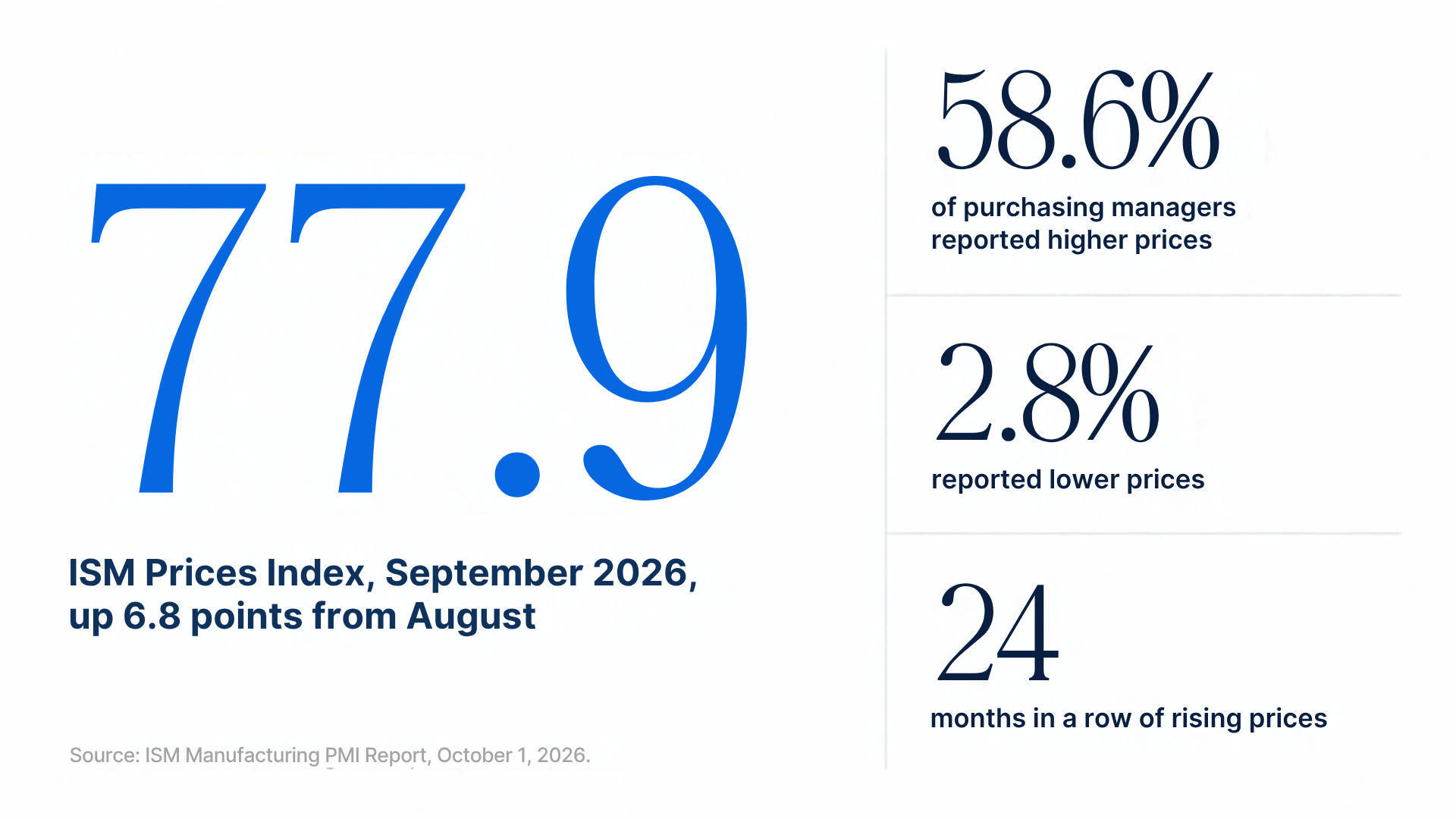
The cause is a mix of conflict and policy. Input costs rose when the war with Iran began in the spring, and tariffs have added to the pressure on imported materials. A Prices Index near 78 is high by any historical standard.
For manufacturers, the question is who absorbs those costs. A company with strong demand and a full backlog can raise its prices. A company that sells into a market with weak demand cannot, and its margin narrows.
One detail in the report supports further orders. ISM described customers' inventories as too low, while manufacturers' own stocks of raw materials contracted. When customers run short, they order more to rebuild stocks. That restocking can keep new orders strong for several months, even if final demand slows.
It also means some of today's orders are timing. Buyers who expect higher prices or longer delivery times order earlier. That pulls demand forward from future months.
The last strong factory cycle offers a useful comparison. The ISM PMI peaked at 63.8 in March 2021, as demand rebounded after the pandemic and supply chains struggled to keep up. Input prices rose sharply that year. The Federal Reserve then raised interest rates through 2022, and the PMI fell below 50 by the end of that year.
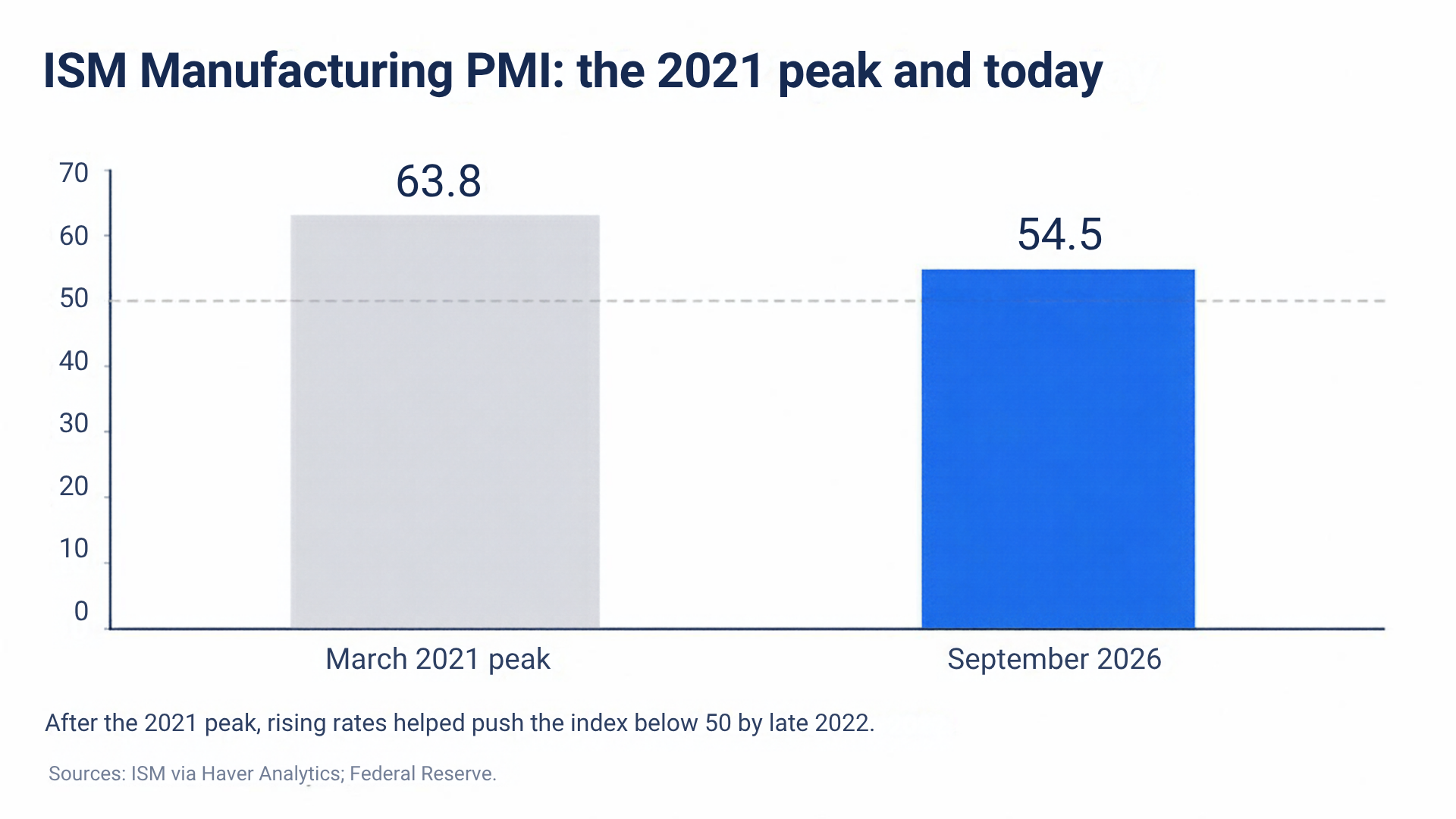
The current cycle is much milder. The PMI sits far below its 2021 peak, and supply chains are in better shape. The pattern is still worth watching. When input costs rise faster than demand, they eventually draw a response from the central bank, and higher rates slow the orders that drove the recovery.
The strongest objection is that the PMI has now fallen two months in a row, from 55.6 in July to 54.5 in September, and missed forecasts. Production also slowed, with its index falling to 56.7 from 58.3.
The slip is real, and it should be read with the rest of the report. Production slowed while orders, backlog, and hiring all rose. That pattern usually signals a sector that is falling behind demand. The measures that look ahead point up, and the measure that looks at current output points slightly down.
The September report describes a recovery with momentum and a cost problem. We expect two things to follow.
Manufacturers with pricing power will widen the gap with those without it. Companies with full backlogs and specialized products can pass on higher input costs. Companies in competitive, price-sensitive markets will see margins narrow first.
Interest rate expectations will become a larger factor for industrial companies. A Prices Index near 78 complicates any plan by the Federal Reserve to cut rates. That matters most for capital-intensive manufacturers and for their customers, who finance equipment purchases.
The restocking cycle will also end at some point. When customers' inventories return to normal, part of today's order strength will fade. The companies best placed for that moment are the ones whose orders come from new projects, such as data centers and defense programs.
US manufacturing has spent most of the last three years waiting for demand to return. It has returned. The next test is whether manufacturers can keep their margins while the cost of everything they buy rises with it.
Manufacturers do not add staff until they believe demand will last.
Sign up for our latest insights and firm announcements.
We respect your privacy and will not share your information.