
On September 25, the Pentagon awarded Raytheon a multiyear contract worth up to $20.7 billion to build AIM-120 AMRAAM air-to-air missiles. The contract runs five years, with two option years, and it aims to raise production to at least 1,900 missiles a year. That is almost six times the previous record AMRAAM award of $3.5 billion in July 2025. Raytheon had already nearly doubled AMRAAM output in 2025 compared with 2024.
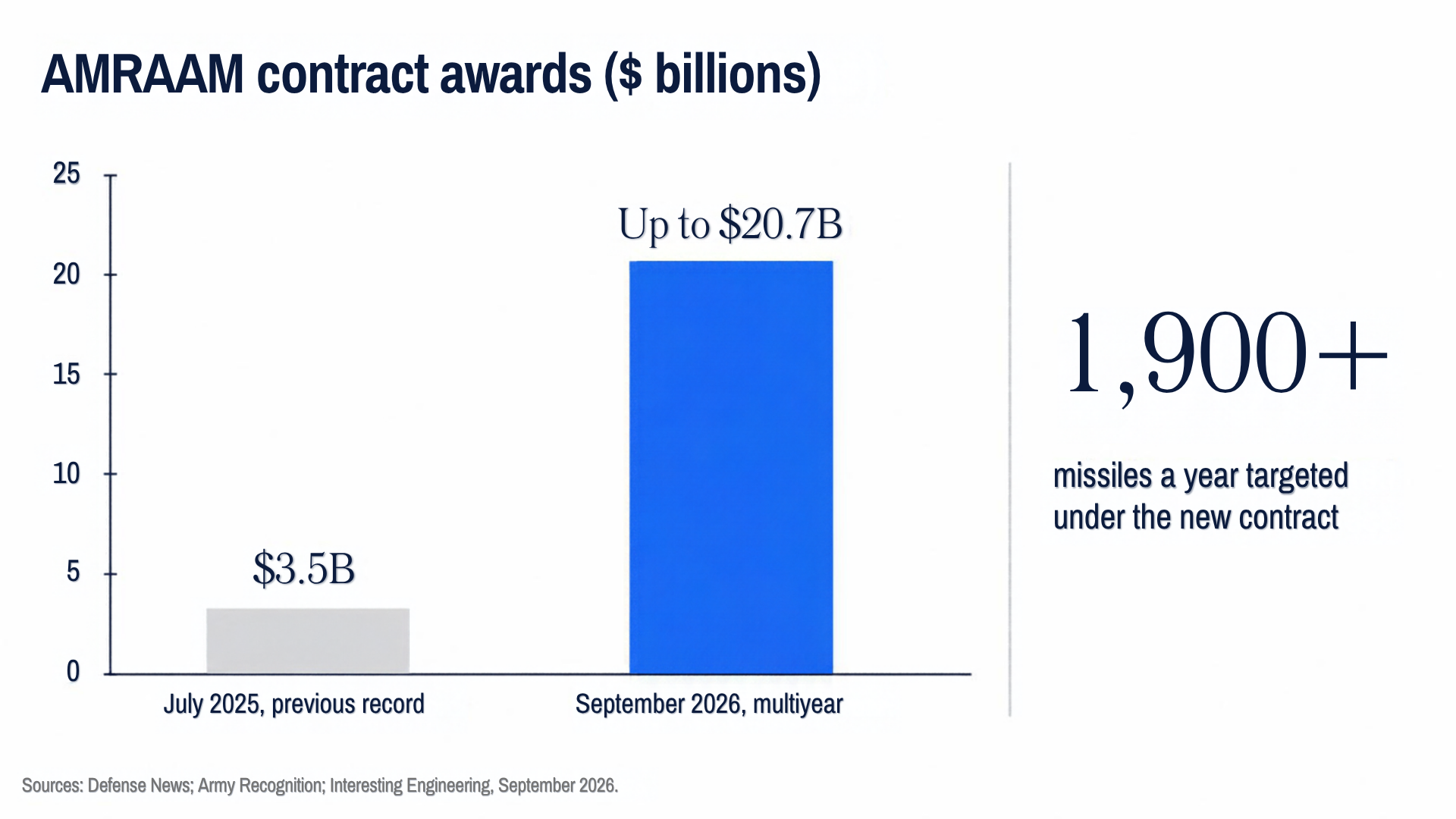
A multiyear contract gives the prime contractor what it needs to invest: a commitment to buy at a set rate for several years. The harder question is whether the hundreds of smaller companies that supply the missile's parts can grow at the same pace. RTX says hundreds of small and midsize suppliers already support its operations. Many of them now face a production target far above anything they have built for.
The contract changes where the constraint sits. Before it, the limit on AMRAAM output was the Pentagon's willingness to commit. After it, the limit is the capacity of the supply chain beneath Raytheon. That shift moves economic power toward the suppliers that are hardest to replace, and it changes how the Pentagon itself buys.
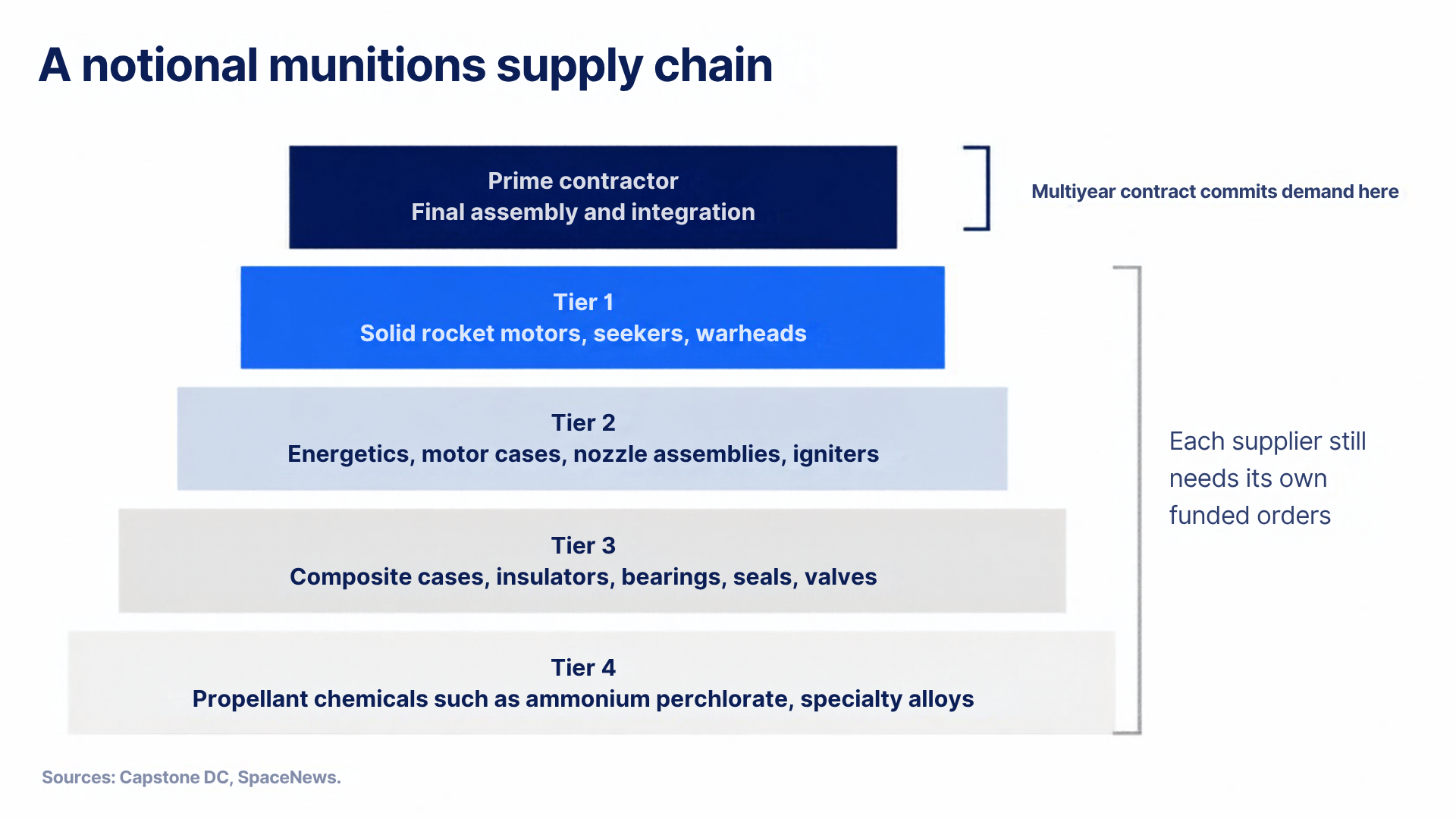
A modern missile is assembled from subsystems made by a layered network of suppliers. A notional munitions supply chain runs from Tier 1 suppliers of solid rocket motors, seekers, and warheads, down to Tier 4 suppliers of specialty chemicals and alloys.
That network has narrowed over time. According to a 2017 Congressional Research Service report, the number of major solid rocket motor suppliers fell from six in 1995 to two or three. Analysts tracking the sub-tier have reported larger declines among the smaller firms that supply motor cases, nozzles, igniters, and propellant ingredients. Ammonium perchlorate, a key propellant ingredient, has long been described as a single point of failure because so little of it is made domestically.
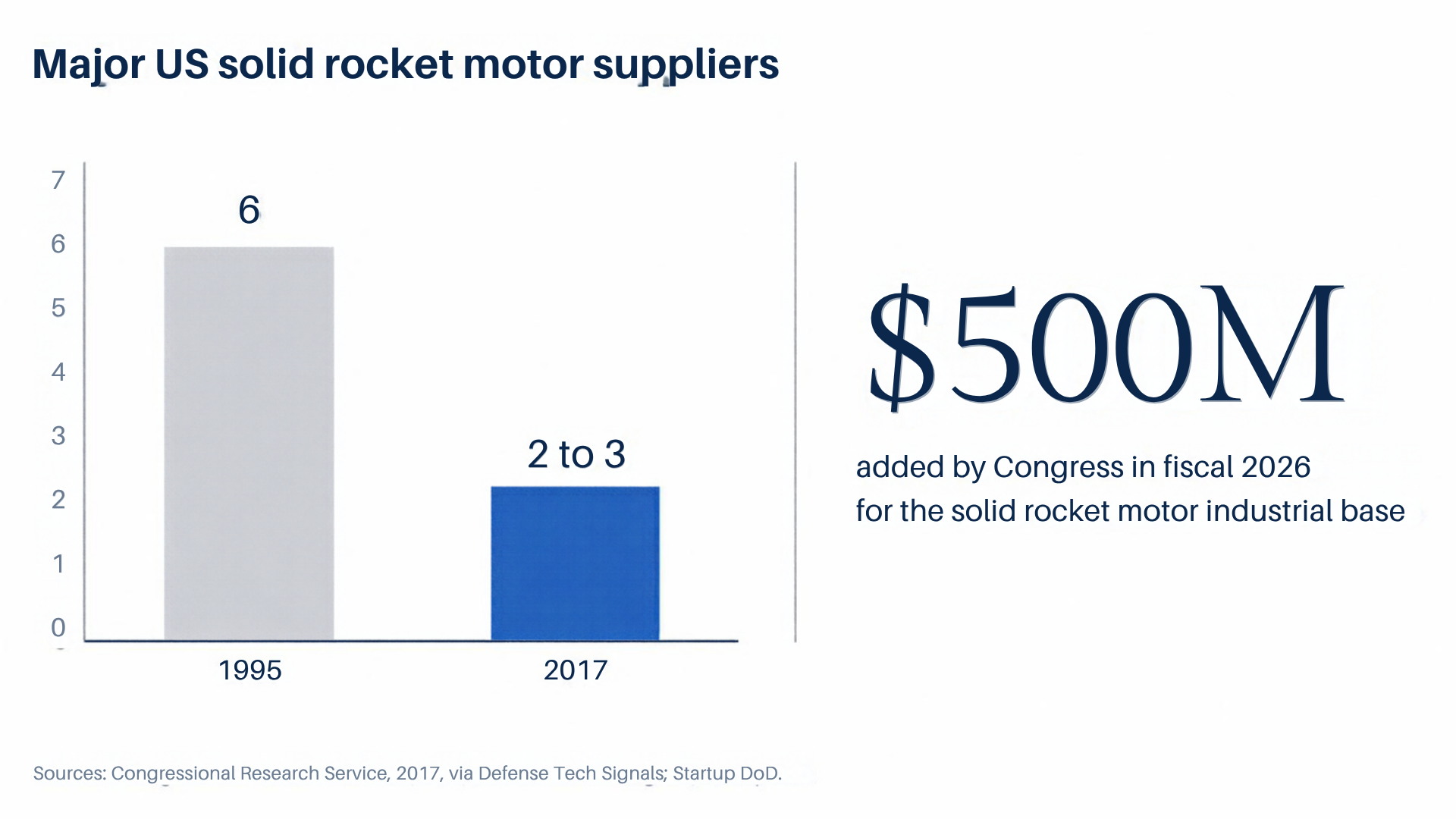
Congress has recognized the problem. The fiscal 2026 defense budget included $500 million for the solid rocket motor industrial base, aimed at the propulsion bottleneck that the Pentagon's own assessments have identified. Seekers and guidance systems are also widely described as among the most constrained components.
The AMRAAM contract gives Raytheon a five-year view of demand. That view does not pass automatically to its suppliers. As a Northrop Grumman executive told SpaceNews this year, the Pentagon's multiyear authorities are specific to each program, and they do not cover the supply chain as a whole. Expanding motor production requires investment in raw materials, nozzles, insulation, propellant ingredients, and workforce.
There is a second gap. Multiyear programs still depend on annual appropriations from Congress, and Congress has not yet fully funded this contract. Industry executives have warned that contractors may hold off on large investments in parts and factories until lawmakers act. The government began the new fiscal year on October 1 under a stopgap that bars new multiyear contracts, which shows how quickly the funding calendar can intervene.
A small supplier that makes one machined housing cannot buy a new machine against a contract ceiling held by its customer. It needs its own funded order, with a quantity and a delivery date.
The Army's effort to increase 155mm artillery shell production offers a useful comparison. Despite a $6 billion investment aimed at reaching 100,000 shells a month, production stood at about 56,000 a month as of February 2026, according to The National Interest. The money arrived well before the output did.
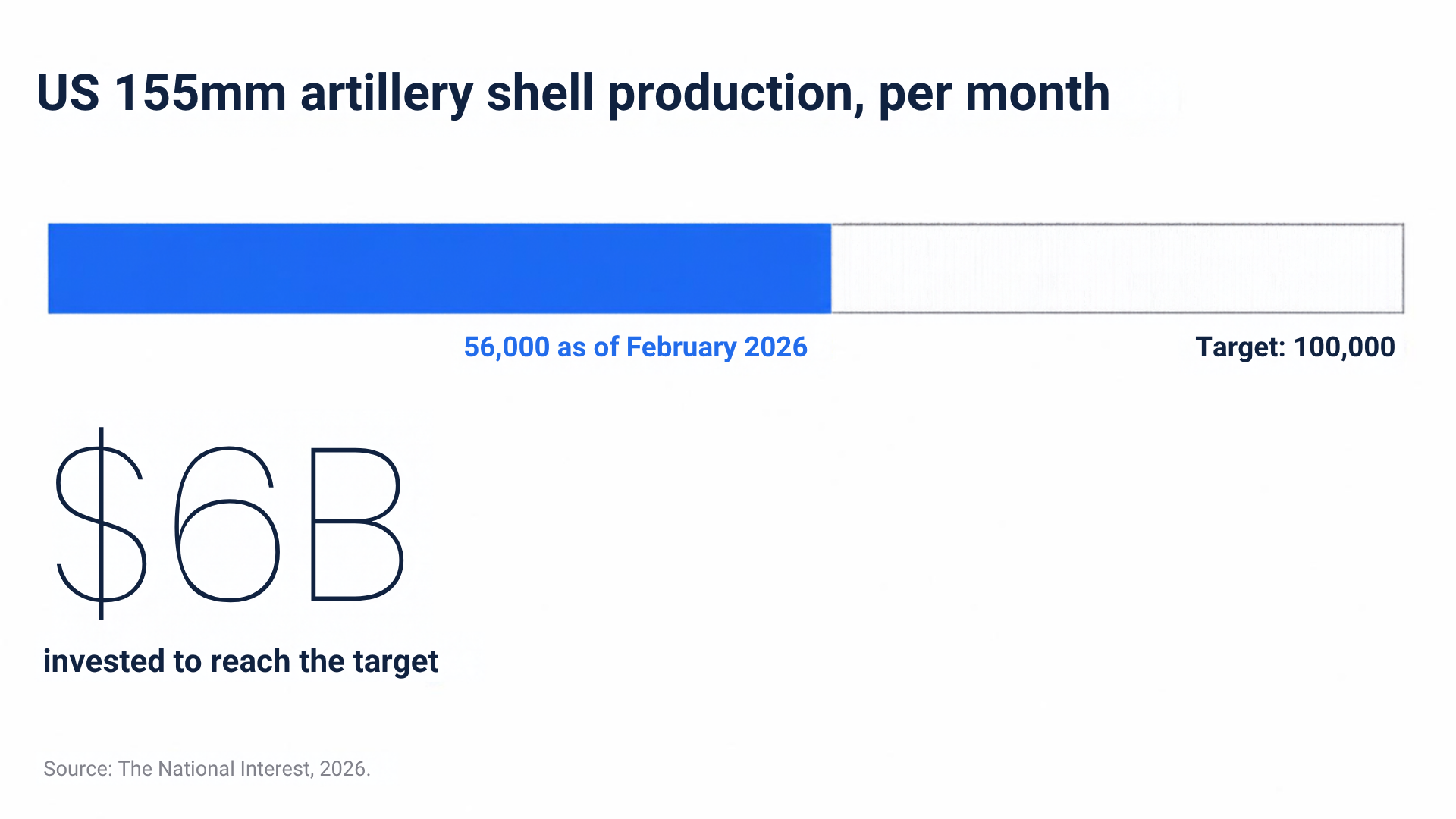
The shell program shows that funding at the top of a supply chain takes years to become capacity at the bottom. New production lines need equipment and certified processes. Each of those steps has its own lead time, and the slowest supplier sets the pace for everyone.
The strongest objection is that large primes manage their supply chains for a living. Raytheon has said it continues to invest in its workforce, technology, supply chain, and facilities. Northrop Grumman says it has committed more than $2 billion across its munitions and solid rocket motor businesses. With a five-year contract in hand, the prime can fund suppliers directly.
Primes will do much of this, and the contract makes it easier. Primes cannot create suppliers that do not exist, though, and they cannot speed up chemical plants or qualification tests by contract alone. Where only one or two firms make a part, the prime is a customer with limited bargaining power, and the bottleneck stays where it is until new capacity arrives.
The AMRAAM contract and others like it are changing the sector in several ways.
Pricing power is moving down the chain. A sole-source supplier of a motor component or a seeker part now holds a position that the prime and the Pentagon both need. Those suppliers can seek longer contracts and better prices.
The Pentagon is starting to buy below the prime. Reports earlier this year described an agreement in which the department contracted directly with a component supplier rather than going through a prime contractor. The $500 million solid rocket motor line is another form of direct support for the sub-tier. Both point toward a procurement model that funds critical suppliers directly.
New entrants have an opening. Companies developing composite motor cases and additively manufactured motors are targeting the exact constraints that limit existing producers. The demand signal is now large and long enough for them to attract capital.
For most of the period since the Cold War, the munitions industry was shaped by low and uncertain demand. The AMRAAM contract signals the opposite. The suppliers that benefit most will be the ones that sit at the narrowest points of the chain.
Funding at the top of a supply chain takes years to become capacity at the bottom.
Sign up for our latest insights and firm announcements.
We respect your privacy and will not share your information.