
On September 29, Nebraska released the first data from a Medicaid work requirement under the new federal law. Between May and August, the state denied 14% of the new applicants who were subject to the rule. Of the people who came up for renewal, 7% lost their coverage.
The state's own data show that most of them lost it over paperwork.

Nebraska went first by choice. Montana followed in July, and Iowa starts in December. By January 1, 2027, 43 states and the District of Columbia must have the rule in place.

Most reporting on the policy follows the enrollee. For investors, the more important question is what happens when that person next needs care. A person who loses Medicaid still gets sick and still comes to the emergency department, and the hospital must treat them. The rule moves part of the cost of that visit from the federal budget onto the hospital's books. Rural hospitals will carry the largest share of that cost, and they have the least room to absorb it. We expect many of them to move services into regional hubs, and that shift will decide where rural care capacity sits through 2030.
Nebraska processed 4,089 applications that needed a work requirement decision between May and August. It processed 7,280 renewals between July and mid-August. At least 1,090 people lost coverage or were denied it. A Georgetown University analysis of the state's figures found that red tape caused the vast majority of those losses. In most cases, a document did not arrive or a deadline passed.
The people who kept their coverage tell the same story from the other side. Of those who passed, 61% were exempt, mainly as parents or as medically frail. In practice, the rule sorted people by their ability to prove an exemption.
None of this is new. In June 2018, Arkansas became the first state to require work for Medicaid. By the time a federal judge stopped the policy in April 2019, 18,000 adults had lost coverage, and most of them had never submitted a single report. Harvard researchers followed the state for 18 months and found no rise in employment. More than 95% of the people the rule targeted already met it or should have been exempt.

The people who lost coverage paid for it in other ways. Half reported serious problems paying medical debt, and 56% delayed care because of cost.
Two states, eight years apart, produced the same pattern. The new federal rule adds one more factor. It requires eligibility checks every six months instead of every twelve, so each enrollee must clear the paperwork twice as often.
When a patient loses Medicaid, the hospital loses the payment and keeps the patient. In rural areas, that loss is large. At the median, Medicaid makes up nearly 10% of a rural hospital's net revenue, and it pays for nearly half of all rural births. Many rural hospitals already lose money on patient care before any cut arrives.
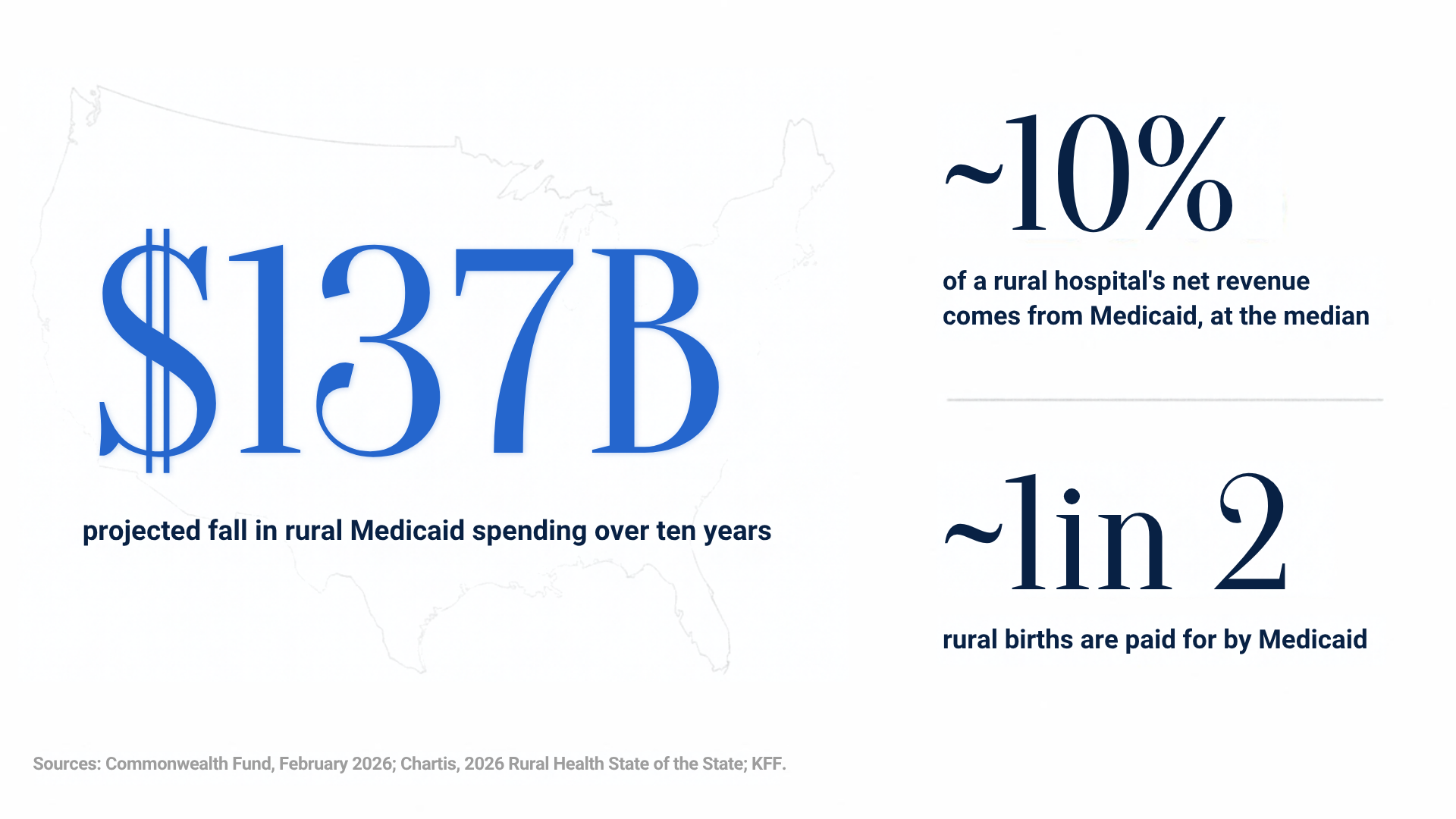
The national figures set the scale. The Congressional Budget Office expects the work requirement to cost 5.2 million people their Medicaid coverage by 2034 and to add 4.8 million to the uninsured. The Commonwealth Fund projects that Medicaid spending in rural areas will fall by $137 billion over ten years.
Hospitals have not waited for January. In April, Valley Health in Virginia trimmed services, and INTEGRIS Health planned clinic closures across Oklahoma after projecting a $130 million funding loss. Both cited the federal cuts.
The best evidence for what comes next is what happened when coverage moved the other way. A 2018 study in Health Affairs linked the Affordable Care Act's Medicaid expansion to stronger hospital finances and far fewer closures, especially in rural markets. The authors estimated that about half of the closures in states that did not expand could have been prevented. They traced the effect to a simple swap: patients who used to arrive uninsured now arrived with coverage, and the hospital got paid.
The same authors warned that cutting coverage would raise the risk of closure, most of all in rural areas. The work requirement removes coverage from the same group of adults whose enrollment helped rural hospitals stay open after 2014.
The strongest objection to this view is the federal response. Congress created a $50 billion rural health fund alongside the cuts. Some readers will also point out that 93% of Nebraska's renewals succeeded.
Both points deserve weight, and neither changes the direction. CMS limits the share of the rural fund that can go to hospitals or patient care to 15%. The fund pays for new ways to deliver care, such as telehealth and regional networks. Those programs help a rural system reorganize, and in practice they will speed the move toward regional hubs.
The 93% figure also hides how the losses build. A 7% loss at each renewal, repeated twice a year, compounds. A 14% denial rate at application keeps new enrollees out, so the program shrinks through attrition even when no one is removed. At a rural hospital with a thin margin, a few points of payer mix decide whether a unit stays open.
Health systems will cut the services that lose the most money first. Labor and delivery and behavioral health depend most on Medicaid and earn the least. Analysts expect some specialty care to move from rural facilities to regional ones, even where the local hospital stays open.
For investors, this changes where rural healthcare value sits. The regional hub will need more beds and outpatient space to take the new volume. The towns around it will need patient transport and telehealth links. Hospitals will also need staff who help patients keep their coverage, because every failed renewal becomes unpaid care.
When we look at a healthcare business in this market, we start with the county map. We ask what share of its patients rely on Medicaid and how far they live from the nearest regional hub. A provider positioned at the hub, or on the routes that feed it, stands to gain volume as the smaller sites consolidate.
Nebraska's numbers suggest the rule mainly measures whether paperwork arrives on time. For rural hospitals, it will measure how much unpaid care their books can carry.
One detail from Nebraska stays with us. In June, the state's association of community health centers said it had not helped a single person enroll in Medicaid since the rule began in May.
Sign up for our latest insights and firm announcements.
We respect your privacy and will not share your information.