
On September 23, Zendesk's chief executive told a conference in Amsterdam that seats are dead. He said Zendesk will drop seat pricing across its business, with announcements due in three to six months. He also warned that software companies still selling seats in two or three years will struggle.
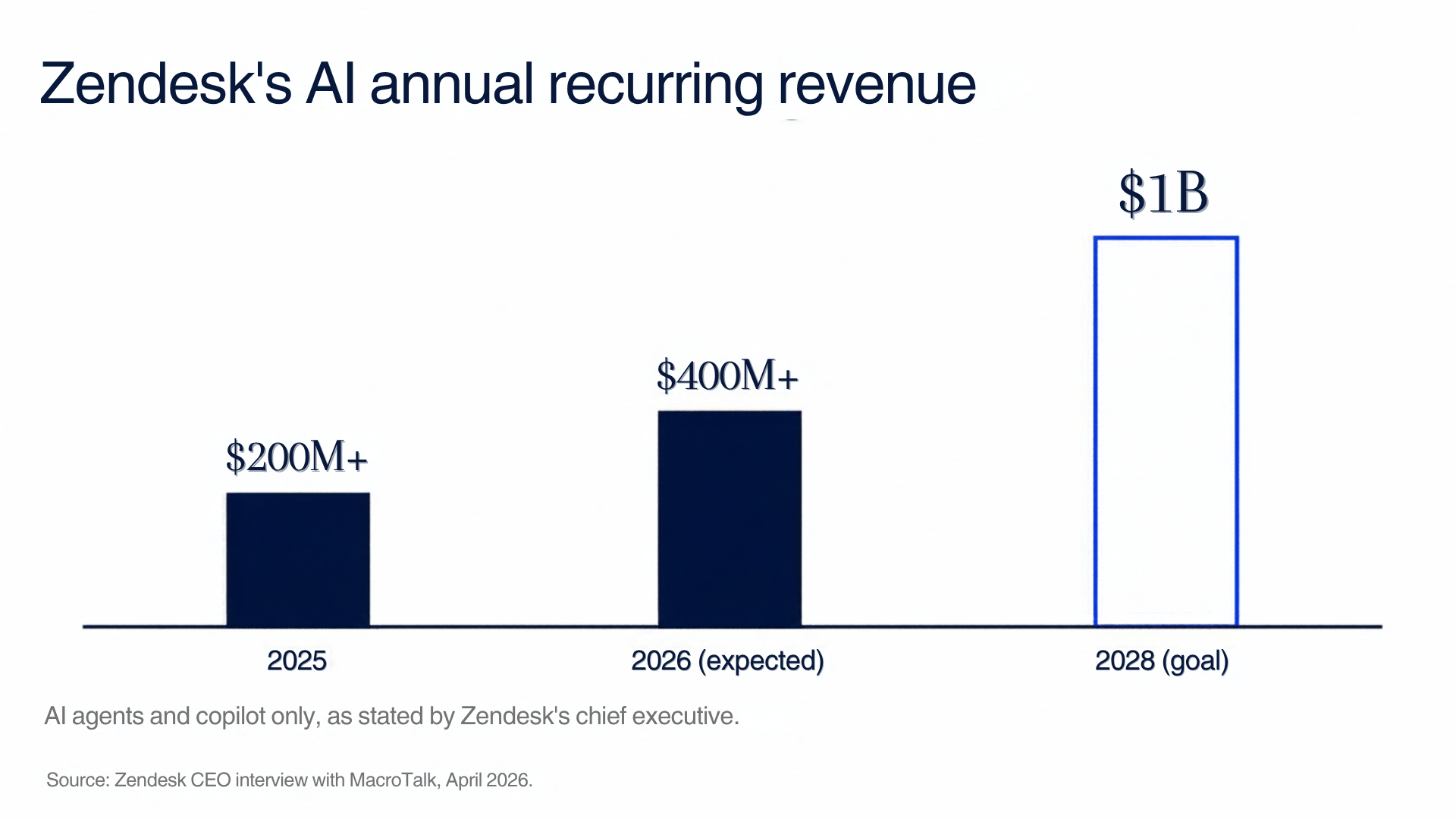
Zendesk has charged for its AI agents by the outcome since August 2024. The company expects AI agents to handle more than 80% of its customers' interactions within about three years.
Most coverage treats this as a pricing story. The larger change is in the economics of the software business itself. For about 20 years, software revenue grew with the customer's headcount and cost almost nothing to deliver at the margin. Outcome pricing ties revenue to work done, and every unit of work now carries a compute cost that the vendor pays. That change moves risk from the buyer to the seller, and it favors a different kind of vendor.
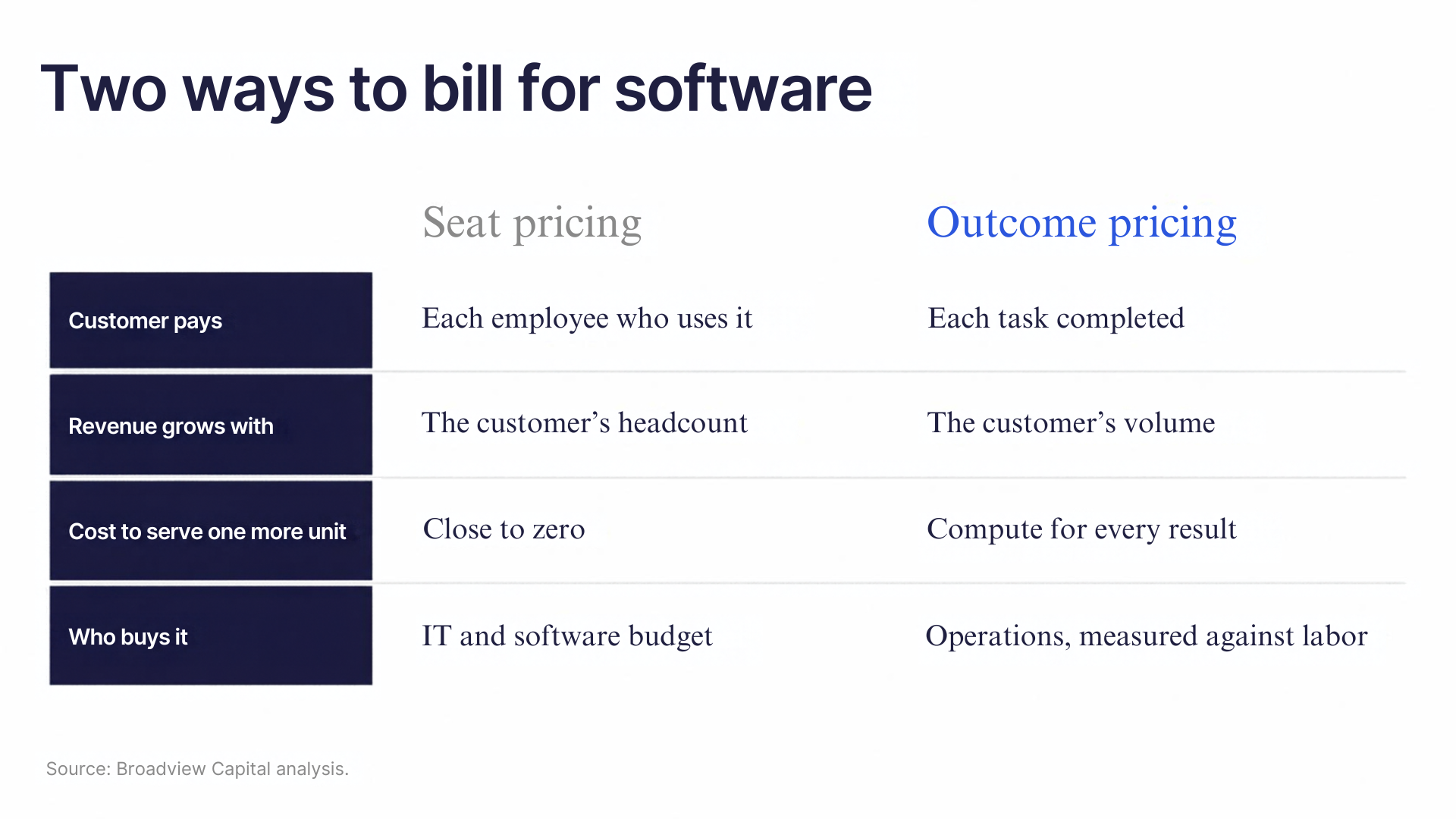
The seat was a simple bargain. A customer paid a monthly fee for each employee who used the product. When the customer hired, the vendor grew. The cost of serving one more seat was close to zero, so most of each new dollar became gross profit.
Investors paid high prices for that model because it was predictable. A vendor could forecast next year's revenue from its customers' hiring plans and its renewal rates.
AI agents break the link to headcount. If an agent resolves a support ticket, nobody needs a seat to do it. The market priced this risk quickly. On February 3, a basket of US software stocks tracked by Goldman Sachs fell 6% in one session after Anthropic launched a set of workplace agents, and about $285 billion in software market value disappeared over the following days.
Under outcome pricing, the vendor is paid when its product completes a defined task, such as resolving a customer request without a human. The vendor's economics change in two ways.
The first is cost. Each resolution consumes compute, and the vendor pays for it. A seat cost almost nothing to serve. An outcome has a real cost of goods, and gross margin now depends on how efficiently the product reaches each result.
The second is volatility. Seat revenue moved with the customer's headcount, which changes slowly. Outcome revenue moves with the customer's volume, which changes month to month. A quiet season now shows up in the vendor's revenue.
The contract changes as well. The vendor and the customer must agree on what counts as an outcome. Zendesk says it defines each outcome with the customer. That definition is now the most important clause in the contract, and it will be the main source of disputes.
Outcome pricing also changes who buys. Seats came out of the IT or software budget, and they were compared with other software. An AI agent priced per resolution is compared with the cost of a person resolving the same case. That decision belongs to the head of support or operations, and it is measured against labor.
This is good news for vendors whose product clearly does a job that people did before. A support leader can see the cost per resolved ticket and decide quickly. It is harder for vendors whose value is spread across many small tasks that no one can count.
The strongest objection is that the industry is not shrinking. Forbes reported that enterprise software spending grew 15% to $1.4 trillion in 2026, even as software stocks had their worst quarter since 2008. Goldman Sachs Research expects the application software market to reach $780 billion by 2030, with agents making up more than 60% of it.
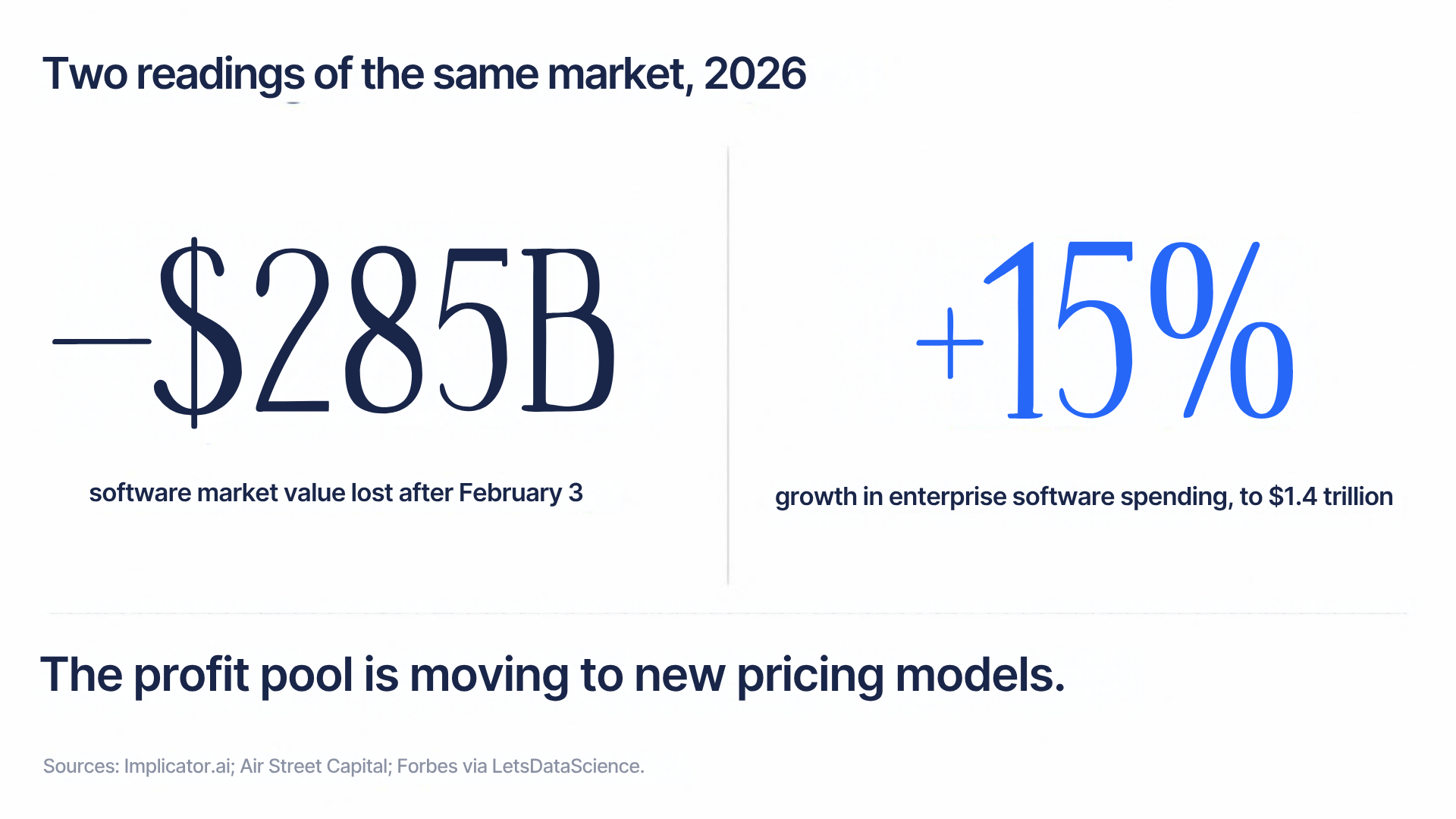
Those figures are correct, and they support the view that the profit pool is moving. Total spending can rise while the share captured by seat-based vendors falls. The question for the sector is who collects the growth, and the answer depends on who can sell outcomes at a healthy margin.
Software has changed its pricing model before. Salesforce built its business in the early 2000s by replacing large upfront license fees with monthly subscriptions. In 2013, Adobe moved its creative products from boxed licenses to subscriptions. In both cases, reported revenue looked weaker during the switch, because a large upfront payment became a smaller monthly one. Over time, the subscription model proved larger and steadier.
The move to outcomes will likely follow a similar path, with one difference. The subscription shift lowered the vendor's cost of delivery, because cloud hosting replaced shipped software. The outcome shift raises it, because every result consumes compute. Vendors will need the same patience through the transition, and they will need to manage a cost line they did not have before.
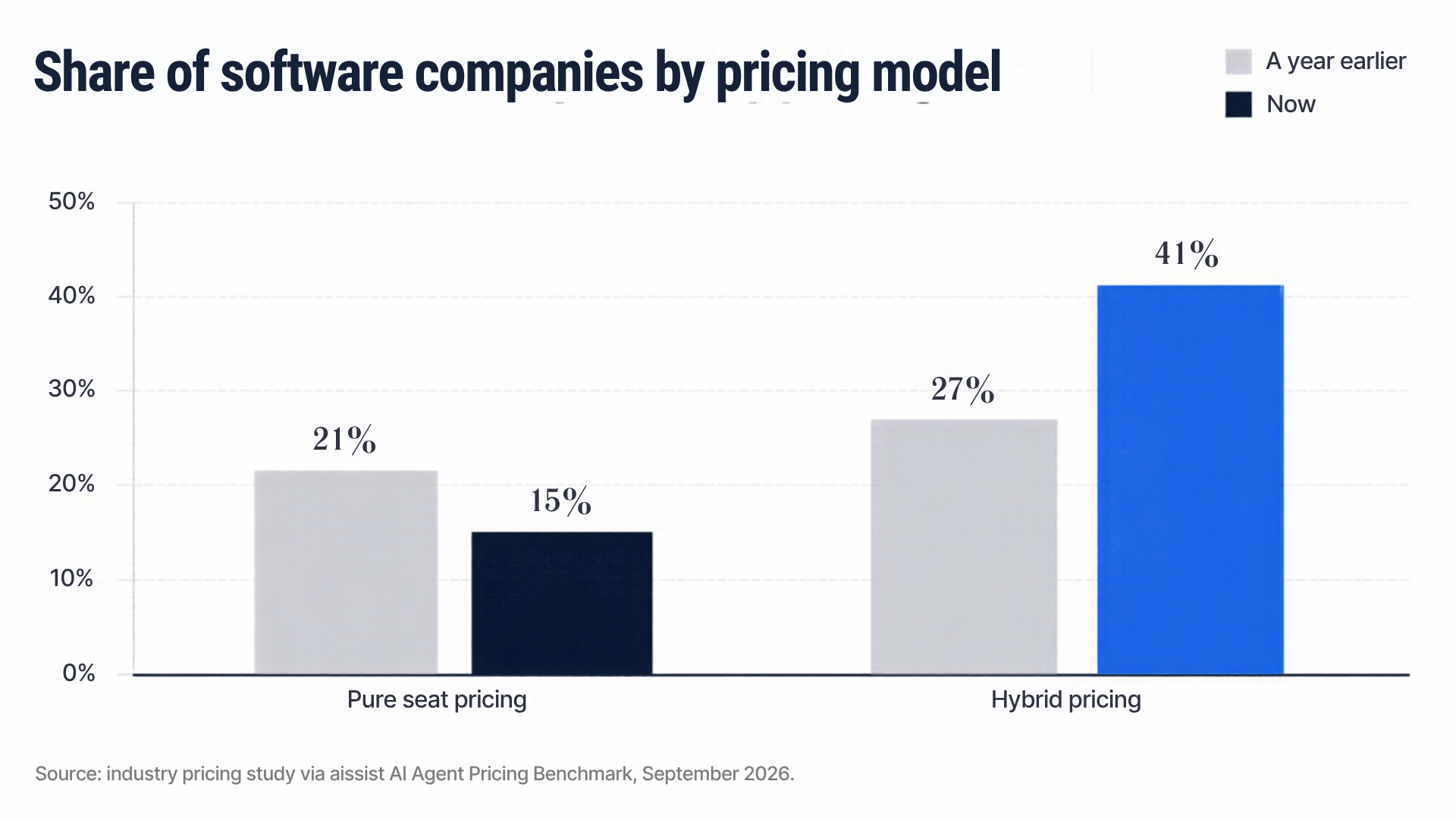
Most large vendors are moving in steps. Salesforce folded Agentforce into higher-priced seats on September 3. One industry study found that the share of software companies using pure seat pricing fell from 21% to 15% in a year, while hybrid models rose from 27% to 41%. Zendesk itself still charges outcome fees on top of seat fees today. Hybrid pricing will be the norm for several years.
The vendors best placed for this shift share two traits. Their product completes a task that a customer can count, and they reach each outcome at a low cost per result. Ownership of the workflow data helps too, because it lets the product improve its resolution rate over time.
The vendors most at risk sell general tools priced by the seat for work that agents now do well. Their customers will cut seats before the vendor can replace that revenue with outcome fees.
Customers gain the most leverage. A buyer who knows its own cost per case can negotiate on equal terms. A buyer who does not will pay whatever the vendor's meter says.
For 20 years, the software industry sold access. The next phase of the industry will sell results, and the companies that win it will be the ones that can measure their results and deliver them cheaply.
A seat cost almost nothing to serve. An outcome has a real cost of goods.
Sign up for our latest insights and firm announcements.
We respect your privacy and will not share your information.