
On September 29, the US tariff on patented pharmaceuticals reached every drugmaker. The default rate is 100%.
Six days earlier, the Commerce Department published the rules that set many specialty drugs at zero. Orphan drugs, cell and gene therapies, nuclear medicines, and several other categories now enter duty-free when they come from 19 named countries. Generic drugs remain outside the tariff for now.
For most healthcare investors, the guidance read as relief. We read it as a schedule. The protections that keep drug costs stable today expire or change on fixed dates between 2028 and 2030. Medicare's own cut to drug reimbursement lands in the same window. A provider or pharmacy business bought in 2026 and held for five years will cross all of those dates before it is sold. We now price each deal against that calendar, and we give less weight to the drug margins a business earns today.
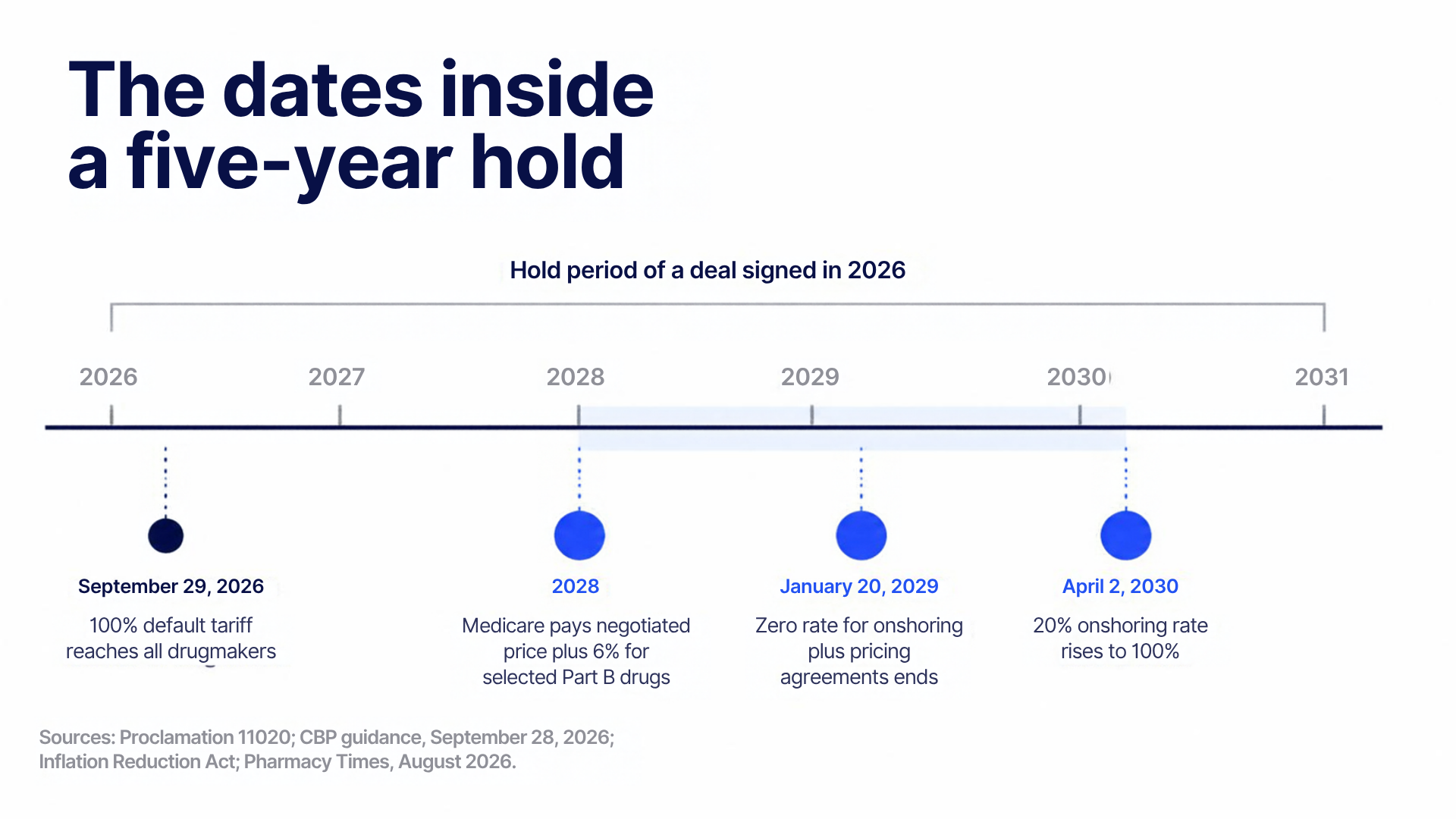
The tariff regime began with Proclamation 11020 on April 2, 2026. It took effect on July 31 for 17 companies named in the proclamation and on September 29 for every other company. A drugmaker can lower its rate in two ways. An approved plan to build US manufacturing cuts the rate to 20%. A company that pairs that plan with a most-favored-nation pricing agreement with the Department of Health and Human Services pays zero.
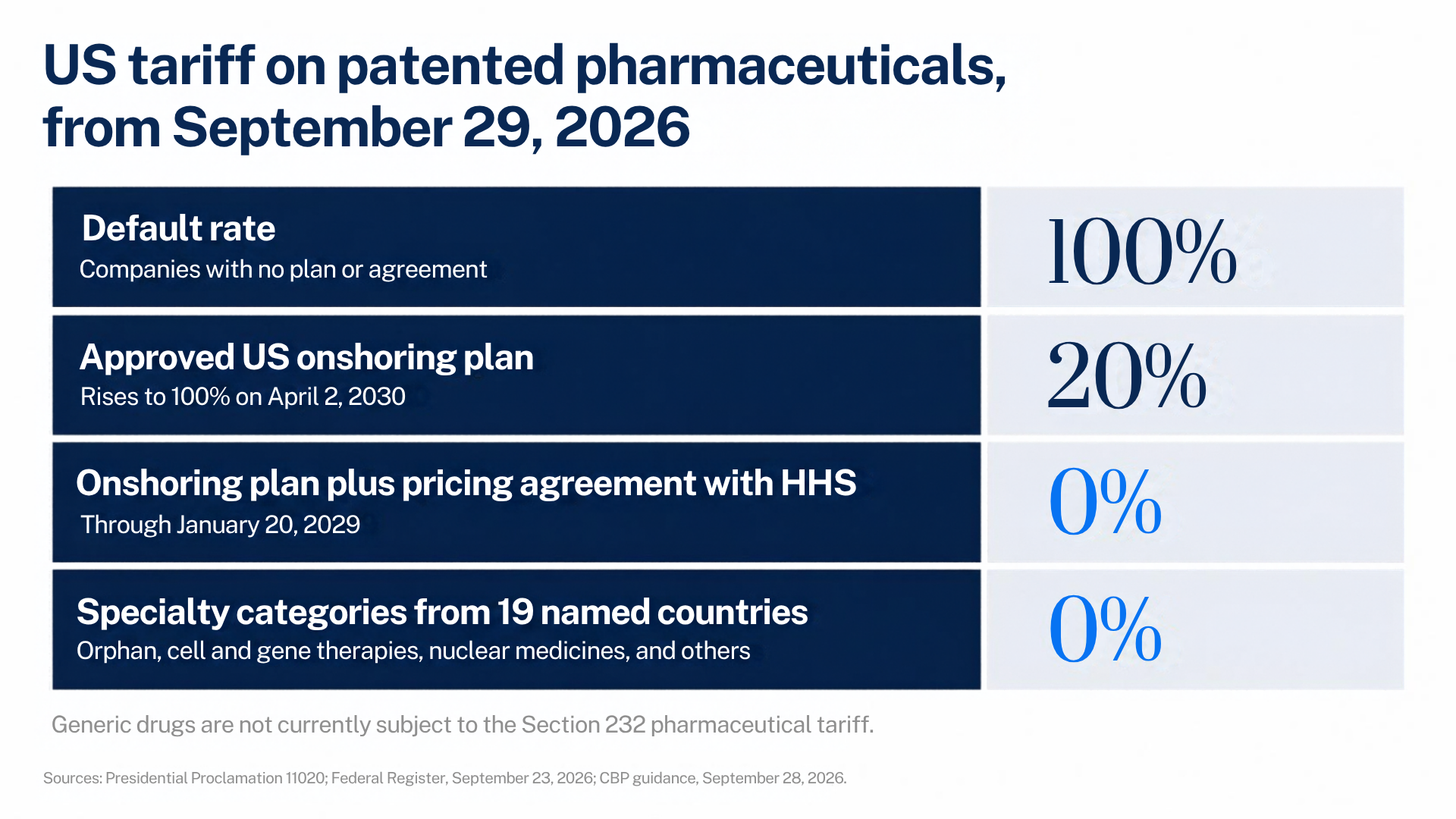
Most of the largest drugmakers have signed such agreements. Specialty categories now have their own zero rate, and material for clinical trials and research enters duty-free under a new tariff heading. A hospital or infusion center that looks at its invoices this month may see little change.
The zero rate for companies with onshoring plans and pricing agreements runs through January 20, 2029. The 20% onshoring rate rises to 100% on April 2, 2030. The specialty zero rate depends on a list of countries tied to current or forthcoming trade and security agreements, and that list can change with the next negotiation.
Each of these dates falls inside the hold period of a deal signed this year. A buyer who models flat drug costs through 2031 assumes that every protection will be renewed on time and on the same terms.
The tariff calendar overlaps with a second change. Under current law, Medicare pays providers for drugs they administer at the average sales price plus 6%. Beginning in 2028, the Inflation Reduction Act extends price negotiation to these Part B drugs, and providers will be paid on the negotiated price plus 6%.
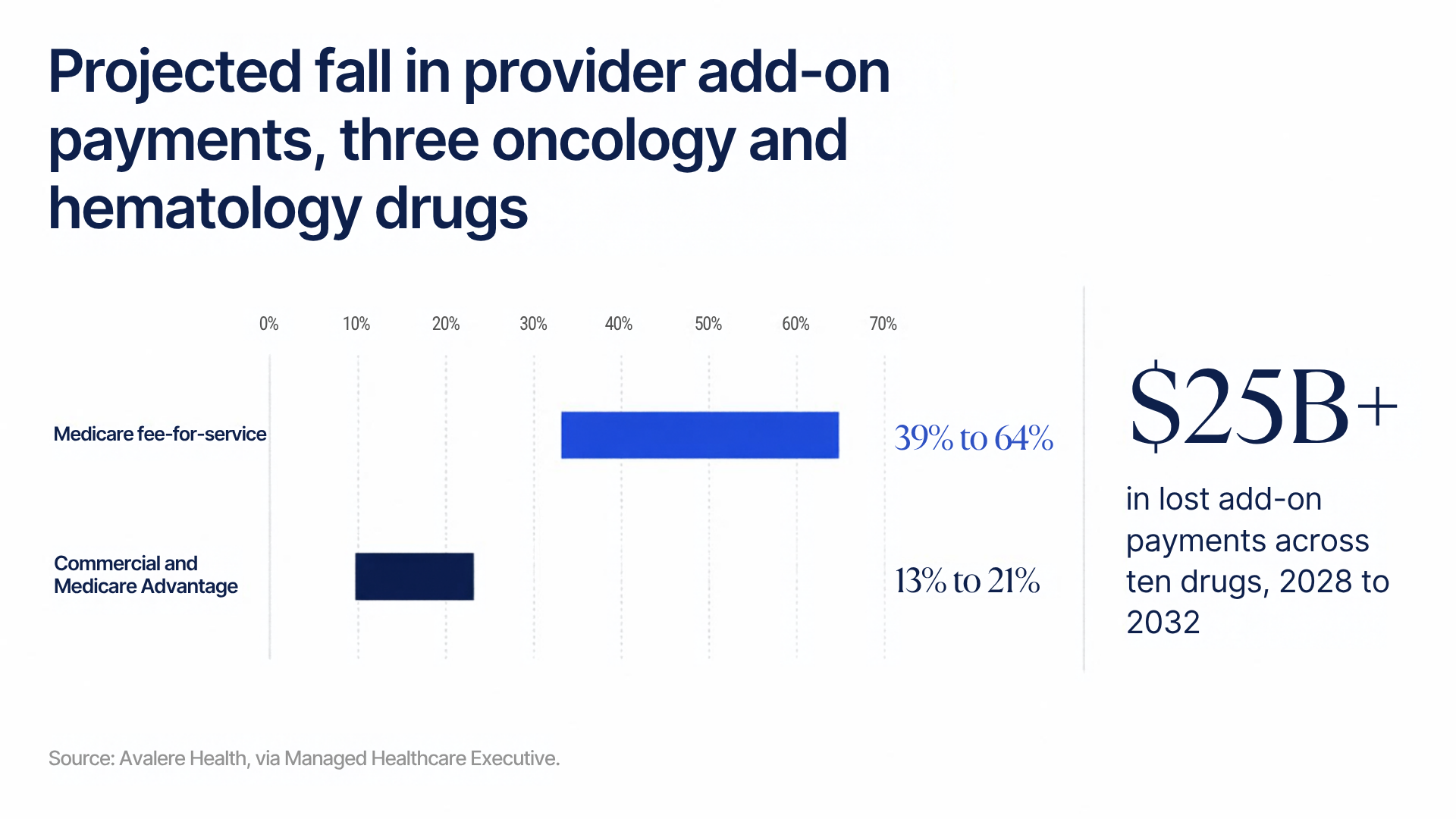
The 6% add-on pays for the cost of handling and giving the drug. When the base price falls, the add-on falls with it. Avalere modeled three negotiated oncology and hematology drugs and projected that providers' Medicare add-on payments for them would fall by 39% to 64%. Because commercial insurers also pay on average sales price, it projected a further 13% to 21% fall in commercial and Medicare Advantage add-on payments. Across ten drugs, it estimated at least $25 billion in lost add-on payments between 2028 and 2032. On September 16 and 17, the Community Oncology Alliance warned CMS and Congress that this approach could threaten independent cancer practices.
A provider that earns part of its margin on drug spread therefore faces a squeeze from both sides. Reimbursement falls from 2028. Then, from 2029, the acquisition cost of some imported drugs may rise.
The way out of the tariff is US manufacturing. Since Eli Lilly's $27 billion commitment in 2025, 14 drugmakers have pledged more than $480 billion for US production, covering 22 new sites and about 44,000 jobs. On August 31, the White House added $19.6 billion in pledges from nine more companies.

A pledge takes years to become a working plant. The August fact sheet named no sites and no construction timelines. Analysts warn that many plants will not come online before 2028 to 2030, which is the same window in which the tariff protections begin to expire. A drugmaker that misses its build date on an onshoring plan faces the 100% rate in 2030, and it will look for ways to pass that cost along.
The strongest objection is that providers will never see the tariff. The importer pays the duty, and most of the largest importers already pay zero. Drugmakers also have strong reasons to keep prices stable while they negotiate with the government.
This is a fair reading of 2026. It is weaker for the years that follow. Companies outside the named group and without agreements have paid the full rate since September 29, and some of their products reach US providers through distributors. A business that relies on a small number of specialty products from one manufacturer carries that manufacturer's tariff status as its own risk. When the 2029 and 2030 dates arrive, the cost will move to whichever party has the weakest contract.
We start by mapping a target's drug spend by product. For each major product, we record the manufacturer, its tariff status, the country of origin, and whether a specialty zero rate applies. That map shows how much of the spend is protected and which date ends each protection.
We then model the business at three points: today, after Part B negotiation in 2028, and after the tariff dates in 2029 and 2030. We set the purchase price on the weakest of those years. A business that only works at today's drug spread is worth less to us than its current earnings suggest.
We also look closely at contracts. Purchasing agreements with price-adjustment clauses reduce the risk, and so do payer contracts that use a reference other than average sales price. Supply from more than one manufacturer helps as well. A provider whose margin comes mainly from clinical services, with drugs as a smaller share of revenue, is better placed than one that depends on drug spread.
The same calendar creates demand on the other side. Drug wholesalers have spent more than $16 billion in three years buying the management companies that run oncology, ophthalmology, gastroenterology, and urology practices. US contract manufacturers and fill-finish sites will see orders from drugmakers racing to meet their onshoring dates. Capital placed in US production capacity benefits from the same deadlines that pressure the businesses downstream.
The tariff schedule turns a drug's price into a date-dependent number. For the next five years, the most useful line in a healthcare deal model may be the one that shows which protection ends when.
Sign up for our latest insights and firm announcements.
We respect your privacy and will not share your information.