
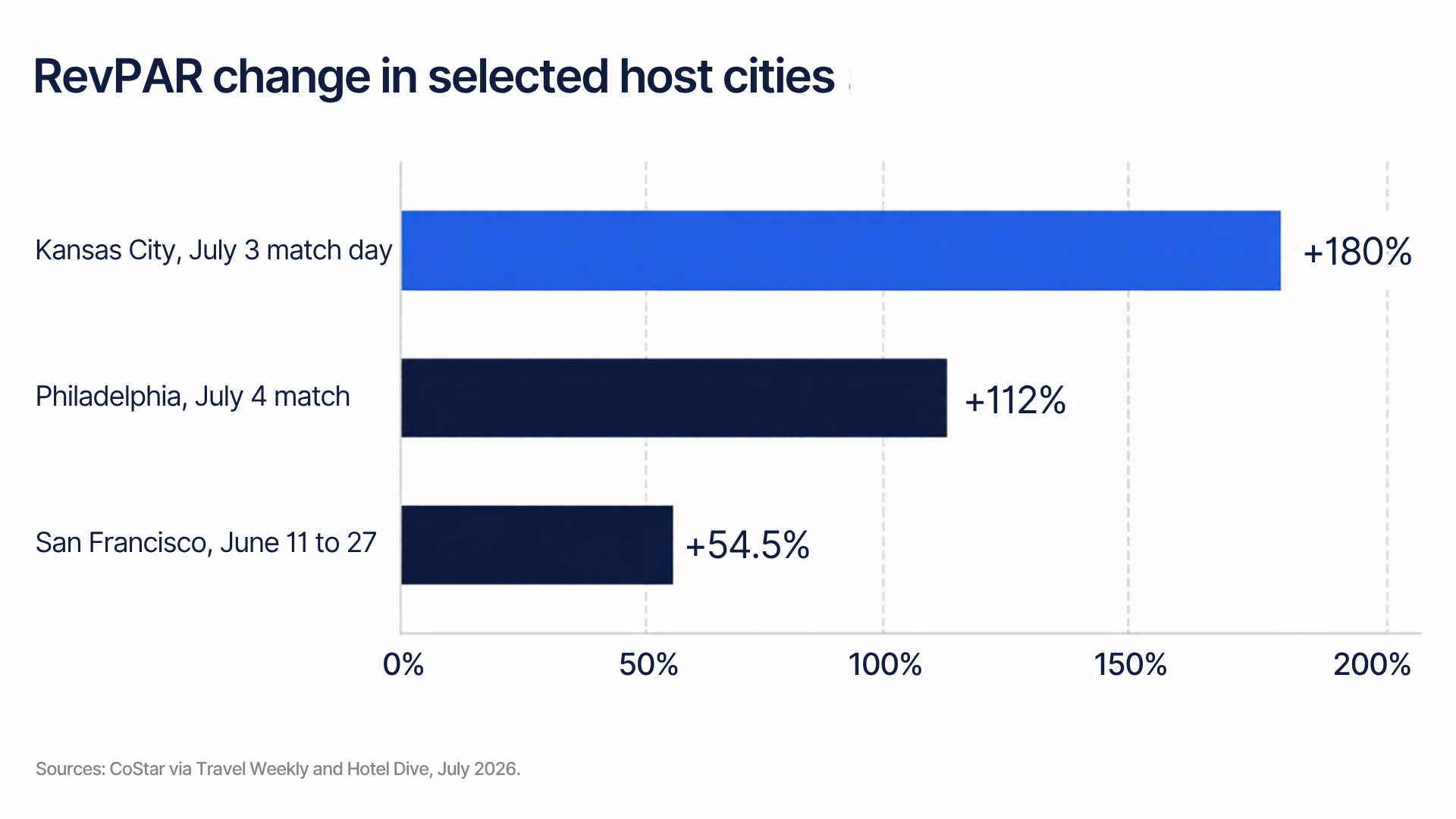
In May, CoStar forecast that hotels in the 11 US World Cup host cities would grow revenue per available room by 13% during the tournament. Between June 11 and June 27, they averaged gains well above 20%. Kansas City's RevPAR rose 180% on its single match day of July 3. Philadelphia's rose 112% for its July 4 match.
The headline figures look like a demand boom. The detail tells a different story. Most of the gain came from higher room rates. Occupancy in many host cities was flat or lower than a year earlier, and some cities lost ordinary business as visitors stayed away.
That difference matters for anyone pricing a US hotel in 2027. The tournament proved that the top end of the market has strong pricing power when demand is concentrated. The evidence that the market has more travelers than before is much weaker. A buyer who reads the 2026 results as a demand story will overpay for the years that follow.
The pattern held from the first week. In the first full week of the tournament, US hotel RevPAR rose 9.7%, and CoStar described the gains as driven by rate, not occupancy. Demand grew 1.6% nationally that week, but those gains were all outside the host cities. Luxury and upper-upscale hotels led, with RevPAR up 24.4% through higher rates.
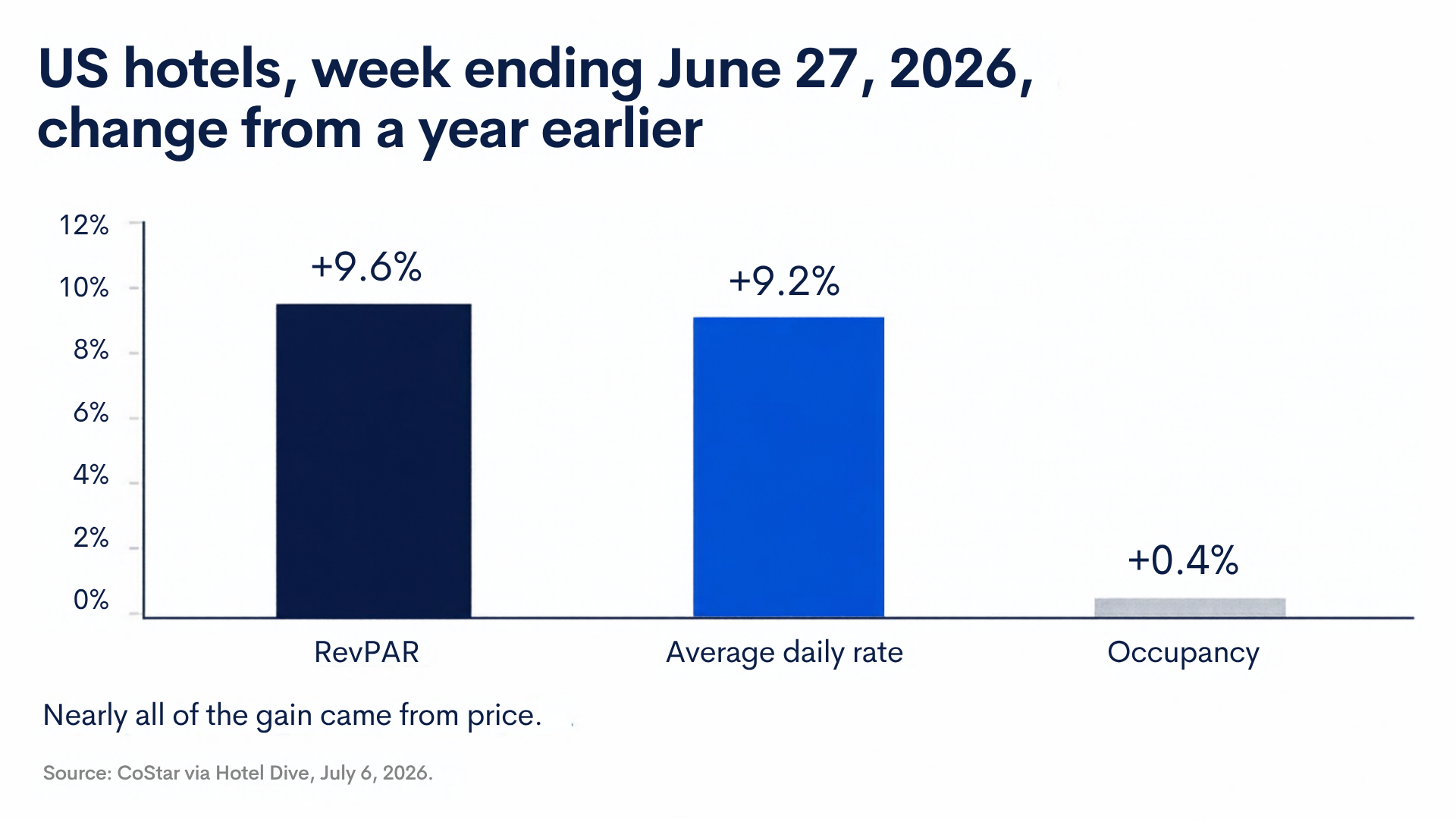
For the week ending June 27, national RevPAR rose 9.6%. Average daily rate rose 9.2%, while occupancy was almost unchanged at 0.4%. Match days reached tournament highs, with RevPAR up 42.1% and ADR up 34.7%. In the final week, luxury hotels posted RevPAR growth of 15.4%, and no other class topped 6%.
The tournament also pushed out demand that would have come anyway. In Miami, RevPAR fell 6.5% in the first full week because rooms sold dropped 15.3%. CoStar attributed that to a pullback in demand not related to the event. Atlanta and Seattle recorded weekly RevPAR declines later in the tournament, and CoStar described an occupancy vacuum in Seattle after its last match.
The warning signs appeared before the first match. FIFA canceled a larger share of its contracted room blocks than hotels had expected. In May, 80% of hoteliers surveyed across the 11 host cities by the American Hotel & Lodging Association said bookings were below their initial forecasts. High-spending fans made up for the shortfall with what they paid, according to CoStar's Jan Freitag.
Economists call this displacement. A major event attracts its own visitors and repels others, such as business travelers and tourists who want to avoid crowds and high prices. The net gain in rooms sold can be small, even when revenue rises sharply.
The last US World Cup followed a similar path. In June and July 1994, US hotel RevPAR rose 6.9%, driven mainly by a 5.0% rise in ADR. Host cities saw RevPAR gains of 11.9% in those two months. Then, as in 2026, the tournament lifted rates more than it filled rooms.
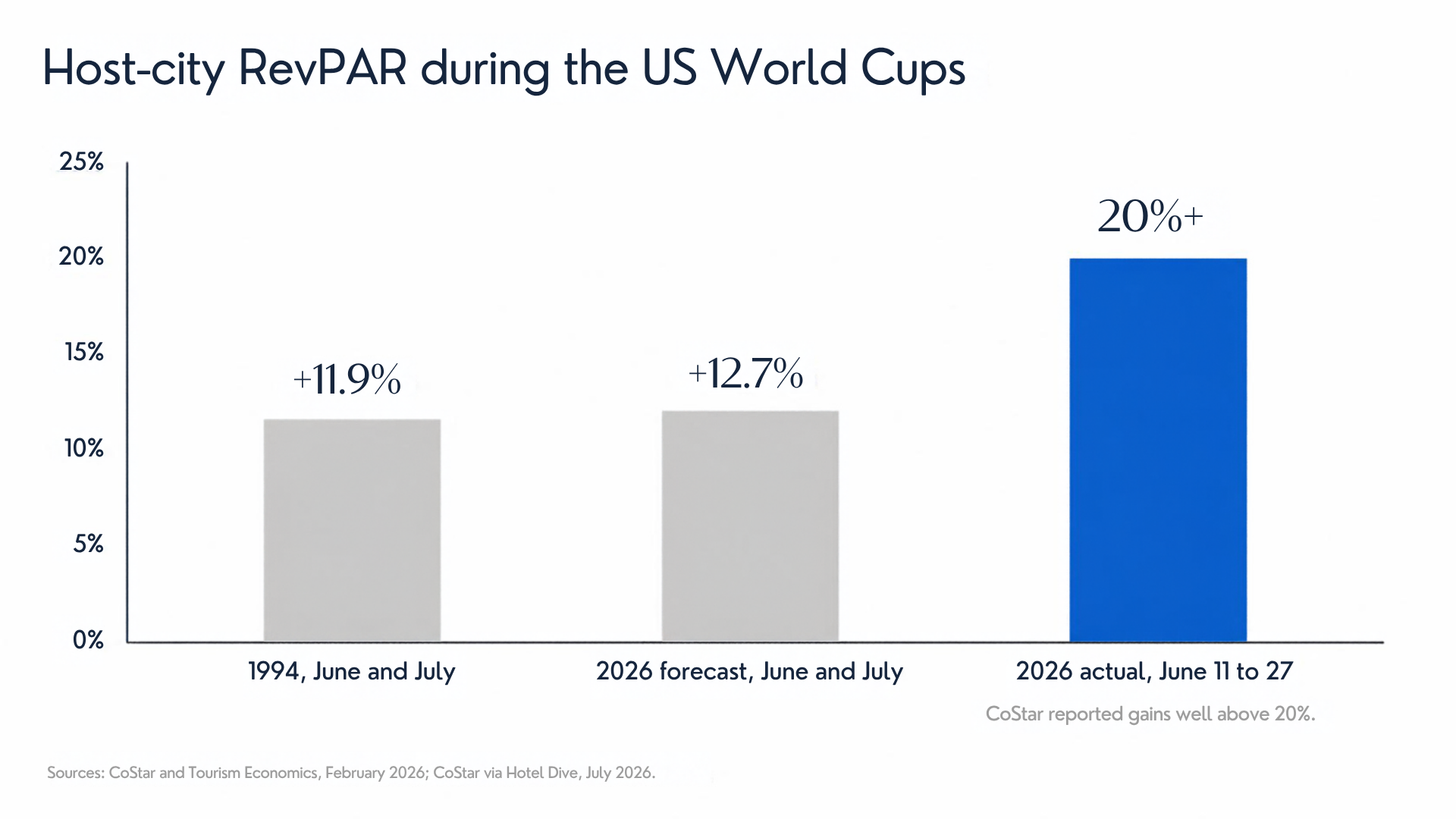
The difference this time was the size of the rate increase. The 2026 gains in host cities ran well ahead of 1994, and they ran ahead of the forecasts. That is a measure of how much affluent travelers were willing to pay, and it is the clearest signal the tournament sent.
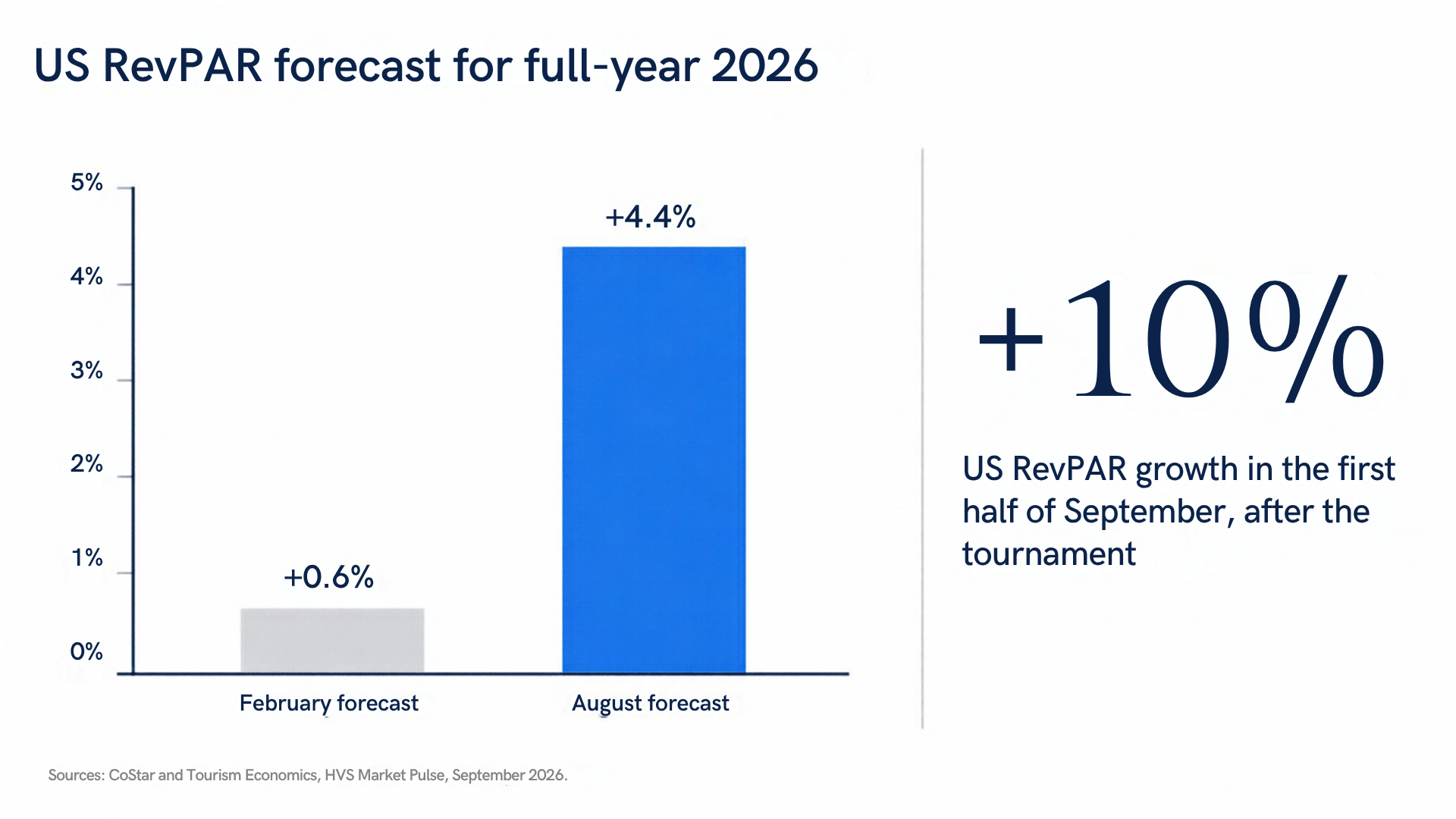
The strongest objection is that US hotel demand improved well beyond the host cities. In the final week of the World Cup, RevPAR outside the host markets still rose 4.4%, with a 1.4 percentage point rise in occupancy. HVS reports that US RevPAR grew just over 10% in the first half of September, after the tournament ended. CoStar and Tourism Economics raised their 2026 RevPAR forecast to 4.4% in August, up from 0.6% in February, when they had counted on the World Cup for only a small lift.
That evidence is real, and it points to a market in better shape than many expected at the start of the year. The source of the gains matters as well. Across the year, rate has risen faster than occupancy. HVS expects ADR growth to slow in 2027 without the World Cup lift, while occupancy and RevPAR growth remain healthy. A market that grows mainly through price is more exposed when the reason for the higher prices disappears.
We draw two conclusions from the summer.
First, the luxury and upper-upscale segments showed real pricing power in large gateway markets. When demand was concentrated, those hotels raised rates far more than any other class, and travelers paid. That supports the value of well-located high-end hotels in major cities.
Second, 2026 revenue in host cities includes a one-time gain that buyers should strip out. A seller's trailing 12-month results will include June and July. The right base for 2027 is the ordinary run rate, which in several host markets was weaker than the headline numbers suggest.
Supply also works in favor of existing hotels. New construction starts are at their lowest levels in years, and the pipeline looks thin into 2028. With few new rooms coming, hotels in strong markets should hold most of their rate gains even as the tournament effect fades.
The 2026 World Cup was a test of how US hotels perform when the whole world wants to visit at once. They passed on price. The harder test, filling rooms in an ordinary year, begins in 2027.
A market that grows mainly through price is more exposed when the reason for the higher prices disappears.
Sign up for our latest insights and firm announcements.
We respect your privacy and will not share your information.