
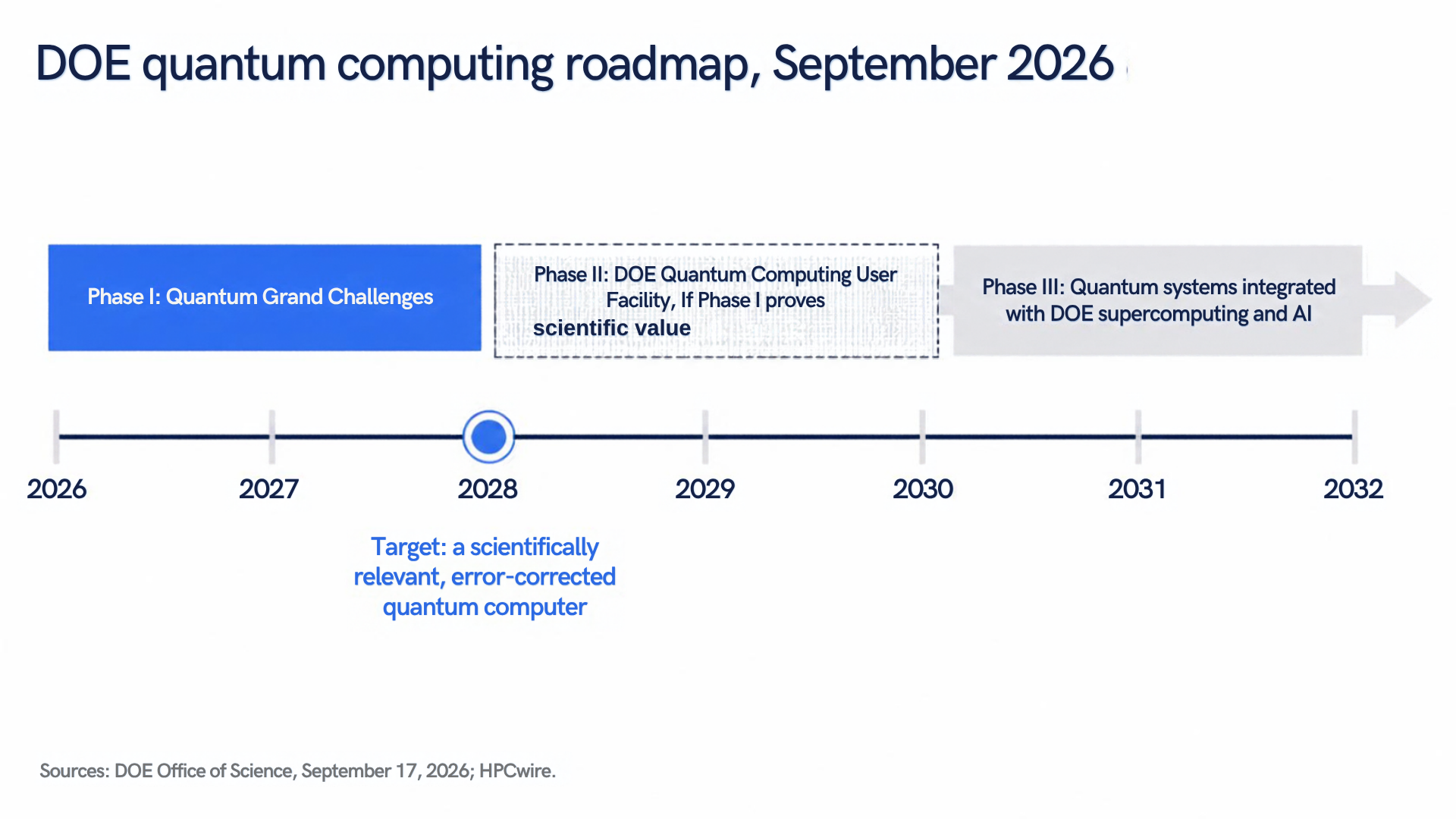
On September 17, the Department of Energy published a national roadmap for quantum computing. Its target is specific: a scientifically relevant, error-corrected quantum computer by 2028. The report comes from the quantum subcommittee of the DOE Office of Science's advisory committee, and Under Secretary for Science Darío Gil presented it.
The roadmap sets out three phases. From 2026 to 2028, Quantum Grand Challenges will pair national laboratories, universities, and companies on competitive scientific problems. If those challenges succeed, a DOE Quantum Computing User Facility would follow. From 2030, the plan is to connect quantum systems with the labs' supercomputers and AI tools.
Most coverage focused on the 2028 date. The more important change is in how the government will judge progress. For a decade, the quantum industry has measured itself by hardware figures, such as the number of qubits on a chip. The DOE roadmap measures it by whether a machine can answer a real scientific question, with results checked by outside experts. That shift will change which quantum companies attract public money, and it gives private investors a clearer signal to follow.
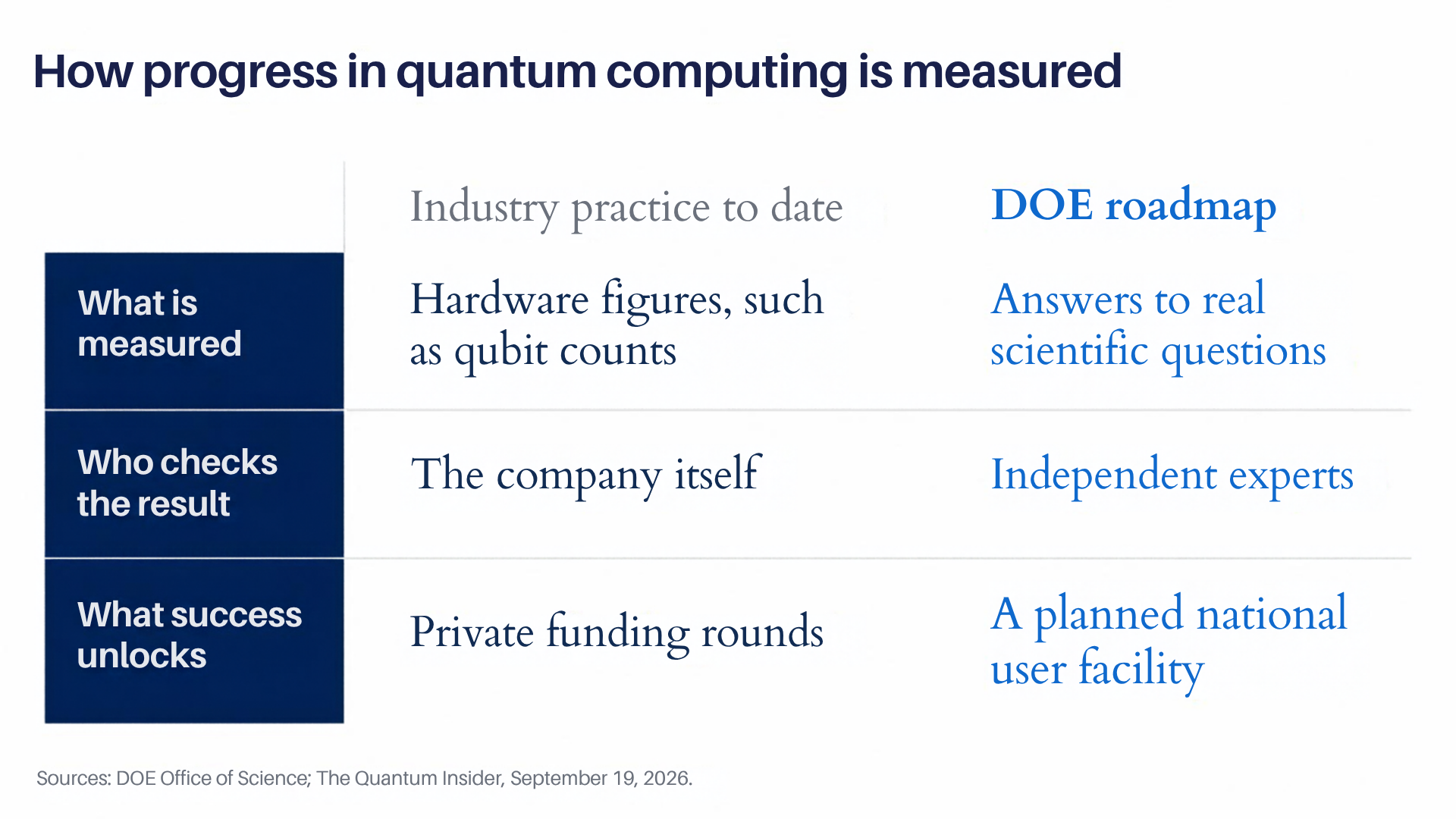
The roadmap does not promise to buy a quantum computer. The Quantum Insider noted that the report places the user facility after the grand-challenge phase and treats it as conditional. It would be built only if quantum systems show scientific value, technical readiness, and lasting demand from researchers.
The DOE also described what the facility would be. In Under Secretary Gil's words, it would be an open scientific instrument where researchers can co-develop hardware, control systems, and software with technology providers, and it would not be a closed commercial cloud service. Access would combine cloud services with systems placed at the national laboratories.
That structure makes the government a demanding customer. It will pay for results, and it will look inside the machine.
Alongside the roadmap, the DOE announced a contest for companies. According to reporting on the announcement, the planned purse is up to $215 million for a company that can field a scientifically useful, error-corrected machine, and most of that money is later-year funding that Congress still needs to approve.
A prize changes the economics for the companies that compete. A research grant pays for effort. A prize pays for an outcome. A company that wins earns both the money and a public, independent validation of its machine, which may be worth more than the money in its next funding round or customer negotiation.
The DOE has run a milestone-driven computing program before. Its Exascale Computing Project set a target for a new class of supercomputer, funded the software and hardware work to reach it, and ended with machines at the national laboratories, starting with Frontier at Oak Ridge in 2022. The program gave suppliers a clear goal and a date, and it shaped which technologies the government bought for years afterward.
The quantum roadmap follows a similar logic with one difference. Exascale machines were built from known technologies, scaled up. The quantum roadmap asks for something that does not yet exist, a machine that corrects its own errors well enough to do useful science. That makes the 2028 test riskier, and it makes the result more informative.
The strongest objection is that this is a modest program. A $215 million purse is small next to the capital that private investors have put into quantum companies, and most of it still depends on Congress. Quantum timelines have also slipped before.
Those points are fair, and they limit what the roadmap can do on its own. They also explain why the program matters more as a signal than as a source of funds. The DOE has set a public standard for what a useful quantum computer must do. Every company in the field will now be asked whether it can meet that standard. Investors gain a clear, independent checkpoint in 2028, which the field has lacked.
The roadmap also sits on existing federal support. The DOE has announced about $625 million to renew its five National Quantum Information Science Research Centers, which link the labs, universities, and industry.

We read two main changes in the roadmap.
The first is in how quantum companies will compete. Hardware announcements will matter less than validated results on scientific problems. Companies that can partner with national laboratories and show a result on a real problem will stand out from those that report qubit counts.
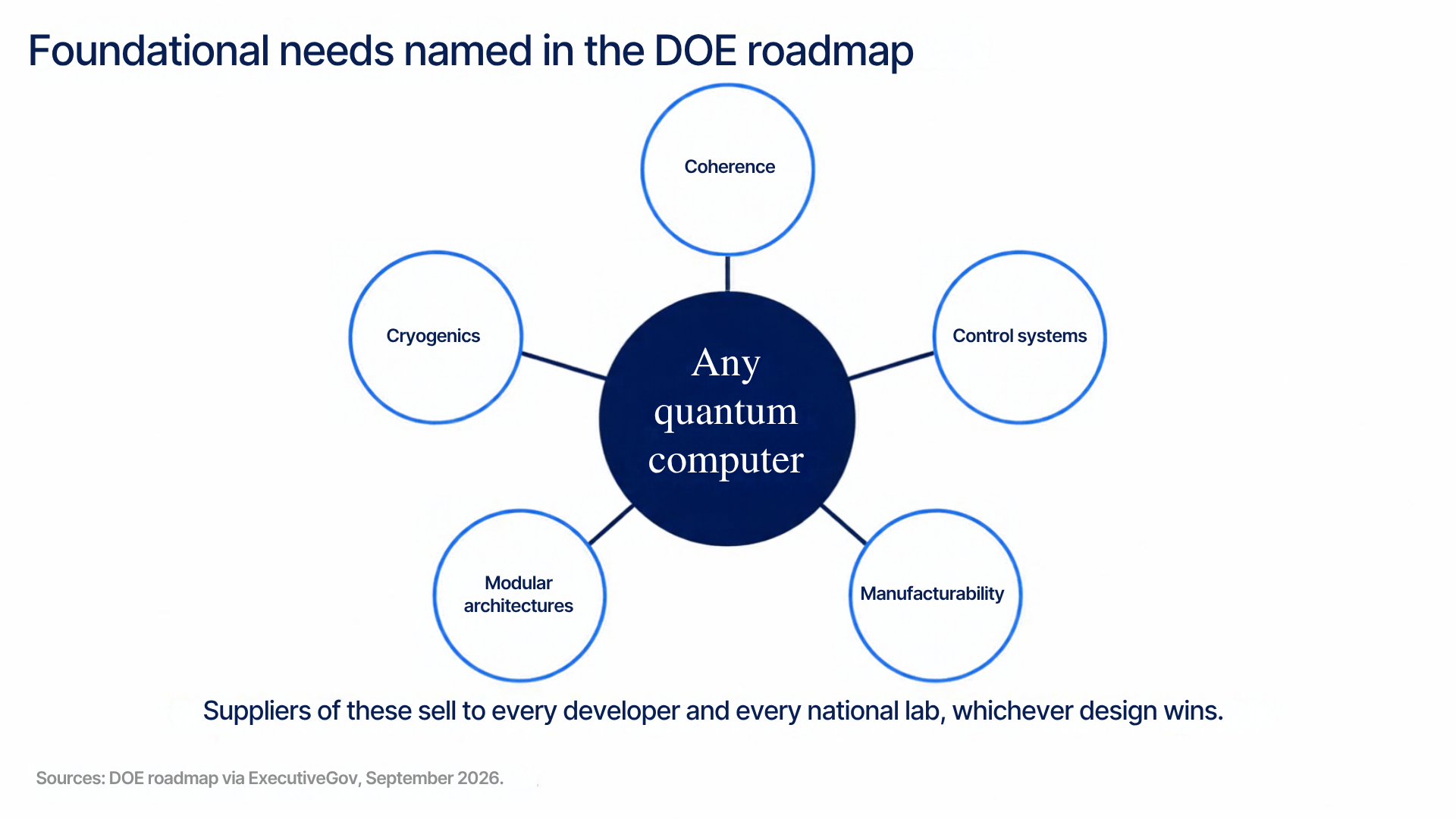
The second is in where near-term revenue sits. The report calls for investment in coherence, cryogenics, control systems, modular architectures, and manufacturability. Suppliers of these parts sell to every quantum developer and every national lab, whichever design wins. They earn during the grand-challenge phase, years before a quantum computer produces a result a company will pay for.
The roadmap also changes how investors can judge progress. Until now, outsiders have had few independent ways to compare quantum companies. The grand challenges will produce public, checked results in a set period. That will help capital move toward the strongest teams and away from the weakest.
For most of its history, quantum computing has asked investors to believe in a future machine. The DOE has now given that machine a date and a public test.
A research grant pays for effort. A prize pays for an outcome.
Sign up for our latest insights and firm announcements.
We respect your privacy and will not share your information.